A silk pillowcase is one of the easiest ways to spend a lot of money on something you cannot judge by looking at it. The photo shows a soft sheen in champagne or blush. The title says "22 Momme 6A Mulberry Silk, OEKO-TEX Certified". The bullet points promise fewer wrinkles, less frizz and better skin. Every one of those phrases is doing a different job, and some are doing no job at all.
This guide explains what momme actually measures; what "6A" can and cannot tell you; what the OEKO-TEX Standard 100 label covers and how to verify it; what dermatologists and reviewers say about the benefits, and how much of it has been tested; and what to check when the pillowcase arrives. Most of the technical explanations of silk online are written by silk sellers, and we say so every time we rely on one. Where a figure comes from a brand rather than a standard or a study, we flag it.
For related reading, see satin pillowcase closures, bonnet or satin pillowcase, silk or polyester satin bonnets and satin sleep eye masks.
The short version
- Momme is a weight measure. One momme is about 4.3 grams per square metre. A higher number means more silk per area. It does not measure fibre quality, softness or cooling.
- Sellers broadly agree that 19 to 25 momme is the useful range for pillowcases. The agreement is among sellers; we found no independent test showing a 25 is better than a 22 for sleep. One seller's own comparison calls the step from 22 to 25 marginal and admits it is "industry-reference framing rather than peer-reviewed data".
- "6A" is a raw-silk fibre grade, used loosely. The grade applies to raw silk before weaving. A Chinese manufacturer's page points out the raw-silk standard does not describe the quality of finished fabric. Sellers also disagree about whether 6A is a formal standard or shorthand. "6A+" and "7A" are not grades in the systems we found.
- A fibre-content label is the thing the law requires. In the US, covered textiles must carry a label with generic fibre names and percentages by weight. "Satin" describes a weave, not a fibre.
- OEKO-TEX Standard 100 is about harmful-substance testing, not organic farming or quality, and you can check a label number online.
- The beauty benefits are plausible and thinly tested. A medical information site says no studies support the wrinkle claim yet. A dermatologist quoted by a review site says how you sleep matters most.
- Silk is easy to damage in the wash. Sellers consistently say cool water, pH-neutral enzyme-free detergent, no bleach or softener, and line drying out of direct sun.
What these things are
Mulberry silk. Silk from the silkworm fed on mulberry leaves, the type most pillowcases are made from. Sellers say other silks, such as tussah, feel and wear differently.
Charmeuse. A weave with a smooth, shiny face and a duller back. Most silk pillowcases are charmeuse. Habotai is a thinner, flatter weave one seller says to avoid for skin-contact products.
Satin. A weave, not a fibre. Satin can be silk, polyester or something else. This is the single most useful fact in the category.
Momme. A Japanese unit for the weight of silk fabric. Sellers give it as the weight in pounds of a piece of silk 45 inches by 100 yards, or about 4.34 grams per square metre; a French seller gives 4.3056. The difference is a rounding quirk and both are fine for comparing pillowcases.
Grade (6A, 5A and so on). A rating of raw silk fibre, covering length, uniformity and defects. More below.
What momme measures (and what it does not)
At 4.3056 grams per square metre per momme, a French silk house lists 19 momme as about 82 g/m², 22 momme as about 95 g/m² and 25 momme as about 108 g/m². Another seller puts it differently: a 25 momme case has roughly 14 per cent more silk than a 22 and 32 per cent more than a 19. These are weight comparisons, and the arithmetic is straightforward.
What the number tells you: how much silk is in a given area; likely thickness, opacity and drape, since a seller's guide says denser silk feels heavier and more opaque.
What it does not tell you: fibre quality, because one seller says directly that its 19 and 30 momme cases use the same grade of silk woven at different weights; smoothness, because a heavier charmeuse is not necessarily smoother; and whether it is silk at all, because any fibre has a weight per square metre. A momme figure can only be trusted if the fibre is silk.
"Thread count" is a muddle
One silk seller equates 19 momme with a thread count of 400, 22 momme with 600 or more and 25 with 750. Another says applying thread count to silk is a fundamental mistake and momme is the right measure. A third calls a 22 momme silk roughly equivalent to 600-thread-count cotton in luxury and durability. These cannot all be right, and none is independently verified. Our suggestion: do not use thread count to compare silk. Ask for momme, fibre and weave.
Is higher momme better?
Sellers say yes, up to a point, and each recommendation lines up with what that seller sells.
| Seller view | Range or claim |
|---|---|
| A silk accessory seller | 19 momme is the minimum for quality sleep use; 22 to 25 is premium |
| A bedding seller | Sheets between 19 and 25 momme are ideal; below 19 not suitable |
| Another silk seller | Pillowcases 19 to 22 are the sweet spot; below 19 thin and tears at seams; above 25 the premium is hard to justify |
| A silk house | 22 became the standard; 19 to 22 is meaningful, 22 to 25 marginal; many find 22 lighter on the face |
| A pillowcase seller | A 22 momme case can last nearly twice as long as a 19 |
| A seller with a 25 momme case | 25 is the right balance for most people |
Two things are worth noticing. Each seller's recommendation lines up with its stock. And the durability claims ("nearly twice as long") are unsupported by any test we could find — the same seller that calls the 22 to 25 step marginal says openly that its comparison draws on industry reference, not peer-reviewed data. That candour is useful, and it is also a fair summary of the evidence.
One price comparison from the same seller: a 22 momme case costs roughly 15 to 20 per cent more than a 19, and a 25 another 20 to 30 per cent above that. The seller's figures — but the point stands: price rises faster than silk weight, so it is fair to ask what the extra weight buys.
Our own working rule, a suggestion and not a standard: 19 to 22 momme is a reasonable range for a pillowcase. Above that, pay for it only if you have a reason, such as wanting a heavier feel. Check the other claims before the number.
What "6A" means
Grade 6A appears on many listings, and its meaning depends who you ask.
What sellers say it is. One explains that raw silk is classified by an international system drawn up by an international silk association after the Second World War, with 11 grades from 6A, the top, down through 5A, 4A and so on to F. It adds that the system tops out at 6A and "7A" is not a grade in it. A Chinese silk manufacturer's page cites two Chinese national standards, one for mulberry silk fabric and one for raw silk quality, the latter dividing raw silk into the same 11 grades, 6A to F.
What it describes. The Chinese manufacturer says the raw silk standard indicates the quality of raw silk, not of the finished product made from it. That matters: a 6A thread can be woven into a good or a poor pillowcase. Another seller says grade describes fibre quality (length, uniformity, absence of impurities) while momme describes density. A third says a serious silk product lists both.
Where sellers disagree. One calls 6A industry shorthand rather than a peer-reviewed standard, and points out that the international standard for fibre names, ISO 2076, does not mention 6A, and neither does ASTM. A beginner's guide on another seller's site goes further, saying 6A, 5A and 4A are usually seller-side quality claims rather than a universal grading system, and that fibre label accuracy, construction details and certification scope are more reliable. Meanwhile other sellers call 6A a genuine grading system and "an internationally recognised standard".
The honest reading. There is a raw-silk grading scheme in which 6A is top. It is applied by producers and sold by sellers, and nothing on a pillowcase listing lets you verify it. We did not find a way for a shopper to confirm a 6A claim on a finished pillowcase.
"6A+", "7A" and "A+++". One brand sells "6A+" silk and describes it as a designation used by premium mills for batches exceeding standard 6A parameters. Another says the equivalent "7A" does not exist in the standard system. We found nothing independent defining 6A+. Treat any grade above 6A as marketing.
Our suggestion: let 6A be a mild positive if the rest of the listing is specific, and never the reason you buy. If a listing gives a grade but not the fibre content, it has the order backwards.
Real silk or satin? The fibre label
The US Federal Trade Commission enforces the Textile Fiber Products Identification Act. Its rules require covered textiles to carry labels disclosing the generic names and percentages by weight of the fibres, as well as the manufacturer or responsible business and the country of origin. A trade-law summary adds that FTC guidance has said such disclosures should also appear in online listings, not just on a physical label. That summary is secondary, so check the listing for yourself.
What follows for a shopper:
- Look for a fibre-content statement. "100% Mulberry Silk" or "100% Silk" is a statement. "Silk-like", "silky satin" and "luxury satin" are not.
- Treat "satin" as a weave. A seller's buying guide says a "22-momme satin pillowcase" that does not name a fibre is almost always polyester. A rule of thumb, not a legal test, but a sensible one.
- Do not accept a momme figure without a fibre. Polyester satin can be heavy too.
- Check the physical label on arrival against the listing.
Silk is not always better. Polyester satin is cheaper and often more durable in the wash, and many people prefer it. The point is to know which one you are buying and to pay the right price for it.
What OEKO-TEX Standard 100 covers
OEKO-TEX Standard 100 is a testing and certification scheme for harmful substances in textiles. Sellers' explainers agree on the following.
- It tests finished articles and their components for harmful substances. One guide says every component of a certified article is tested; a silk seller's guide says it is often the first label worth checking on silk pillowcases because it screens the finished item that touches skin.
- It is not an organic label. A mattress seller's guide and others state it does not certify how raw materials were grown, unlike GOTS. Another guide says it allows conventional and genetically modified cotton and synthetic fertilisers. For silk, GOTS is about organic plant-based fibres and does not apply in the same way.
- It applies to any fibre. The same guide says it covers cotton, wool, silk, linen, polyester, nylon and blends, so a polyester satin can carry it too.
- Certificates are renewed. A seller guide says certificates are valid for one year and must be renewed.
- You can check the number. Several sellers explain the same procedure: find the label or certificate number on the tag or listing and enter it exactly as shown, case-sensitive, in the OEKO-TEX Label Check online. One guide advises confirming the status, holder name, the scope of what is covered and the expiry date, and treating the claim as unverified when holder, scope or expiry do not match.
What to do with that: a logo without a number is decoration — ask for the number; check that the certificate covers the product, since some cover a fabric, a product class or a particular article, and read the scope line; and do not read "OEKO-TEX" as "organic" or "sustainable", which a retailer's own page also makes clear.
We did not find an independent source explaining which OEKO-TEX product class a pillowcase should be certified under, so we leave that to the scope line in the label check.
The benefits: what is supported
This is where marketing runs furthest ahead of evidence, so we separate the claims.
| Claim | Support we found |
|---|---|
| Less friction and tangling for hair | Plausible mechanism, dermatologist opinion, a reviewer's impression |
| Less breakage | Opinion; difficult to measure; no trial found |
| Fewer wrinkles | A medical information site: no studies yet; a health magazine: studies scant; one seller concedes no evidence |
| Better for sensitive skin | Some dermatologist opinion; the nearest study concerns silk clothing |
| Keeps skincare on your face | Plausible; untested in our sources |
Hair. The case is that a smoother surface creates less friction overnight, so less snagging, frizz and breakage, and that silk absorbs less moisture than cotton, leaving hair oils and products in place. A medical information site quoting a board-certified dermatologist says silk's smoothness makes it less likely to snag or kink hair overnight, and quotes a cosmetic dermatologist saying silk absorbs less moisture than cotton. A reviewer who tested several cases says the slick texture could mean fewer tangles and probably breakage, though breakage is hard to isolate. That is plausible and consistent, but it is opinion plus mechanism; we found no controlled trial. Several marketplace blog pages cite specific studies, journals and percentage reductions ("37 per cent fewer fractures") that could not be traced to a real publication, and we did not rely on them.
Skin and wrinkles. The medical information site is direct: sleeping on silk may lead to fewer wrinkles, and "there are no studies to support this claim (yet)", arguing from reasoning about friction and pressure creases. A bedding brand, in a post otherwise promoting silk, says the logic of reduced shear tracks but the evidence does not exist. A health magazine says studies on silk and skin and hair are scant and quotes a New York dermatologist who says the pillowcase feels nice but will not solve ageing concerns. A review site quotes a dermatologist who says silk may be gentler but does not prevent wrinkles, and that how you sleep matters most: side sleepers get more wrinkles on the side they sleep on, and sleeping on your back can help.
Sensitive skin. The medical information site says a silk pillowcase may irritate sensitive skin less than synthetic fibres or even cotton, and that there is some evidence. The nearest research mentioned is a 2019 study in which wearing silk clothing for a month helped atopic dermatitis. Clothing, not bedding, so it does not settle the question.
A fair summary: silk is a nice, smooth surface with plausible benefits, and the claims on a listing are well ahead of the evidence. If you are buying for comfort, it is a reasonable purchase. If you are buying to prevent wrinkles, the best-informed source we read suggests changing how you sleep is a bigger lever. And a reviewer who tested several concluded you do not need to spend a fortune to get the benefits of silk.
Terms the listing uses loosely
| Term | What it can legitimately mean | What it does not tell you |
|---|---|---|
| 22 momme | The fabric weighs about 95 g/m² | Whether it is silk; the fibre grade; the weave |
| 6A | Top raw-silk grade, if true | That the finished fabric is good; that it can be verified |
| 6A+ / 7A | A seller's own label | Anything in the standard system |
| Mulberry silk | Silk from silkworms fed mulberry leaves | Grade, weight or weave |
| Pure silk / 100% silk | A fibre claim (should match the label) | Momme; quality |
| Charmeuse | A smooth-faced weave | Weight; fibre |
| Satin | A weave | Fibre; silk is not implied |
| Thread count (on silk) | A seller's attempt to translate momme | Anything standard; sellers disagree |
| OEKO-TEX certified | Some product or component has a certificate | What it covers; whether the number checks out |
| Hypoallergenic | The seller's opinion | A defined test; no definition we found |
| Anti-ageing / anti-wrinkle | The seller's hope | A study |
| Cooling | Silk can feel cool to touch | A test of temperature while sleeping |
| Zipper closure | Has a zip | The quality of the zip or the seam at the zip |
Checks to run when it arrives
Our own suggestions. None is a standard, and none replaces the care label.
Read the sewn-in label. Fibre content, country of origin and the responsible business. It should say silk, and it should match the listing. A missing label on a product sold as silk is a reason to query the seller.
Compare label with listing. Fibre, size and care instructions.
Look at both faces. One should be glossy and one duller if it is charmeuse. Look for pulls, uneven dye patches, wavy seams and puckered corners.
Check the zip or closure. Open and close it a few times. It should run smoothly and sit flat, away from your face.
Check the weight by hand. A pillowcase at 19 to 25 momme should feel substantial but fluid. A flimsy, nearly sheer one deserves a closer look. A feel check, not a measurement.
Look up the certificate. If the listing or tag gives an OEKO-TEX number, enter it in the label check and compare holder, scope and expiry.
Smell it. A strong chemical smell is a reason to wash before use and to ask the seller if it persists.
Wash it before first use, following the label. Sellers recommend washing new silk before use.
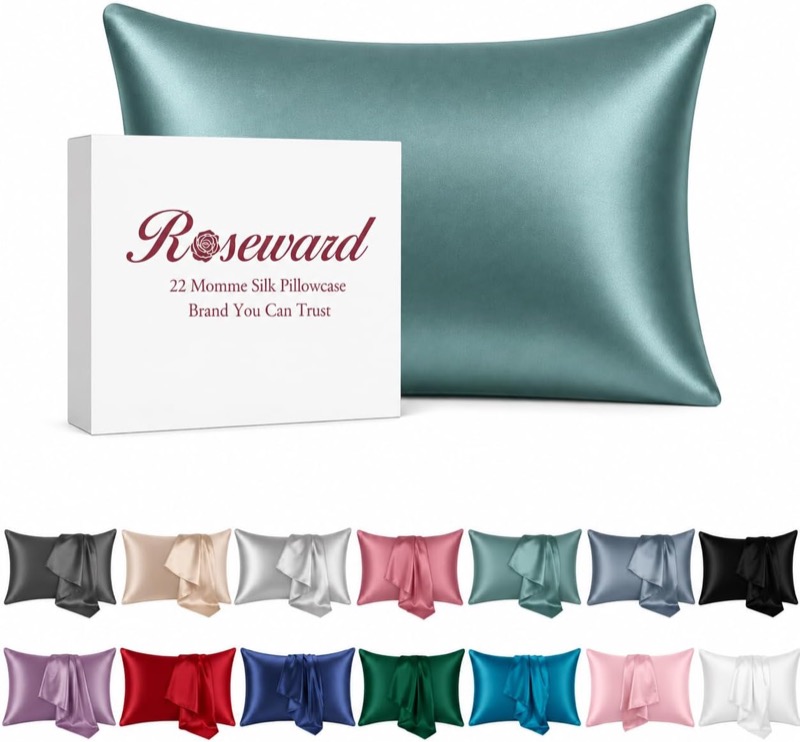
22 momme mulberry silk pillowcase
A retail example with the full label stack this guide unpacks: 22 momme, 6A, OEKO-TEX, anti-ageing. One of those is measurable, one is verifiable by number, and the last is a claim the evidence does not support.
What to look for before you buy
A fibre statement. "100% mulberry silk" or "100% silk" on the listing. If only "satin" or "silky" appears, treat it as polyester.
Momme and weave together. For example a 19 to 22 momme charmeuse. If momme is missing, ask.
Which face and which back. Charmeuse is shiny on one face and dull on the other. A good listing says which side is meant to touch you.
A named certificate with a number. If OEKO-TEX is claimed, a number you can look up.
The closure and the seams. A seller's momme guide suggests lower weights tear at seams under stress. A hidden zip or envelope back is a preference; our closure guide covers the trade-offs.
Size. Standard, queen and king pillowcases differ, and a snug fit stops the pillow shifting. Measure your pillow and compare with the listing's dimensions.
Care instructions. Silk that says "dry clean only" costs more to own.
Reviews that mention washing. Search "pilled", "snagged", "faded", "ripped", "shrunk" and "polyester". Not evidence, but a pattern is a signal.
Returns. A silk pillowcase can only be judged by sleeping on it. A window that allows a few nights' use is worth paying for.
What a higher price should buy
Price does not prove silk or quality. A higher price can reasonably buy a stated fibre and a stated momme rather than only one; a certificate number you can verify; neat flat seams and a closure that does not pucker; a care label with realistic instructions; a returns policy that lets you try it; and honest wording about benefits.
It should not buy a longer string of grades. A listing with five claims and no fibre content is worse than one with two claims and a label.
Keep it, query the seller, or send it back
| What you see | What it suggests | What we would do |
|---|---|---|
| Label says polyester or a blend; listing said silk | Listing misdescribes the product | Return it; report if it was sold as "100% silk" |
| No label at all | Missing required information | Query the seller; return if no answer |
| OEKO-TEX number does not check out | Claim may be unverified | Ask the seller; return if no explanation |
| Pulled threads or snagged seams out of the bag | Poor finishing | Return it |
| Zip catches or puckers | Weak construction | Return it, or choose an envelope back |
| Label matches the listing, finish is clean | Nothing wrong found | Keep it and sleep on it |
| Dye bleeds in first wash | Colour fastness problem | Stop washing; contact the seller |
| It feels thin and sheer | May be lighter than described | Check the listed momme; ask the seller |
Washing and looking after silk
Silk's care is where a good purchase turns bad, and the sources agree on most of it. Almost all of them are silk sellers or home-advice sites.
- Check the care label first. Sellers and advice sites say most silk pillowcases can be washed at home unless the label says dry clean only. One seller says "dry clean" without "only" usually means you can hand wash safely.
- Cool water. Sellers give a maximum of about 30 °C. A bedding seller gives 29 °C, and a home-advice site notes some labels say cold as a precaution and silk is fine at 30 °C but not much warmer.
- pH-neutral, enzyme-free detergent. Several sellers say enzymes can degrade silk because it is a protein fibre. Use a small amount.
- No bleach, no fabric softener, no optical brighteners. One seller describes chlorine bleach as dissolving silk fibre.
- Be gentle. Do not wring or twist. If machine washing, use a mesh bag and a delicate cycle, and wash silk on its own.
- Dry it flat or on a line, away from direct sun and heat. Tumble drying is advised against; a home-advice site says direct sun can bleach thin fibres, and one seller says to lay wet silk flat rather than hang it.
- Iron on the lowest setting if you must.
- How often to wash is not settled. Our suggestion: follow the care label, and wash sooner if you sleep with hair oil or night creams on — one reason to own two.
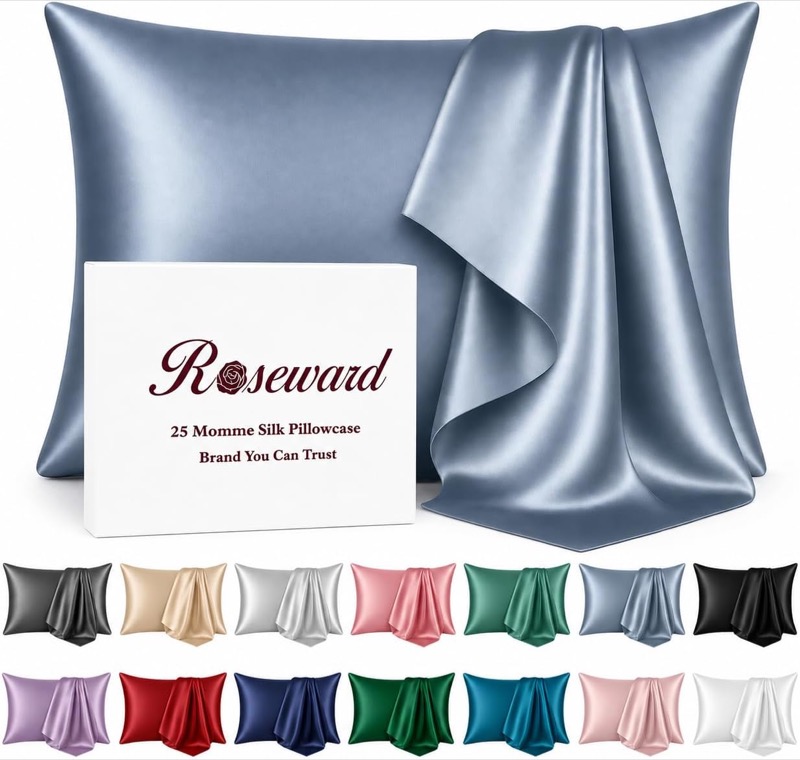
Silk pillowcase with eye mask set
A bundle listing from the same category, where the extra item changes what you are actually comparing. If a set is claimed as certified, the certificate scope should cover both pieces.
When to see a professional
A pillowcase will not treat a skin or scalp condition. If you have persistent itching, a rash, hair loss, acne that is not clearing or a scalp problem, see a doctor or dermatologist. If you suspect a reaction to a fabric, dye or detergent residue, stop using the item and ask for advice rather than changing pillowcases repeatedly.
What your listing can say
If you sell silk bedding, this is the wording that survives scrutiny.
Safe to print, if true:
- "100% mulberry silk, 22 momme, charmeuse weave" — fibre, weight and weave are three separate facts and all can be stated.
- "OEKO-TEX Standard 100, certificate number [x]" — with the number on the listing so it can be checked.
- "Hidden zip, 20 × 26 in" — construction you can photograph.
- "Hand wash or delicate machine wash at 30 °C with pH-neutral detergent; dry flat, away from sun."
- "Smooth surface that may reduce friction on hair overnight" — a mechanism claim, not an outcome promise.
Avoid unless you hold evidence for each: "anti-ageing" or "anti-wrinkle", "reduces breakage by X per cent", "6A+" or "7A" presented as a standard, "OEKO-TEX certified" without a number, "organic" when the certificate is Standard 100 rather than GOTS, "hypoallergenic", "cooling" as a measured property, and "thread count" applied to silk. If you sell polyester satin, do not use the word silk-anything; "silky" next to "satin" is where most misdescription complaints start.
We are not lawyers, and this is not legal advice. Textile labelling rules differ by market, and in the US the fibre-content requirement is law.
Frequently asked questions
What does momme mean? A unit of silk weight. One momme is about 4.3 grams per square metre, so a 22 momme fabric weighs roughly 95 g/m². It tells you how much silk is in the fabric, not how good the fibre is.
What momme should a silk pillowcase be? Sellers mostly say 19 to 25, with 22 the commonly cited standard. We found no independent test ranking them.
Is 19 momme real silk? It can be. Momme measures weight, not fibre quality. Check the fibre label.
Is 6A silk better? 6A is the top raw-silk grade in the scheme sellers describe. It is not verifiable on a finished pillowcase, and one silk seller calls it shorthand. Treat it as supporting information, not proof.
Is "6A+" or "7A" a real grade? One silk seller says 7A does not exist in the standard system. We found no independent definition of 6A+.
How do I tell silk from satin? Read the fibre label. Satin is a weave, so a satin pillowcase can be silk or polyester.
Does OEKO-TEX mean the silk is organic? No. It tests for harmful substances and does not certify how raw materials were grown.
How do I check an OEKO-TEX label? Enter the number as printed (case-sensitive) in the OEKO-TEX Label Check, and compare holder, scope and expiry with the product.
Do silk pillowcases prevent wrinkles? The best medical source we read says no studies support this yet, and a dermatologist quoted by a review site says sleeping position matters most.
Do they help hair? Dermatologists quoted in consumer articles say smoothness reduces friction and that absorbent cotton can pull moisture from hair. We did not find a controlled trial.
Can I machine wash silk? Many sellers say yes on a delicate cycle in cold water with a mesh bag and a silk-safe detergent, unless the label says dry clean only.
Is a silk pillowcase worth it? A personal choice. It is a comfortable surface with plausible benefits and little hard proof, and one reviewer concluded you do not need to spend a fortune to get them.