A size range can look complete and still fail at the thumb
A press-on set can include many loose tips and still leave one customer unable to make a wearable ten-piece manicure. The failure often shows up at the thumb: the largest available tip leaves natural nail visible at both sides, while the next option does not exist. The rest of the set may fit well, which makes the problem easy for a brand to miss when it approves a sample on a limited group of hands.
Recent community discussions include buyers whose largest numbered thumb tip is too small, customers looking specifically for a size 00, and customers caught between a too-small thumb tip and one that looks or feels too wide. Marketplace sizing-kit listings routinely ask shoppers to select shape and length, a reminder that the physical system matters before a usable thumb size can be identified.
Consumer guides normally respond by telling people to measure in millimetres, check a chart, or try another brand. Those are sensible buying steps. A product brand has a different job: it needs to decide whether the largest tip in its actual line gives enough usable coverage, whether it remains compatible with the intended shape and curve, and how a customer should buy when it does not.
The aim is not to declare one width "wide" for every market or promise that a size 00 will fit every thumb. It is to build a traceable decision around the approved tip family.
Why the thumb exposes a weak assortment
The thumb is not simply the largest version of another finger. It concentrates several fit decisions in one place.
It may be the only missing size
A customer can have a usable index, middle, ring, and pinky combination but fail to find a thumb tip that reaches sidewall to sidewall. That creates a poor customer experience even when nine pieces of a mixed set are technically usable. One buyer in a recent discussion described exactly this pattern: the other fingers fit, but the largest thumb option did not.
Width is not the same as a good fit
Adding a wider tip can solve exposed natural nail, but it may create a new issue if the cuticle outline, C-curve, or sidewall profile is wrong. Community posts often describe the next size as looking too big even when the smaller option exposes nail at the sides. That is a useful observation, not proof of how a particular material or shape will perform. It tells a brand to test more than one flat width figure.
A tapered shape can change the question
Customers do not experience a short square, medium almond, and long stiletto in the same way, even if the number underneath is familiar. The usable contact zone, side profile, and visual proportions change with the tip design. A "wide-thumb option" should therefore be scoped to the relevant family and shape rather than presented as a universal fix.
The shortfall can be hidden by a 24-piece count
Pack count tells a shopper how many pieces are included; it does not tell her whether the largest available piece will cover her thumb. A set can contain duplicates, gaps, or a size sequence that suits a broad average while excluding a specific extreme. Reporting on press-on sizing notes the practical tension: a kit may include many widths yet still fail to create a complete set for people at either end of the range.
For a brand, the question is not "Do we have a large size?" It is: which sample proves the largest size in this exact tip system is a credible option for the customer we say we serve?
Start with a coverage record, not a size label
Terms such as large, wide, XL, and 00 can be useful for navigation. Begin product development with a physical coverage record for the actual tip family.
For each proposed largest size, record:
- tip-family name, supplier line, and internal version;
- stated number on the underside;
- measured width at the relevant contact area;
- width and profile at the cuticle-side edge;
- shape and approved length;
- curve photographs from front and side;
- the source and date of the received sample; and
- the final SKU or kit version for which the record applies.
Do not use the record to manufacture false precision. It lets the brand compare the largest approved tip with a later sample, another supplier line, or the intended sizing kit.
Keep the customer-facing chart separate from the internal record. The chart should help someone identify a possible range and choose a physical sizing route. The internal sheet should document why the business believes that route remains connected to the finished set.
Sample the thumb as a separate approval task
When a collection is tested only as a full ten-piece set, the thumb can disappear inside a general verdict of "fits" or "does not fit." Give it its own acceptance line.
Use at least three reference situations during sampling:
- Coverage at the widest point. Place the selected tip without forcing it. Check whether the natural nail remains visibly exposed at either side and whether the tip extends into skin. Record the observation and photograph it from above.
- Cuticle and side profile. Check that the top edge does not demand an awkward compromise: centred enough to look balanced but so high or broad that it presses into the cuticle area. View from the front and from the side rather than approving from one photograph.
- Next-size comparison. When the largest tip appears too small, try the closest wider candidate from the same family if one exists. Record why it is acceptable, unacceptable, or unresolved. This protects against solving only a millimetre gap while ignoring curve and shape.
The task is not to simulate every customer. It is to find out whether the line has an identified endpoint and whether that endpoint was tested as it will be described.
Choose a range response deliberately
Once a thumb gap is clear, a brand has several legitimate responses. They are not interchangeable.
Extend the size run within the same tip family
If the source offers a larger option that belongs to the same mold family, request an unprinted sample and compare it with the existing largest tip. Confirm the number, shape, curve, cuticle profile, and the sizing-kit relationship before adding it to the selling range. Do not assume that a larger labelled number from a different line can be substituted.
This is often the cleanest path because the customer can still use one familiar shape and one chart. It is only clean when the approved sample demonstrates that continuity.
Offer a defined wide-fit or custom path
For a made-to-order business, a physical sizing kit or a recorded millimetre submission may be a better route than claiming a standard preset will solve the issue. State what the customer will receive: for example, a selected individual thumb size paired with a defined shape and length, or a custom ten-piece set after a kit check.
The phrase "wide fit" needs a product definition behind it. Name the eligible shapes, the exact tip family, the current largest size available, and the order route. If that detail is absent, the label is mostly marketing language.
Build a mixed or expanded assortment
A ready-to-wear retail set may need more than one large tip, a larger number of distinct sizes, or a different assortment distribution. Higher count does not automatically mean better coverage. Compare actual sizes and duplicates against the customer task.
State the limit and do not oversell it
Sometimes the largest approved tip still does not cover a customer who needs more width. The honest answer is not to advise squeezing the tip on, relying on glue to bridge a gap, or filing a smaller piece larger. Say that the current line may not be suitable and provide the most appropriate alternate route if one exists. An accurate limit is better than a return caused by an impossible fit.
Retail and sourcing references
The following links are retail and sourcing references for comparing large-size and wide-range tip options. We may earn a commission from qualifying purchases through these links. The linked products do not prove that a listed large size matches your approved tip family, shape, curve, cuticle profile or finish. Recheck current product details, size availability, minimum order requirements, and CPS eligibility before ordering.
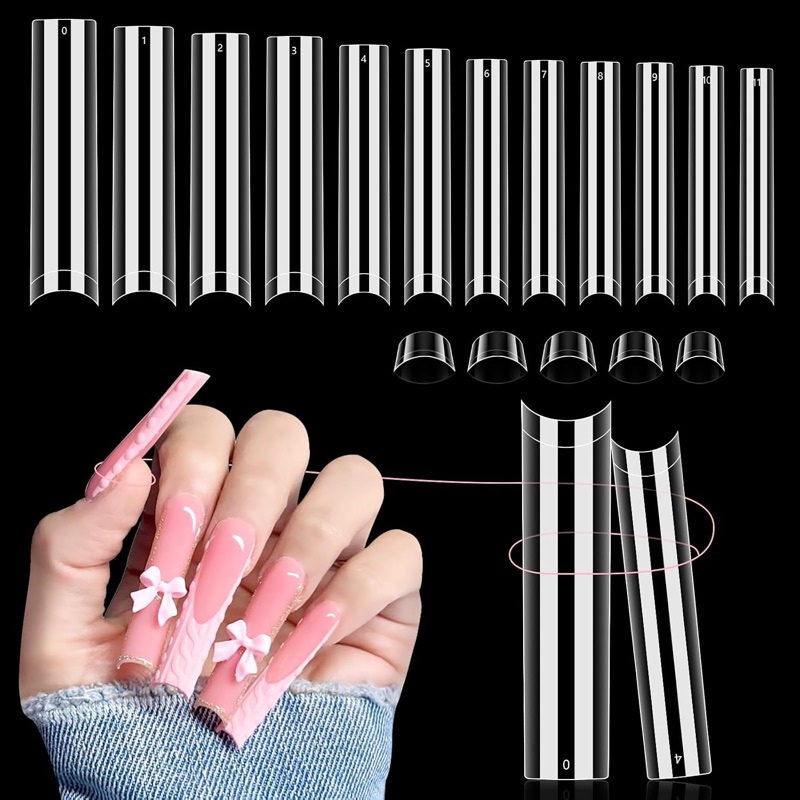
3XL square nail tips, no C-curve, 504 pc
A 504-piece square tip set offered in 3XL, listed as a no C-curve profile. A reference for the largest-size end of a run: check the stated widths against your own measured thumb record, and confirm how far the size sequence actually extends.
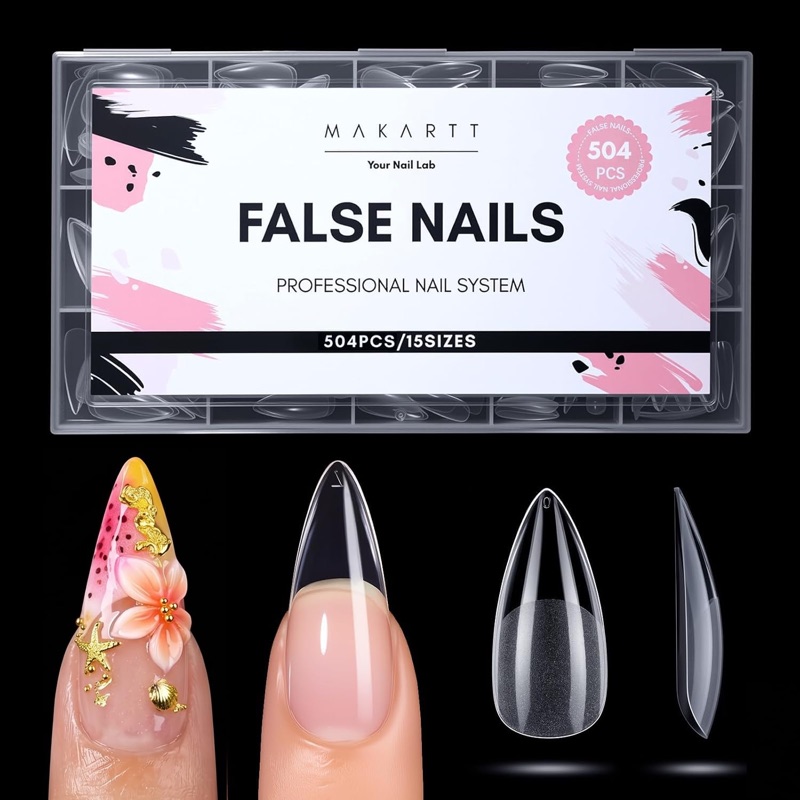
Medium sharp almond nail tips, 15 sizes, 504 pc
A 504-piece almond assortment spread across 15 distinct sizes. Useful when comparing an expanded assortment against a narrow run — the piece count alone does not tell you whether the largest size covers a wider thumb, so check the size list.
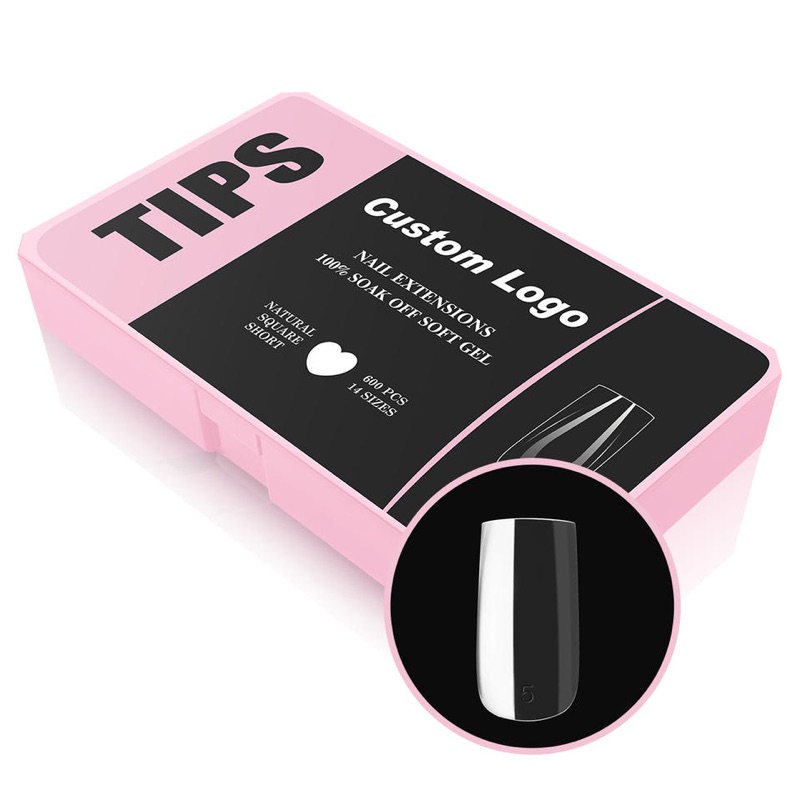
14 Sizes 602 pcs Factory-OEM Premium Soft Gel Nail Tips — Natural Clear, Square, Full Cover
A wholesale 602-piece full-cover pack listed across 14 sizes from an OEM supplier. A sourcing route for asking whether a larger option belongs to the same mold family as your approved tip — the listing alone does not confirm the widest size or its measurements.
Card photos are the current marketplace listing images and may differ from the delivered product; confirm details on the live listing.
Connect the size chart, sizing kit, and checkout
A customer should not see a large thumb option on a social post, receive a kit that ends at another size, and then find checkout only permits a preset range.
Audit these three places together.
| Customer touchpoint | What should match | What to investigate before publishing |
|---|---|---|
| Product page | Eligible shape, length, current size scope | Is the largest physical tip in stock and shown for this SKU? |
| Sizing kit | Same family and numbers used for the final set | Does the kit include the largest relevant thumb option? |
| Size chart | Measurement method and version | Does the chart describe this line rather than a different tip system? |
| Checkout | Available preset and custom choices | Can a customer actually order the option explained by the chart? |
| Support script | Limits and next step | Does the team know when to offer another size route rather than a guess? |
Marketplace examples demonstrate the commercial expectation that a sizing kit can be selected by shape and length. Treat that as a prompt to keep the same specificity across your own pages, not as evidence that every kit is accurate or that every seller has an inclusive range.
For the internal side, connect these fields in the Press-On Nail Size System Builder: supplier line, shape, length, measured largest tip, kit version, customer-facing label, and approval date. The tool should store the evidence you collected; it should not invent a range from a generic template.
Do not let a consumer workaround become a product claim
People adapt press-ons in many ways: they file edges, choose another shape, buy two sets, or use a different design on a thumb. These are useful signals about what is going wrong. They are not a substitute for a product decision.
Filing can reduce a tip's width; it cannot create width where the largest tip is already too small. A second set may provide duplicates, but it does not resolve a missing largest size.
Keep customer copy narrow and usable. Better language includes:
Check the millimetre chart and select the sizing kit for your chosen shape and length. If the largest sample tip does not cover your thumb sidewall to sidewall, contact us before ordering a custom set.
Avoid "fits all thumbs," "guaranteed wide fit," or "just file it to fit." Those statements hide a real range limitation inside an easy-sounding fix.
Supplier questions that expose a thumb-size gap early
Ask for physical clarity before committing to an artwork file or an order quantity.
- What is the largest numbered tip in this exact family, and what are its usable internal measurements?
- Is there a size 00 or other larger option in the same mold family? If so, can you provide a blank sample?
- Do the approved wide options exist in each proposed shape and length, or only in selected variants?
- Which tip family will be used in the physical sizing kit, and does it include the same largest size as the finished set?
- If the source or mold changes, what sample can the brand compare before reordering?
- Can the supplier pack the expanded range so the customer can identify and record the relevant thumb number?
An Alibaba supplier listing can help a brand find a candidate product role, but it cannot validate any of these answers alone. Before ordering, confirm current availability, minimum order requirements, customisation, sample terms, shipping, and the precise product identity. Do not infer those facts from a product photo or a generic description.
The decision that makes a range credible
A broad size range is not proven by a high piece count or an attractive size-chart label. It becomes credible when the largest available tip has been measured and sampled within the actual tip family, the sizing kit and checkout lead to the same option, and the brand states what it can and cannot supply.
The thumb is valuable because it makes a vague claim testable. If the range can give a customer with a larger thumb a clear, evidence-based route to a set, it is doing real product work. If it cannot, that gap is a product-development decision waiting to be made — not a customer error to explain away.