A clear drawer organizer for lipsticks, palettes and brushes looks like the easiest product in the beauty accessory aisle to source. It is a box with compartments. Yet the category is a quiet source of returns: cracked corners that arrive in the post, drawers that stick, a faint yellow cast after a few months on a sunny dresser, fine white lines that appear after someone wipes it with a cleaning spray, scratches from the protective film peeled off in the factory instead of at the customer's home.
The listings make it harder to see what is being sold: "Crystal clear acrylic." "High-clarity, no yellowing." "Thick, shatterproof." "Waterproof and easy to clean." "Premium quality." The same word, "acrylic", is used loosely for several different clear plastics, and the material decides how the organizer looks after six months, what it can be cleaned with and how it fails when dropped.
This guide explains what the main clear plastics are and what the plastics trade says about them, why cleaning instructions matter more for acrylic than most sellers realise, what health and regulatory sources say about where cosmetics should be stored, and sets out a screening test. It recommends no product and makes no claim about product shelf life beyond what the cited sources say. For nearby storage products, see the cosmetic bag lining guide and the makeup sponge case test.
What the box is actually made of
Clear organizers are made from a small family of transparent plastics. Plastics suppliers and trade sites describe them in broadly consistent terms.
Acrylic (PMMA). Described by plastics suppliers as the clearest common plastic, with light transmission around 92 per cent, a rigid glass-like feel and good scratch resistance relative to competitors. One supplier's comparison says acrylic outperforms polycarbonate in clarity and scratch resistance, and a medical-plastics trade magazine says neither clear ABS nor PETG matches acrylic's clarity, scratch resistance or light transmission. A chemicals marketplace article says acrylic does not yellow or haze under prolonged UV exposure and that most commercial grades are UV-stabilised.
Polystyrene (PS) and styrene copolymers. A cheaper clear plastic. A retail buying guide says polystyrene is lighter, cheaper to produce and slightly more flexible but more prone to scratching than acrylic. The same chemicals article says polystyrene absorbs UV and can show visible yellowing within months of sun exposure, describing it as suited to indoor, budget, disposable use. A furniture retailer's guide repeats that cheaper clear plastics warp under weight, scratch easily and yellow over time. Supplier and retailer descriptions, not test results, but consistent.
PETG. Described as a tougher, more flexible clear plastic with good chemical resistance. A sign-materials supplier says acrylic is the choice for clarity and rigidity while PETG is more durable, lightweight and flexible; another says PETG is more impact-resistant and less likely to shatter, easier to mould into complex shapes and less hard on the surface than acrylic.
Polycarbonate (PC). Often described as the most impact-resistant clear plastic, with a weakness for yellowing in sun and scratching, according to a materials guide. Rare in cheap organizers.
Three points follow for anyone writing or reading a listing.
First, "acrylic" is used as a generic word for clear plastic. A retail listing may say acrylic when the material is polystyrene, SAN or PETG. The difference matters for clarity, scratch resistance, yellowing and cleaning. Ask the supplier for the polymer in writing and, for any claim you will print, have a laboratory identify it.
Second, each material fails differently. Acrylic is rigid, so it tends to crack when dropped. PETG tends to flex and scratch. Polystyrene yellows and becomes brittle. A claim of "shatterproof" is nearly always wrong for rigid acrylic and needs a test.
Third, thickness is a spec, not an adjective. "Thick" means nothing. Measure wall thickness of the base, the sides and the drawer bottoms at several points, and write the numbers on the listing.
Cleaning: where most sellers go wrong
This is the most useful practical point in the category, and it is almost never on a listing.
Acrylic can be damaged by common household cleaners. Manufacturers of acrylic sheet say not to use window-cleaning sprays, kitchen scouring compounds or solvents such as acetone, gasoline, benzene, alcohol, carbon tetrachloride or lacquer thinner, because these can scratch the surface and weaken the sheet, causing small surface cracks called crazing. A US supplier's bulletin adds that treatment with such solvents may not craze the surface immediately and the cracks may appear days or weeks later. A government conservation institute's cleaning note warns that many household cleaners contain abrasives that scratch acrylic and solvents that cause crazing. Industry and hobbyist guides single out ammonia in glass cleaners as a common cause of cloudiness.
The advice on alcohol is not uniform, which is itself a lesson. One acrylic sheet maker's care page lists alcohol among products to avoid, yet another page from the same maker says diluted isopropyl alcohol at 30 per cent strength or 3 per cent hydrogen peroxide can be used for disinfecting, and lists several germicidal wipes as incompatible. A plastics blog says acrylic should not meet ammonia, alcohol or acetone except when spot-treating adhesive, while stating elsewhere that isopropanol is safe for intensive cleaning when used properly. Different sources with different concentrations in mind — so do not reduce this to a simple rule. What they support is narrower: cleaning agents, concentrations and wipes matter, a safe method is mild soap and water with a soft cloth, and damage can be delayed.
For a seller this has two consequences. The care instructions should say what to use (mild soap, water, a soft cloth) and what not to use (ammonia-based glass cleaners, solvents, nail polish remover, abrasive pads). And you should test your own sample against the cleaners customers actually use, because dermatology advice for brushes and tools is to wipe them with alcohol, so some customers will reach for an alcohol wipe on the organizer too.
Where cosmetics should be stored, and what a listing may imply
An organizer is bought to hold products that go on skin and near eyes, so storage guidance from health sources shapes what you can sensibly promise.
The US Food and Drug Administration says determining a cosmetic's shelf life is the manufacturer's responsibility, that heat can make preservatives break down and allow bacteria and fungi to grow faster, and that consumers should store cosmetics properly — for example not leaving them where they are exposed to heat. A dermatologist at a university health system advises storing products in a cool, dry space, because bacteria multiply faster in warm, humid environments; keeping them out of sun-exposed areas; using a drawer or cabinet if the bathroom has a window; and suggests it may be best to store makeup outside the bathroom because heat and humidity from the shower can degrade it. A cosmetics educator quoted by a beauty site recommends a cool, dry, dark place such as a drawer or cupboard and notes bright vanity lights are also a factor. A retailer's storage guide names humidity as a risk for powders, which can clump or grow bacteria in steamy rooms. A consumer skincare guide says a bathroom can be convenient but a bedroom drawer may be more stable if the bathroom gets very warm.
What this means for a listing: an open, clear organizer on a bathroom counter or a sunny vanity is in tension with the storage advice in these sources. You can sell open organizers honestly, but you should not describe them as protecting products or extending shelf life. A lidded or drawered organizer keeps dust off and light out, and one lifestyle guide recommends organizers with lids for exactly that reason. That is a design suggestion, not evidence the product extends life. Describe the organizer's function (holds, sorts, displays) and add a one-line note that cosmetics are best kept cool, dry and out of direct sun. Do not make shelf-life or hygiene claims for the organizer.
A related warning from a dermatologist quoted by a news site: surfaces and applicators that touch cosmetics should be clean, and products that have touched contaminated skin or tools should be thrown away. An organizer is not a barrier against that.
Terms the listing uses loosely
- Acrylic. Ask for the polymer and a report.
- Crystal clear / high clarity. A feel claim. The numbers behind it are light transmission and haze, which can be measured; a supplier quoting about 92 per cent is describing the material, not your batch.
- No yellowing. The plastics trade attributes yellowing to UV exposure and material type. A "no yellowing" claim needs an accelerated-ageing test or a UV-stabilisation statement, and even then describes only the conditions tested.
- Shatterproof / unbreakable. Rigid acrylic can crack. Drop-test it and describe what happened.
- Waterproof. The material may not absorb water, but seams, drawers and slides are not sealed. Say water-resistant to wipe-clean only if you tested it, or leave it out.
- Easy to clean. Only if the recommended method does not craze or cloud the plastic.
- BPA-free / food-grade / non-toxic. Claims about chemistry that do not follow from the material being clear. We did not research how they apply to cosmetic storage products. Do not use them unless you hold a supplier statement and a report you can show, and ask a compliance adviser what is appropriate in your market.
- Stackable. Requires a load test, not a drawing.
- Premium / luxury. Decoration.
What goes wrong with these products
- Transit cracks. Corners, drawer fronts or dividers cracked on arrival because the packaging did not protect rigid material.
- Scratches. Surface scratches from stacking without film or from abrasive cloths.
- Hazing and crazing. Fine cracks or cloudiness after cleaning with the wrong agent, sometimes delayed.
- Yellowing. A cast, particularly on cheaper plastics, after sun exposure.
- Seam failures. Bonded joints that open, show glue lines or trap bubbles.
- Sharp edges. Rough, unpolished or chipped edges that cut fingers or snag fabric.
- Sticking drawers. Drawers that bind, tilt, fall out or have no stops.
- Tipping and sliding. A tall unit that falls forward when a drawer is opened, or slides on a smooth surface.
- Residue. Adhesive from protective film or tape left on surfaces.
- Dimensions wrong. Compartments that do not fit the products shown in the listing images.
Reading the results: pass, revise or fail
| Result | Pass | Revise | Fail |
|---|---|---|---|
| Contents and fit | Matches the listing; products fit | Minor fit issue; update the listing | Products shown do not fit |
| Thickness | At or above the stated figure at every point | Thin at one point; tighten the spec | Below the stated figure or badly uneven |
| Material | Polymer confirmed by report | Not confirmed; drop the word "acrylic" | Material differs from the listing |
| Clarity | Clear, no cast, no streaks | Slight cast; state it or change supplier | Hazy, yellow or full of defects |
| Edges and seams | Smooth edges; clean tight seams | Rough edges; request polishing | Sharp edges or seams that open |
| Drawers | Smooth for 2,000 cycles; stops work | Slight sticking; adjust clearance | Binding, falling out or tipping |
| Stacking | No change at the tested load | Slight bowing; lower the stated load | Cracks or collapse |
| Cleaning | No damage from the recommended method | Damage from some cleaners; warn on the card | Damage from soap and water |
| Light and humidity | No visible change | Faint cast; state limits | Visible yellowing or warping |
| Drop and transit | No cracks in transit | Cracks at corners; upgrade packaging | Cracks in the packed drop |
Treat sharp edges, cracks in transit and damage from the recommended cleaning method as a stop. They are the defects customers notice first.
The sample test: ten steps in an afternoon
These are our own screening procedures, not a standard. They compare samples with each other and with what you plan to claim. Use at least three units of each model from different cartons, plus a few spare pieces (or spare drawers) you are prepared to damage. Callipers, a ruler, a light box or bright window, a kitchen scale and a few common cleaners are enough. Material identification and accelerated ageing need a laboratory.
1. Contents, dimensions and packaging. Check contents against the listing: number of drawers, dividers, feet, protective film. Measure overall size, each drawer's internal size and weight, and compare with the listing. Check that compartments fit the products shown — a lipstick, a round palette, a foundation bottle — by placing real items. Inspect the packaging: protective film on all surfaces, edge protectors, dividers between units.
2. Thickness. With callipers, measure wall thickness of the base, sides, drawer bottoms and dividers at five points on each unit. Record the minimum, not the average. Compare units and compare with the figure on the listing. A spread beyond a small amount suggests inconsistent sheet or thermoforming.
3. Material identification. Ask the supplier for the polymer in writing. For any claim of acrylic, send a sample to a laboratory for infrared identification, and keep the report with the batch record. Do not rely on feel, sound or a burn test.
4. Clarity and colour. Place a sample over printed text, then over a white card, then over a mid-grey card, and photograph each with fixed phone settings next to a reference sheet of known clear material if you have one. Look for haze, yellow or blue cast, streaks, waviness and trapped particles. A light box helps. If you plan to quote light transmission or haze, get them measured, not copied from a material datasheet.
5. Edges, corners and seams. Run a fingertip and a nylon stocking along every edge and corner. Record sharp, rough or chipped edges. Inspect bonded seams under a loupe for gaps, bubbles, glue overflow and whitening. Press the seams firmly by hand and check for movement. Stress whitening around corners is a sign of overstressed plastic.
6. Drawer function. Open and close each drawer 2,000 times at a steady pace, with a typical load of cosmetics (weigh the load and record it). Record sticking, tilting, binding, drawers that fall out, missing stops and noise. Check that a drawer cannot be pulled completely out by accident when a customer pulls briskly. Place the unit on a smooth surface and check whether it slides or tips as drawers are opened.
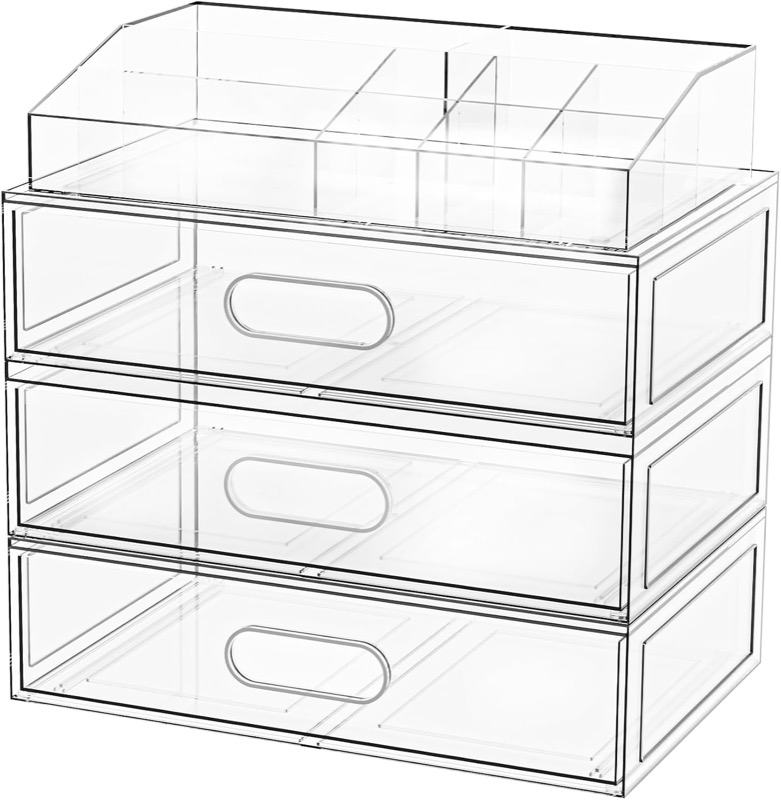
Clear stackable organizer with drawers
A retail example of the format this guide covers, with the exact claim stack to test: crystal clear, acrylic, shatter-resistant, BPA-free. The listing also states dimensions, which is the first thing to check against real products.
7. Stacking and load. Stack two or three units as the listing shows, and add a distributed load equal to a reasonable amount of product on top. Leave for 48 hours. Check for bowing, cracking at corners, drawer binding and slipping between units. Record the load you used. Do not claim a stacking capacity beyond what you tested.
8. Cleaning and chemical exposure. Use spare pieces. Treat separate areas with: mild soap and water on a soft cloth; an alcohol wipe; an ammonia-based glass cleaner; a household all-purpose spray; and nail polish remover on a cotton pad for ten seconds. Photograph under angled light immediately, again after 24 hours and again after a week, since crazing may be delayed. Repeat the soap-and-water cleaning 20 times and look for scratches. Then expose spare pieces to common cosmetics for 24 hours (lipstick, foundation, perfume, nail polish) in a closed container and wipe clean. Record staining, clouding or softening, and write the listing's instructions from these results.
9. Light, heat and humidity. Place one unit and a retained control in a window with direct sun for two to four weeks, shielding the control in a dark cupboard. Compare colour against the control on a white card. Separately, place a spare piece in a closed bathroom during showers, or in a sealed box with a damp towel, for 48 hours. Check for warping, haze and seam changes. Crude screens; they do not replace an accelerated ageing test if you plan to say "no yellowing".
10. Drop, transit and volunteer panel. Fill a drawer with typical cosmetics and drop the packed unit from the height your carrier allows onto a hard floor — flat, on an edge and on a corner. Inspect for cracks and compare with a drop of an unpacked unit from desk height, which shows how the organizer behaves in homes. Then give units to at least eight volunteers for two weeks and ask about drawer feel, fit of products, scratches, cleaning, and any cracks or odours. A usability check, not an ageing study.
Special cases: lids, rotating trays, logos and gift sets
Lidded and hinged boxes. A lid keeps dust and light off, and one lifestyle guide recommends lidded organizers for that reason. It also adds a hinge — a new failure point. Open and close the lid 2,000 times, check that it does not slam, and check that the hinge pin or tab does not crack the plastic around it. Look for a lid that traps moisture inside after a damp-hand opening.
Rotating and tiered trays. Rotating bases add a bearing and a centre pin. Load the tray with realistic weight, spin it 2,000 times and look for wobble, noise and a pin working loose. Tiered units tip more easily, so repeat the tipping test with the top tier loaded.
Printed or engraved logos. A logo on clear plastic adds another surface to test. Rub the print with a damp cloth and a mild-soap cloth 50 times, and repeat after a cosmetics-contact test, because lipstick and perfume can lift ink. Engraving and laser marking can introduce stress marks at the edges; inspect around them under angled light.
Gift sets and bundles. If the organizer ships with brushes, a mirror or pouches, test each component on its own and check the bundle matches the listing. A bundle listing that counts the box or the film as an item is a common source of complaints.
Multiple colour options. Tinted or frosted versions need their own clarity and light tests. Frosted surfaces show fingerprints and cosmetic stains more easily, so run the cosmetics-contact test on each finish and do not assume the clear version's results carry over.
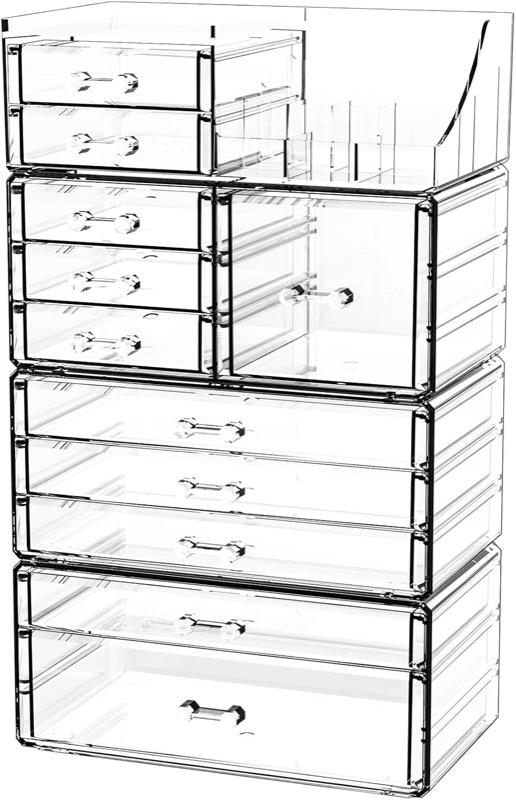
Acrylic organizer tower with multiple drawers
A taller build to compare: more drawers means more cycled parts and a higher centre of gravity. The tipping test and the 2,000-cycle drawer test matter more here than on a single low drawer.
The supplier brief
- The polymer for each part, with a laboratory identification report and the sheet or resin grade.
- The thickness specification for each part, with tolerances, and how it is checked.
- Any UV stabilisation or anti-yellowing treatment, and any ageing test results with method.
- The seam method (solvent bonding, adhesive, or moulded one-piece), the adhesive and a seam strength test.
- The edge finishing process, such as flame polishing or buffing, and the inspection plan.
- The drawer design: runners, stops and the cycle test they have run.
- The protective film, how it is applied and whether it is removed before shipping.
- The cleaning instructions they recommend, tested against the agents customers use.
- The packing method, carton drop test and the damage rate they expect.
- Minimum order quantity, lead time, sample policy and replacement terms, on the quotation and not in chat.
What your listing can say
- Material: "Clear acrylic (PMMA)" only with a report; otherwise "clear plastic" and the polymer you can confirm.
- Dimensions and thickness: the measured numbers, including the minimum wall thickness.
- Clarity: describe what you see ("clear with no tint in our samples") and avoid comparative words without a measurement.
- Durability: say what you tested ("drawers tested to 2,000 openings with a load of X") and that rigid plastic can crack if dropped. Do not say shatterproof.
- Care: wash with mild soap and water and a soft cloth; do not use ammonia-based glass cleaners, solvents or nail polish remover; test any other cleaner on a hidden spot first.
- Storage: a short note that cosmetics are best kept cool, dry and out of direct sunlight, consistent with the FDA and dermatology guidance we cite, and no claim that the organizer prolongs shelf life.
Avoid "shatterproof", "no yellowing", "waterproof", "antibacterial", "BPA-free" and "non-toxic" without evidence for each.
Frequently asked questions
Is acrylic better than polystyrene for an organizer? Plastics suppliers say acrylic is clearer, harder and more resistant to yellowing, while polystyrene is cheaper and suited to indoor budget use. Supplier statements; test your own samples.
Why did my organizer get cloudy after cleaning? Acrylic sheet makers warn that ammonia-based cleaners and many solvents can cloud or craze acrylic, sometimes days later. Use mild soap and water.
Can I clean it with an alcohol wipe? Sources disagree and depend on concentration and product. One acrylic maker lists alcohol among products not to use; another allows diluted isopropyl alcohol. Test your own sample and state the result.
Is it a good idea to keep makeup in the bathroom in an organizer? Dermatologists and the FDA advise keeping cosmetics away from heat, humidity and direct sun, so a dry drawer or cabinet is usually preferred. An organizer does not change that.
Does an organizer extend product shelf life? We found no evidence that it does. Do not say so.
Can I say it is shatterproof? Not for rigid acrylic. Drop-test it and describe the result.
What thickness should I specify? We found no standard. Pick a minimum from your own tests and write it on the listing.
What should I do about the protective film? Decide whether to ship with it on. Film protects against scratches but can leave residue. Test the residue after a month.