A lighted makeup mirror looks simple: a glass or acrylic face, a ring or strip of LEDs, a touch switch, a USB cable, a stand. The listing, though, is dense with numbers: "CRI 95", "3 colour modes", "5000K daylight", "10X magnification", "4000mAh rechargeable", "360° rotation", "waterproof touch screen". Each number is a claim a buyer will rely on when deciding whether the mirror will help them see their face accurately, and several are hard to check by eye.
That gap is both the opportunity and the risk. The opportunity: a seller who can say what a number means, and show how it was measured, stands out in a category where most listings repeat the same adjectives. The risk: a mirror whose light is uneven, whose "10X" lens blurs unless you press your nose to it, or whose lithium battery has no transport paperwork becomes a returns and compliance problem.
This guide explains what the main specifications do and do not tell you, what trade and government sources say about colour rendering, flicker, magnification distance and battery transport, and sets out a screening test you can run on samples with ordinary tools. It recommends no product and makes no claim about anyone's eyesight, skin or makeup results. If you are also sourcing the rest of a vanity kit, see the makeup brush set test and the cosmetic bag lining guide.
What a lighted mirror is actually made of
Most lighted makeup mirrors share four parts, and each is a place where a listing claim can go wrong.
The mirror face. Sellers describe silvered glass, acrylic or "HD" mirrors, sometimes with a second magnifying face. Trade reviewers say better magnifying mirrors use silvered glass with anti-distortion treatment, and cheaper acrylic lenses can warp the reflection. That is a reviewer statement from an affiliate site rather than a measurement, but it points at something you can check: look at a grid in the reflection and see whether the lines stay straight.
The light. A ring, a surround of bulbs or a strip of LEDs, often with a diffuser. This is where colour temperature, CRI, brightness and flicker are decided, and it is the part of the listing most likely to be a single marketing number.
The electronics and power. A touch or button control, a dimming circuit, a USB-C or micro-USB port, and often a built-in lithium-ion cell. The control board decides how the light is dimmed — which affects flicker — and the cell decides runtime, charging behaviour and what paperwork you need to ship it.
The mechanics. A stand, base, hinge or swivel, sometimes a suction cup or a magnetic detachable lens. These decide whether the mirror tips, drifts out of position or loosens after a few months. Reviewers list stiff or loosening hinges, a touch button that is easy to bump while rotating the head, and a frame screw that loosened after several months among their complaints. Anecdotes, but they match the failure modes below.
Colour temperature: what the Kelvin number does and does not say
Colour temperature, in kelvin, describes whether white light looks warm (lower numbers) or cool (higher). Mirror makers and lighting retailers repeat a few figures. One mirror manufacturer's guide gives 4000K to 5000K as the ideal range for makeup; another says neutral white or daylight at roughly 5000K to 5500K suits colour-critical work; a lighting brand offers 3000K, 4500K and 6400K settings so one mirror covers both camps; a review site suggests at least warm (about 3000K), natural (about 4500K) and cool (about 6000K) modes. Every one is a brand or affiliate view, and they differ. There is no standard that says one number is correct for makeup.
What a seller can honestly say is narrower: the mirror offers certain colour temperatures, they were measured, and the user can switch between them.
Two practical points follow. First, the number on the listing is nominal. A mode labelled 5000K can sit somewhat above or below, and the three modes of a cheap mirror can differ by more than the labels suggest. Second, colour temperature says nothing about how faithfully the light renders colours. Two lights at the same kelvin can make skin and lipstick look different, which is where CRI comes in.
CRI and R9: useful, but not a guarantee
The Colour Rendering Index (CRI, written Ra) compares how a light source renders a set of reference colours against a reference illuminant. The US Department of Energy and lighting engineers have said for years that CRI has well-known limitations. A DOE solid-state lighting summary describes it as a measure of colour fidelity only — not always the same as the rendering people prefer — and notes the newer IES TM-30 method adds a fidelity index, a gamut index and a graphic in place of one number. DOE also published a note that no peer-reviewed evidence supports the ENERGY STAR CRI 80 threshold as a guarantee of acceptable colour quality.
For makeup the red end matters most. An electronics-industry article explains that the standard Ra calculation uses eight reference colours, that a saturated red called R9 is not one of them, and that an LED can score Ra 80 while R9 is zero. ENERGY STAR's lamp criteria, according to that article, ask for Ra above 80 and R9 above zero, which it calls a modest requirement. A DOE presentation gives a rule of thumb that R9 above zero is good, above 50 very good, above 75 excellent. So a listing that says only "CRI 95" tells you something, but not what the reds look like; a listing that gives Ra and R9 together tells you more.
Three cautions when you read a mirror listing:
- A CRI number is a claim until you see the report. Some product pages give lumens, CCT, Ra, R9 and a colour-consistency value and say they come from lab-grade testing. We cannot verify those pages. Ask for the report: who measured, which instrument, which sample, which mode, at what dimming level.
- CRI is measured on the light source, not the whole mirror. A diffuser, a tinted cover or a dimmed setting can change the light that reaches the face. The report should say what was measured.
- High CRI does not make a mirror "daylight". Daylight changes through the day, and "daylight" in a listing is a colour-temperature label, not a promise that makeup will look the same outdoors. Avoid wording that says it will.
Brightness and evenness
Several lighting guides say even light matters more than intense light, and that a face lit from the front by light coming from the mirror, not the ceiling, avoids shadows. A brand blog says more lumens are not automatically better for makeup. These are design opinions, but they are consistent, and they suggest what a screening test should look at: whether the light on the face is even, whether it glares in the eyes, and whether dimming works through its range.
A claimed lumen figure is hard for a small seller to check. A phone lux app is not a calibrated meter, and a figure for a bare LED ring says little about the light reaching the user. What you can do is compare samples with the same app, at the same distance and in the same dark room, and look for large differences between units and between modes. Treat that as a consistency check, not a measurement of the claim.
Flicker: the claim nobody puts on the listing
LED lighting can flicker — output varying rapidly over time — and how a mirror dims influences how much. Lighting-industry explainers say a common dimming method is pulse-width modulation, which switches the LEDs on and off quickly and may add moderate-frequency components, in one source typically 400 to 800 Hz. IEEE Std 1789-2015 is the recommended practice most often cited, and explainers note it is a recommended practice rather than a standard, and that its recommendations are conservative. Percent flicker is defined as 100 times the difference between maximum and minimum output divided by their sum.
The same sources say people differ in sensitivity. Flicker can be invisible to most people yet associated with eyestrain or headache in some, and one article names people with migraines and epilepsy as more sensitive groups. We are not clinicians and make no health claims about lighted mirrors. The practical point: dimming at low brightness is where cheaper drivers tend to misbehave, so it is worth checking, and "flicker-free" should not appear on a listing unless there is a measurement behind it.
Magnification: the number depends on distance
Magnification is the claim customers misunderstand most, and sellers pay for it in returns. A magnifying mirror is concave, so the image grows as you move closer up to a point and then blurs or inverts. A mirror brand's explainer says a typical 10X mirror gives a sharp image at roughly 4 to 6 inches from the surface, and beyond its focal range the image can appear inverted. Reviewers say a true 10X needs about four inches, a 5X about six to eight, and that very high magnification can feel dizzying at the wrong distance. A personal-care brand says 5X is probably the best single magnification and suggests a second lower-magnification side if you choose 10X or more. These are seller and affiliate statements, but they agree with each other and with how a concave mirror behaves.
Some listing hygiene follows:
- State the working distance. Give a distance range alongside the magnification, so the first time a customer sees a blurred face they know why.
- Say what "10X" refers to. Detachable magnifier, fixed second face, or the main mirror. One marketplace review of a 10X mirror complained it was "not 10x", which a clear spec avoids.
- Do not describe magnification as improving eyesight or reducing strain. We found no evidence supporting such wording.
- Check the field of view. A bigger lens shows more of the face at once; a small 10X lens may show only an eye.
Rechargeable battery and shipping paperwork
Many portable mirrors contain a lithium-ion cell. Transport and compliance sources say lithium-ion batteries ship under UN numbers — UN3480 for batteries, UN3481 for batteries contained in or packed with equipment — and that cells and batteries must have passed the UN Manual of Tests and Criteria, section 38.3. Manufacturers publish UN38.3 test summaries, and one electronics maker notes overseas shipping of products with rechargeable batteries may need a safety data sheet or the UN38.3 summary. A law firm's presentation lists the basics: UN38.3 testing, a safety vent or design that prevents violent rupture, and protection against external short circuits. It also cites a civil penalty proposed against a battery company that offered lithium batteries to a carrier for air transport without shipping papers and emergency response information.
The US Consumer Product Safety Commission has also warned consumers against loose lithium-ion cells installed in small consumer products without the required protections; we cite a trade-press summary of that warning rather than the CPSC page itself.
None of this substitutes for advice. Rules differ by market and transport mode, and wording varies with the battery's watt-hour rating. Treat these as the questions to ask: Which cell? Which watt-hour rating? Is there a UN38.3 summary for this exact cell, with a report number? Which standards does the finished product claim, and who tested it? Ask a compliance adviser and your freight forwarder before you list or ship.
Terms the listing uses loosely
- Hollywood lighting. A style, not a specification. Count the bulbs or LEDs and check where they are.
- Natural light / daylight. A colour-temperature label. See above.
- HD mirror. No standard meaning. Test for distortion.
- Shadowless. Even light reduces shadows; it does not remove them. Test with a face, not a ruler.
- Waterproof / splash-proof. Only valid with an ingress-protection rating and a test report. A touch control that misreads wet fingers is a different problem.
- Long battery life. Meaningless without brightness, mode and temperature. Runtime on a low setting is not runtime at full.
- Anti-fog. No test is described. Treat as unverified.
- Eye protection / eye-care light. We found no evidence behind this wording. Leave it off unless you hold a report specific to the claim.
The sample test: ten steps in an afternoon
These are our own screening procedures, not a standard. They compare samples with each other and against what you plan to claim. Use at least three units from different cartons. A phone lux app, a slow-motion phone camera, a grid card and a ruler are enough for most steps; a spectrometer or a laboratory report is needed for CRI, R9 and colour temperature claims.
1. Contents, specification and labelling. Check parts against the listing and packing list: stand, cable, suction cup, magnetic lens, manual. Record mirror diameter, overall height, weight and cable length. Read the nameplate and manual; note power input, battery capacity and any markings. A claim on the listing that appears nowhere on the unit or in the manual is a red flag.
2. Light distribution on a white card. In a dark room, hold a plain white card at typical face distance and photograph it with fixed phone settings in each mode and at three brightness levels. Look for hot spots, dark corners and visible LED dots. Repeat with a face if you have a volunteer, and note whether the ring reflects in the eyes in a way that causes glare.
3. Mode consistency. Photograph the white card in each colour mode with identical settings for all three units. A phone camera cannot give kelvin values, but it shows whether unit A's "neutral" matches unit B's. Anything clearly different goes to the supplier.
4. Colour rendering evidence. Ask the supplier for a spectral report of the light source in the finished mirror, with Ra and R9, CCT, measurement date and sample. If you plan to print a CRI or R9 figure, commission your own measurement on a sample from your batch. Do not quote the supplier's number as your own result. If neither is available, do not state a CRI.
5. Flicker check. View the lit mirror with a phone camera in slow-motion at full, mid and lowest brightness and look for rolling bands. Do the same with a pencil waved in front of the light in a dark room and look for a dotted trail. Crude checks; they cannot give percent flicker or confirm any standard. If you find banding at low brightness, send a video to the supplier and ask what dimming method the driver uses. If you need to claim flicker performance, have it measured with a flicker meter.
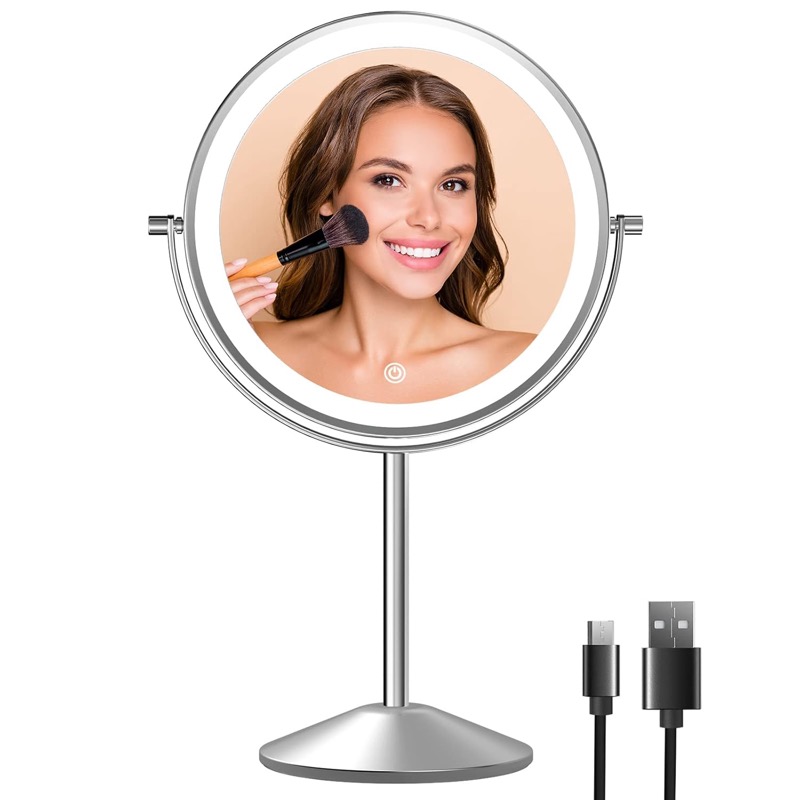
8 inch lighted 1X/10X mirror, three light settings
A retail example with the claim stack this guide examines: 10X, three settings, rechargeable. The listing helpfully states a recommended distance for 10X, which is the single number most mirror listings leave out.
6. Magnification and distortion. Hold a printed grid and a card with small text at several distances from each magnifying surface. Record the distance at which text is sharp, where it blurs, and where it inverts. Look for waviness in the grid lines. Compare with the claimed magnification by measuring the apparent size of a known object against the same object in a flat mirror. Write down the working distance and use it on the listing.
7. Mirror face and edges. Inspect under light for pinholes, haze, scratches and bubbles. Run a fingertip over the edges. Press the magnetic or snap-in lens and check it holds when the head is tilted and rotated. Wipe with a dry microfibre, then a damp cloth and an alcohol wipe, and look for coating loss or streaks.
8. Stability and mechanics. Set the mirror on a smooth tabletop and a slightly tilted surface. Tilt and rotate the head through its range 200 times, recording loosening, noise or drifting. Press lightly on the top edge and note whether it tips. Tap the touch control with dry and slightly damp fingers 100 times each, recording missed and ghost touches. Drop the packed unit from the height your carrier allows and re-inspect.
9. Battery and charging. Charge fully, then run at full brightness in the coolest mode and at mid-brightness, recording runtime. Record charge time from empty and the body surface temperature with an infrared thermometer after one hour of charging and one hour of use. Check that the mirror works while plugged in if the listing says so. Stop and quarantine any unit that swells, smells or gets uncomfortably hot, and report it to the supplier. Request the UN38.3 summary and safety data sheet for the exact cell, and check the model and capacity match the unit.
10. Splash, cleaning and volunteer panel. Wipe with a damp cloth and a sanitiser wipe, as users do, and check the body, printing and touch surface. If you plan any water-resistance claim, do not rely on this: it needs an ingress-protection test report. Then give units to at least eight adult volunteers with a short protocol: use for a week, note glare, comfort, how often they adjust it, whether the touch control behaves, and any headache or eye discomfort. Tell them to stop using any mirror that bothers their eyes and see a professional if it persists. This is a usability check, not a study, and cannot show any benefit.
What goes wrong with these products
- Colour modes that do not match. Warm, neutral and cool are not what the labels say, or differ between units.
- Uneven light. Hot spots near the LEDs, a dark side, or a visible ring reflected in the eyes.
- Flicker on dimming. Visible or camera-visible banding at low brightness.
- Blurred or distorted magnification. A focal distance far shorter than the listing implies, or a wavy image.
- Mirror defects. Pinholes in the silvering, edge chips, scratches, or a lens that pops out.
- Tipping or drifting. A light base, a hinge that will not hold position, a pole that wobbles.
- Touch control faults. Ghost touches, a switch that fails with damp hands, or a button bumped during rotation.
- Battery problems. Short runtime, slow or heating charge, a cell that swells, or missing transport documents.
- Cable and port problems. Loose port, no charging while on, a cable too short to reach a socket.
- Missing or wrong parts. A suction cup, magnetic lens or stand not in the box.
Reading the results: pass, revise or fail
| Result | Pass | Revise | Fail |
|---|---|---|---|
| Contents and labels | Everything on the listing is in the box and on the nameplate | Minor wording mismatches; fix the listing | Missing parts or claims with no basis |
| Light distribution | Even on card and face, no glare | Slight hot spot; request a better diffuser | Strong hot spots or glare in the eyes |
| Mode consistency | Modes look alike across units | Small unit-to-unit difference; tighten the spec | Modes mislabelled or inconsistent |
| Colour rendering | Report in hand with Ra and R9, matching the claim | Report missing; drop the CRI claim | Report contradicts the claim |
| Flicker | No visible banding at any level | Banding at the lowest level; ask for a driver change | Banding across most of the range |
| Magnification | Sharp at the stated distance, grid lines straight | Distance shorter than expected; state it | Warped image or magnification well below the claim |
| Mirror face | Clean silvering, edges safe, lens secure | Cosmetic marks; tighten inspection | Pinholes, sharp edges or a lens that falls out |
| Stability and touch | Holds position, no ghost touches | Stiff hinge; change the hinge spec | Tips over, drifts or the control fails |
| Battery | Runtime near spec, temperature acceptable, paperwork matches | Runtime shorter than claimed; correct the listing | Swelling, overheating or no battery paperwork |
| Volunteers | Comfortable, no complaints | Complaints fixed by instructions | Repeated eye discomfort or glare |
Treat a failure on battery documents, overheating or sharp edges as a stop. The rest are prompts to change the specification or the claim.
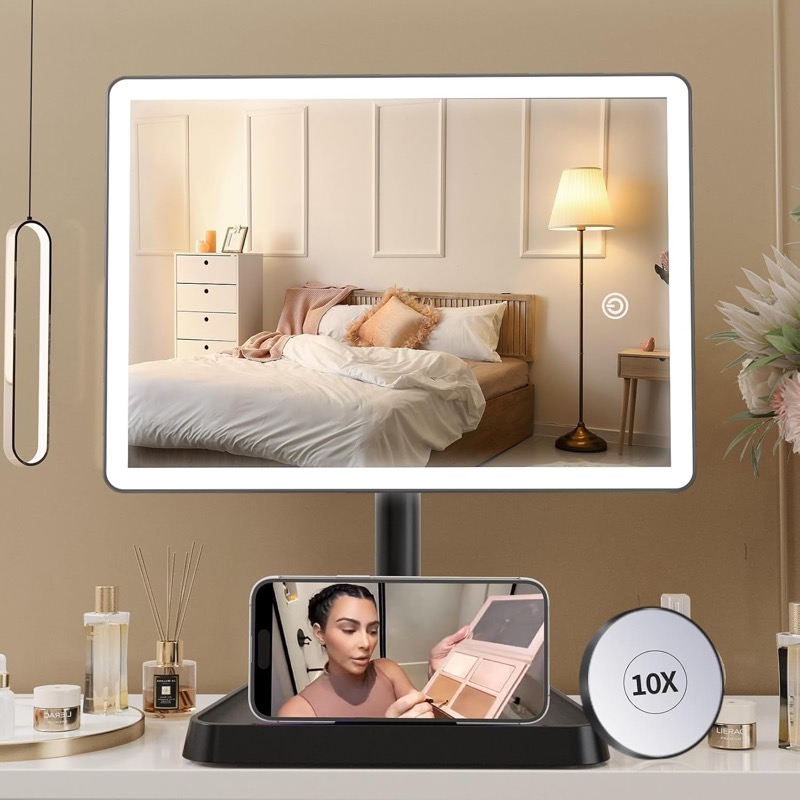
Vanity mirror with 96 LEDs and detachable 10X spot
A second format to compare: a large 1X face plus a detachable spot lens. Two lenses means two focal ranges to measure, and a detachable part adds a retention check the single-face mirror does not need.
The supplier brief
- The LED type, count and layout, the diffuser material, and the colour modes with their measured CCT.
- A spectral report on the finished mirror with Ra, R9 and CCT, with date, instrument and sample.
- The dimming method, driver type and any flicker data with method.
- The mirror material and coating, the magnifier optics, and the measured working distance for each magnification.
- The battery cell model, capacity, watt-hour rating, protection circuit, UN38.3 summary and safety data sheet.
- The charging input, charging time and runtime at stated brightness levels.
- Any ingress-protection rating, with test report and conditions.
- The hinge and stand design, the tilt cycle test and the tip-over test they have run.
- The packing list, carton drop test results and the manual.
- Minimum order quantity, lead time, sample policy and replacement terms, on the quotation and not in chat.
What your listing can say
- Light: "Three colour modes (values you measured)". Add CRI and R9 only if a report exists, and name who measured it.
- Daylight: use it as a colour-temperature label ("5000K mode"), not a promise about how makeup looks outdoors.
- Magnification: "10X on the detachable lens; sharpest at about the distance you measured". Add a lower-magnification side if you have one.
- Flicker: say nothing without a measurement. If you have one, say the method and result.
- Battery: capacity, measured runtime at stated settings, charging time, and a note that the battery is lithium-ion. State shipping restrictions where relevant.
- Water: "Wipe clean with a damp cloth" unless you hold an ingress-protection test report.
- Care: gentle cleaning for the mirror surface, keep the charging port dry, and do not leave the unit charging unattended.
Avoid "eye protection", "anti-fog", "shadowless", "waterproof" and "professional grade" without evidence for each.
Frequently asked questions
What CRI should a makeup mirror have? Retail guides commonly say 90 or higher. That is a rule of thumb from sellers and reviewers, not a standard. Ask for R9 as well, because Ra alone can hide a weak red.
Is 5000K the right colour temperature? Sources disagree: some say 4000K to 5000K, others 5000K to 5500K, and some brands offer three settings. Offer modes you have measured and let customers choose.
Why is my 10X mirror blurry? Because a concave mirror is only sharp within a short working distance. Seller and reviewer sources put it around four to six inches for 10X. State the range.
Is 10X too strong? Reviewers say it suits tweezing and fine detail, and that very high magnification can feel dizzying if the distance is wrong. A second, lower-magnification side or a detachable lens helps.
Can I call the light flicker-free? Not without a measurement. Dimming method matters, and low brightness is where many drivers show it.
Do I need paperwork for the battery? Probably, and the details depend on market and transport mode. Lithium-ion batteries ship under UN3480 or UN3481 and are expected to pass UN38.3. Ask your freight forwarder and compliance adviser.
Can I say the mirror is waterproof? Only with an ingress-protection rating and a test report that covers the finished product.
What if a customer reports eye discomfort? Ask them to stop using the product, record the batch and the setting, and take it seriously. We make no claim about eye health.