A customer with waist-length hair buys a curling rod advertised for long hair, wraps it, and runs out of room. The sections overlap, the ends will not stay put, and the hair is still damp in the morning. Other long-hair buyers describe curls that only form near the ends, or a comfortable-looking rod that turns into a bad night's sleep.
Those are individual complaints, not a failure rate. They are still useful, because they name a specific product question: what does "XL" or "for long hair" mean once someone is actually wrapping hair around the tool?
For a brand ordering a private-label set, the question is narrower again. Not "which curler is best" but "does this sample hold the hair profile we intend to claim, and can the supplier repeat it". This guide sets out a test you can run before artwork or a larger order, and it pairs with the wider material questions in silk or polyester satin for hair accessories.
A longer rod is not automatically a better rod
Length helps only when it is usable length. A rod with bulky sewn ends, a knot, a clip or a thick connector gives away part of its span to the closures. A 150 cm rod may offer considerably less than 150 cm of wrap.
Diameter moves in the other direction. A thicker rod produces a broader bend but consumes length faster, so the same head of hair may run out of rod sooner. A thinner rod takes more turns and can feel less cushioned at the temple.
That is why "extra long" alone does not answer a fit question. Usable span, diameter, section size and hair density interact. A brand that only tests one long-haired model on one rod, one night, is testing a single point in that space.
Define the hair profile and the style first
"Long hair" is not a specification. Write the target down before you order samples.
- length range, in centimetres, of the hair you intend to serve;
- whether the hair is layered, and roughly where the layers start;
- approximate density and texture;
- whether extensions are in scope — if yes, they must be tested, not assumed;
- the finish you are selling: loose bend, broad wave or defined curl.
Then name the format. A single ribbon wrapped from the part down each side is a different product from a set of short flexi rods, foam rollers or a multi-section system. Each divides the hair differently and produces a different balance of curl, volume and sleep comfort. If the listing shows one rod, test it as a single-rod system rather than assuming it replaces four rollers.
Measure working length separately from total length
Two numbers belong in every sample record: total length and usable wrapping length.
Measure the total length first, then find where hair can sit without sliding onto a closure or being trapped under a seam. Mark those endpoints and photograph them. Repeat the measurement twice; on a compressible rod, state whether it was relaxed or under tension, and ask the supplier to use the same definition.
Then test the intended wrap. With your defined section size and starting position, record how much rod remains, whether the ends stay secure, and whether hair reaches the closure. A pass means the named hair length fits without unusually thin sections or loose ends — write that criterion into the brief so the test does not drift.
Diameter and wrap capacity are different measurements
Measure diameter at the centre and near both ends. Soft-filled or wired rods compress, so note whether the reading was taken unloaded or held in a typical wrap. A visibly varying diameter is a construction issue, not a rounding error.
Capacity depends on usable length, section size, density, wrap spacing and how the rod is fixed — not on diameter alone. This is why "can it hold thick hair?" is a poor supplier question and a dimensioned sample is a better one.
If the kit contains two rods, test whether two are enough for the profile you are claiming. A tester may need to split the back section, which changes timing and instructions. If the product is sold as a one-rod kit, record when a second rod or an extra clip becomes necessary, and decide whether to include one, narrow the claim, or change the configuration.
Run the sample test under repeatable conditions
Use more than one tester inside the target profile. This is not a statistically representative study; it is an early screen for obvious failures before packaging spend.
Give every tester the same instruction card. Do not coach one person through a workaround and compare that result with an uncoached test.
Keep preparation consistent: dry or damp hair exactly as your planned instructions say, the same sectioning pattern, and no styling product in only one trial. Record how the hair is wrapped, whether ends stay put, whether the rod shifts during ordinary movement, and whether the result is still acceptable when removed.
If the product is marketed for overnight use, test at bedtime and on waking. A short mirror try-on cannot answer a sleep question. Ask about pressure at the crown, temples, ears and the back of the head, and whether the rod pulls, slips or catches hair on removal. Include side and back sleepers if they are in your market.
Inspect core, cover and closures as one system
The outer fabric tells you very little about how the rod behaves. Ask what the core is made of and how it is secured.
Bend the sample repeatedly by hand, then check whether it returns to shape, develops a hard kink, or pushes toward the cover. The core and its ends should not migrate into the wearer's contact area. One complaint about a wire failing is a single report, not a failure rate, but it points at a reasonable inspection item.
Run a hand over seams, end finishes, attached ties and clips. Look for rough seams, loose threads, exposed wire, or a closure that becomes bulky when wrapped. Open and close any clip several times and note whether the hold changes. These are buyer checks, not a durability certification.
Check the anchor, the closure and the pack-out
The parts you ship decide whether the set works. A clip at the crown keeps the centre section in place while the hair is wrapped, and scrunchies or ties hold the ends — so test each one in its actual role. Does the clip stay attached through a normal night without pinching hair? Does the closure hold a full section, or does it slip once the wrap gets thick? Can the wearer take it off in the morning without snagging?
Test the set using only the accessories in the box. A tester's own clip from a drawer will hide a packaging gap, and the customer will not have it. Count every component against the pack-out list, and if a second rod or an extra clip turns out to be genuinely necessary for your claimed hair profile, either include it or say so in the instructions.
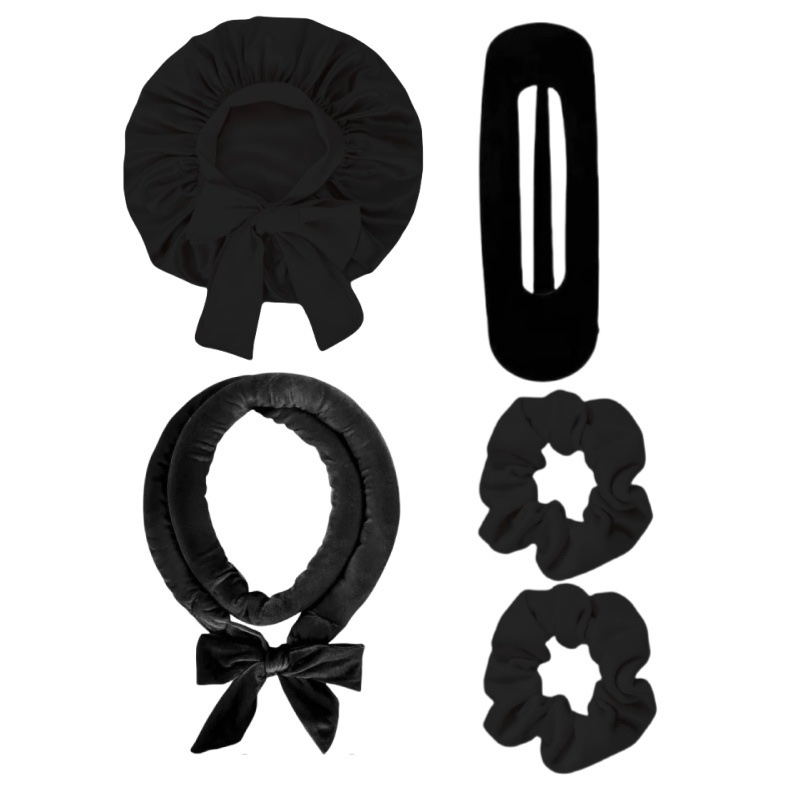
Long velvet heatless curling rod set with sleep cap
A wholesale set built around a long rod with a sleep cap, the format this guide is written to test. Confirm usable wrapping length, diameter and core material with the supplier before treating it as a match.
Card photo is the current listing image and may differ from the delivered set; confirm dimensions and contents on the live listing.
Material words to check before you print a claim
"Satin" describes a weave or finish, not a fibre. Silk satin and polyester satin are not interchangeable descriptions, and a listing that uses both is telling you the wording is loose.
Ask for fibre content by component — rod cover, sleep cap, ties — plus care instructions and any test record that supports a claim you intend to publish. Do not repeat "100% silk", "silk-like" or "damage-free" from a marketplace title unless the exact product and its evidence match. A heatless method avoids a heated barrel; that alone does not prove it prevents all breakage.
A buyer scorecard
Set pass conditions before you compare samples so the decision does not collapse into "works" or "doesn't work".
| Test area | What to record | Hold the sample if… |
|---|---|---|
| Fit profile | Hair length, texture, density, layers, target style | The test group does not match the claim |
| Working length | Usable span, end treatment, rod remaining | Hair enters the closure area or ends cannot secure |
| Diameter | Centre and end readings, loaded or unloaded | The sample compresses, kinks or varies visibly |
| Retention | Wrap method, shifting, end security, removal | It needs an undisclosed extra rod or workaround |
| Comfort | Pressure points, sleep position, removal feel | Repeated discomfort or an exposed core |
| Construction | Core, seams, cover, closures, accessories | Core migrates or components differ from the brief |
| Version | Item code, date, sample photos, supplier confirmation | The production version is unclear |
Send a supplier a precise sample request
A useful enquiry names the user, the style and the test conditions rather than asking for "good quality long curlers".
For example:
We are evaluating a heatless rod set for long, dense hair wrapped from a centre part for overnight use. Please confirm: exact item code and version; total length; usable wrapping length; diameter at three points; core material and construction; cover fibre content; seam and end design; included accessories; sample cost; MOQ; packaging; and production lead time. Please mark the usable span on a dimensioned photo. We will assess wrap capacity, end security, overnight comfort and construction against our brief before discussing quantity.
Change one meaningful feature at a time during the first comparison. If one sample is longer and also has a thicker core, a different fabric and a new closure, a better result tells you nothing about which change mattered. Compare stock items first; ask about custom changes once you know the gap. Ask too whether the sample is the current production build or a hand-finished prototype.
Approve the version, not the listing title
Keep a dated reference sample with its supplier, model, colour, dimensions, stated materials, packaging and test notes. Photograph it from the side and both ends.
If the listing changes, the supplier changes, or the factory substitutes a core or fabric, treat the replacement as a new sample. A saved product name is not version control.
Before a repeat order, compare the received unit with the approved reference: total and working length, diameter, seam placement, core feel, colour, accessories and package contents. Decide how many units to inspect based on order size and the cost of a mismatch. Photograph differences, record the lot reference, and ask the supplier to explain any change before accepting it.
Finally, keep the customer promise narrower than the test. If one rod was tested on waist-length, dense hair for one night, do not claim it works for every length or holds a curl all day. State the tested setup and describe only what your evidence supports — the dimensions, the closure type and the hair profile you tried. A narrow claim that survives a reorder is worth more than a dramatic one the next lot cannot defend.