For most healthy adults, an over-the-counter pair in the 15 to 20 mmHg range is the sensible starting point for long flights, desk days or shifts on your feet. Firmer pairs, 20 to 30 mmHg and above, are medical-grade and are better chosen with a pharmacist or clinician — particularly if you have swelling you cannot explain, diabetes, reduced feeling in your legs or any circulation problem. Whatever level you pick, the fit matters as much as the number: a pair that bunches, rolls or pinches can do more harm than none.
Listings blur three questions: why you want compression, whether it is safe for you, and which size delivers the pressure on the label. This guide takes them in that order and says where the evidence is thin. It is general information, not medical advice.
For the same "measurement beats label" approach applied to activewear, see sports bra fit; for washing anything elastic, the bra wash bag test.
What do compression socks actually do?
Cleveland Clinic describes graduated compression socks as applying the most pressure at the ankle, easing off higher up the leg, so blood is less likely to pool and fluid is helped back toward the heart. The clinic lists possible benefits as less swelling, relief for tired or heavy legs and a lower risk of clots, and notes they are a standard part of treatment for chronic venous insufficiency. The same page says they may also help people who sit for long periods, are pregnant, are on bed rest or stand all day.
Is there evidence they work — for flights, standing jobs and tired legs?
Flights: yes, with a limit on what the result means. A 2021 Cochrane review of randomised trials in passengers on flights of at least four hours found that wearing compression stockings cut symptomless deep vein thrombosis sharply: 3 of the people wearing them developed one, compared with 47 who did not, among 2,637 participants with follow-up data (odds ratio 0.10, high-certainty evidence). There was also moderate-certainty evidence that superficial vein thrombosis may be reduced, and weaker evidence of less leg swelling.
The limit is in what was measured. An American Family Physician summary of the review says it is unclear whether stockings prevent symptomatic DVT, pulmonary embolism or death, and reports that the ideal compression strength could not be determined: four trials used ankle pressures of 20 to 30 mmHg and five used over-the-counter strengths of 10 to 20. The same summary notes symptomatic clots after long-distance travel are rare — about 27 per million passengers within 14 days — and that the American Society of Hematology advises against routine use in low-risk travellers while supporting stockings for high-risk travellers on flights over four hours. It adds that the practice is unlikely to be harmful.
Standing and desk work: softer. Cleveland Clinic says compression socks may help muscles recover for people on their feet all day, and calls them not a magic bullet. We did not find a randomised trial in the sources we read that tests socks for a standing job specifically, so claims that science proves it should be read as plausible rather than established.
What do the mmHg numbers mean?
mmHg is millimetres of mercury, a unit of pressure, measured at the ankle. Sources group it into bands, and the bands differ slightly.
| Level | Cleveland Clinic | NATF / Vasculearn | Expert quoted by NBC Select |
|---|---|---|---|
| Mild | 8 to 15 | under 20 | 8 to 15: everyday wear |
| Moderate | 15 to 20 | under 20 | 15 to 20: standing or sitting all day |
| Firm | 20 to 30 | 20 to 30: most commonly prescribed | 20 to 30: usually recommended by a professional |
| Extra firm | 30 to 40, usually prescription | 30 to 40 | 30 to 40: only if a doctor prescribes it |
Where they agree is the useful part. Anything up to about 20 mmHg is normally sold over the counter for minor swelling and discomfort; 20 to 30 is the level most often prescribed for varicose veins or after a DVT; 30 and above is generally for more serious conditions under medical supervision. One sock brand says 20 to 30 mmHg can be bought without a prescription but is medical-grade and best discussed with a provider first, which matches the clinical pages.
A practical note from a podiatrist quoted by NBC Select: higher compression is harder to put on and take off, so mild to moderate pressure is a sensible middle ground for most people. If you cannot get a pair on easily, you will not wear it.
Which level should you start with?
Use the reason you are buying, not the highest number you can tolerate.
- Tired legs, an occasional long flight, a desk job: start at 15 to 20 mmHg. The Cochrane trials used 10 to 20 and 20 to 30 without being able to pick a winner, and that range is where the clinical and consumer pages converge for ordinary use.
- Standing all day: 15 to 20 is the common recommendation. One retail guide suggests 20 to 30 for roles of eight hours or more on your feet, but we found no independent source for that threshold, so ask a pharmacist if 15 to 20 is not enough.
- Visible varicose veins, recurring swelling or a past clot: this is a medical conversation. The 20 to 30 band is typical, but the choice should come from the person treating you.
- Higher-risk flights: the haematology society position described above is that stockings can be recommended for high-risk travellers. Whether you are high-risk is a question for your doctor.
If you are unsure, choose the lower band. Several sources point out that the sensible approach is to start gentle and adjust.
Who should not wear them, or should ask first?
This is the part marketing skips.
Cleveland Clinic says people with open wounds, skin infections or extremely fragile skin should avoid them. It says people with severe swelling — whether sudden and unexplained or from a condition such as heart failure or kidney disease — should ask a provider first. People with peripheral artery disease may benefit but should wear them only under medical supervision, and people with significantly reduced leg sensation, such as from diabetic neuropathy, need their risks and benefits weighed carefully.
The North American Thrombosis Forum, republishing Vasculearn Network material, lists severe peripheral artery disease and leg ulcers or wounds among reasons not to use them. NBC Select's experts add that older adults and anyone with chronic leg swelling should find the cause before starting, that people with blocked arteries or serious heart conditions should avoid them unless prescribed, and that pregnant people should check with their doctor. The same article says thigh-high and waist-high styles should be worn only under medical supervision.
There is some tension: the thrombosis forum lists pregnant women among people who may benefit, while NBC Select tells pregnant people to check first. These are compatible if read together — compression can be helpful in pregnancy, but it should be a decision made with your own clinician rather than from a shopping page.
Sudden, unexplained swelling is a symptom to get checked rather than something to cover with a sock.
How do you get the size right?
Sizing is where the printed pressure either holds up or falls apart. Sources disagree on method, so know the options.
Cleveland Clinic recommends being professionally measured and having a provider advise on the pressure level, and says a pharmacist or medical supply specialist can help if you do not want to measure yourself. The thrombosis forum says a healthcare provider can determine size and level for prescription stockings, with measurements potentially including ankle width, calf length and width, thigh width and overall leg length. NBC Select, by contrast, advises using the brand's own size chart, based on foot size, for over-the-counter pairs.
For an inexpensive light pair, the brand's chart is a reasonable start; for 20 mmHg or above, or unusually shaped legs, get measured. Either way:
- Measure in the morning, when swelling is lowest. Retail guides and the thrombosis forum all say to put them on first thing for the same reason.
- Closed-toe knee-highs distribute pressure most evenly, according to NBC Select, and ankle-length styles may leave the calf — where swelling often occurs — unsupported.
- Check calf width, not just shoe size. A pair that fits your foot but squeezes your calf is the classic mismatch. Some brands publish a calf range; use that kind of figure as a filter.
- Expect some initial awkwardness. The thrombosis forum says some soreness at first is normal and should fade if the stockings fit properly.
How long do they last, and how do you care for them?
The sources disagree, so treat any number as a guide. The thrombosis forum suggests replacing stockings every five to six months and owning more than one pair. A health-information site suggests washing by hand or on a gentle cycle inside a mesh bag to preserve compression. NBC Select gives no schedule at all and only mentions that some pairs lasted several years in a reviewer's use — an anecdote, not a durability test. If your socks have gone baggy, lost their grip at the top or no longer feel snug, they are no longer delivering the pressure on the label, whatever their age.
How long should you wear them, and can you sleep in them?
Cleveland Clinic says to put them on in the morning before swelling starts and take them off at bedtime or after exercise, and that sleeping in them is generally not recommended apart from an occasional nap. NBC Select goes further: six to eight hours a day is sufficient for most people, longer wear is for medically supervised cases, and you should not wear them to sleep because swelling naturally drops when you lie down. Both are rules of thumb, not trial-derived limits.
Putting them on is easier with a technique: sit with your back supported, turn most of the sock inside out, slip your toes into the toe pocket and roll the fabric up your leg, with rubber gloves for grip.
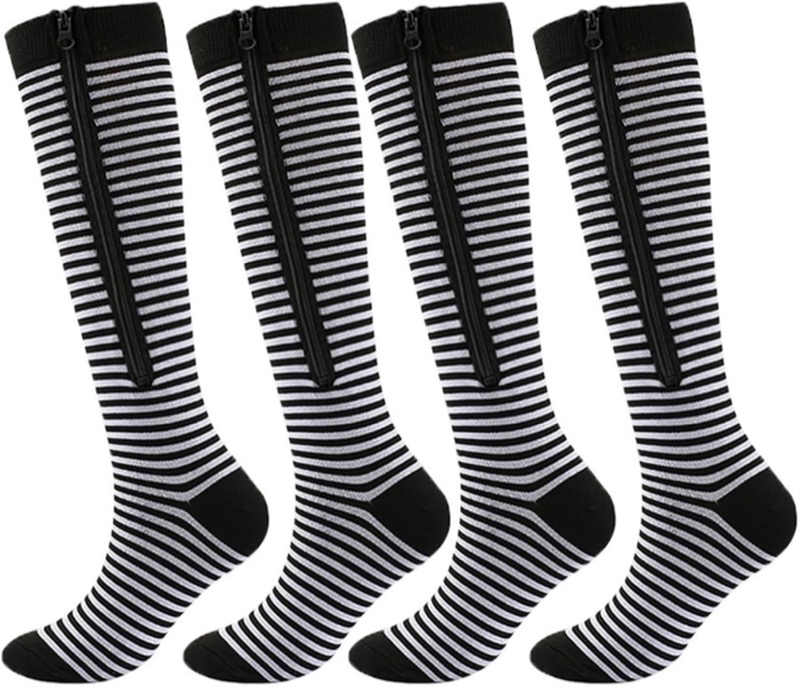
Zipper knee-high socks, 15–20 mmHg
A retail example from the over-the-counter band, with a zip down the side. The zip is the answer to the most common practical complaint — getting them on — and also an extra seam to check for pressure and rubbing.
What are the warning signs to stop?
Cleveland Clinic's list is clear: remove the socks if they feel uncomfortably tight, or you notice pain, numbness, tingling, skin discolouration or damage, or worsening swelling, and contact a provider, who can tell whether there is a medical problem or you simply need another size. The thrombosis forum gives numbness, significant pain and discolouration as reasons to call your doctor. NBC Select adds that leg pain during running or exercise can signal compartment syndrome and calls for prompt medical attention.
What should you check on the listing before you buy?
- The mmHg range, as a number, not "gentle" or "firm". If it only says "graduated", you cannot compare.
- Where the pressure is measured. It should be the ankle. A listing that does not say is hiding something.
- A size chart that includes calf circumference, not only shoe size.
- Closed or open toe, and length. Knee-high is the common default.
- Material and care instructions. If you have sensitive skin, check the fibre content; the clinical pages do not name a best fabric, so do not trust a listing that does.
- Return policy. Fit is hard to judge on paper.
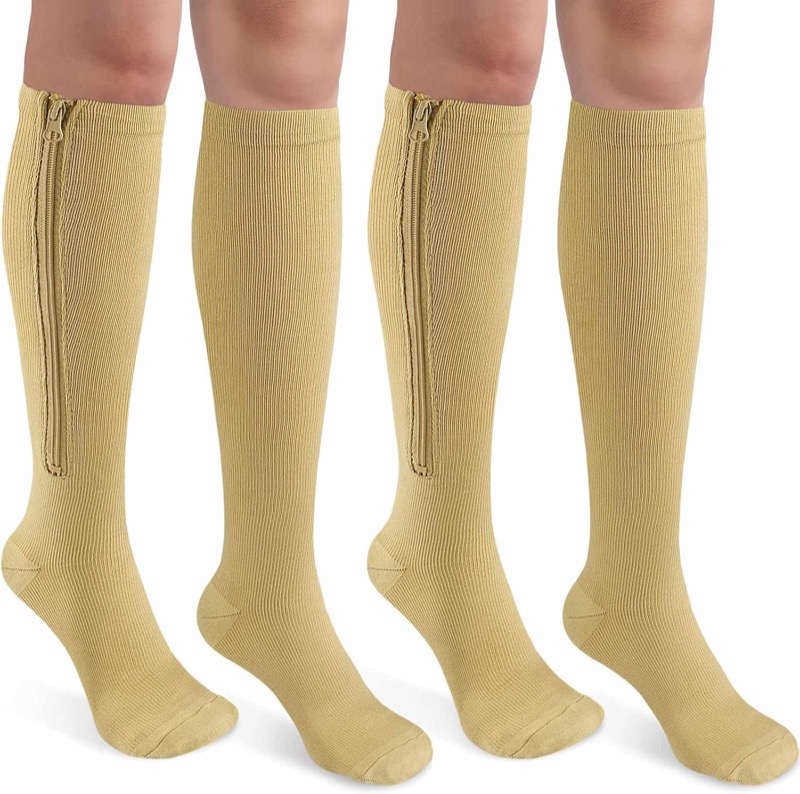
Two-pair compression socks, 15–20 mmHg
A two-pair pack in the same pressure band. Owning two is what the replacement guidance assumes — you wear one while the other washes, and the compression survives fewer hot cycles if you alternate.
If you sell compression socks, what should the listing say
Safe to print, if true:
- "15–20 mmHg graduated compression, measured at the ankle" — the level and the measurement point in one line.
- "Fits calf 11–15 in; ankle [x] in" — the two measurements that decide whether the pressure arrives.
- "Knee-high, closed toe, [x] % nylon / [y] % spandex."
- "Put on in the morning; remove at bedtime."
- "Do not use if you have severe peripheral artery disease, open wounds, infected or fragile skin, or unexplained swelling without medical advice."
Avoid: "medical grade" on a 15–20 pair, "prevents DVT", "cures varicose veins", "improves circulation" as an unqualified outcome, "one size fits most", and any claim that a pair is safe for everyone. The contraindications list is short, cheap to print, and the single most responsible thing a listing can carry.
Frequently asked questions
Are compression socks and flight socks the same thing? Often the same kind of product. The Cochrane review calls them compression stockings or flight socks and tested graduated compression worn throughout a flight. Anti-embolism stockings, by contrast, are mainly for people confined to bed after surgery, with generally lighter and more even pressure.
Can I wear them every day? For most people without a contraindication, daytime wear is common. One brand's medically reviewed guide says it is safe for most people provided they do not bunch or fold. Treat that as a brand view and use the warning signs above.
Are they safe in pregnancy? Some sources list pregnancy as a use; NBC Select says to check with your doctor first. Do the latter.
What if 15–20 is not enough for my standing shift? Ask a pharmacist before moving to 20–30; that band is medical-grade, and the choice should come from someone who knows your history.
Can I sleep in them? The clinical advice is no, apart from an occasional nap: swelling drops when you lie down, and a pad you cannot see under the covers is a poor way to notice a problem.
How tight should they feel? Firm and even, with no bunching or rolling at the ankle or behind the knee. Pain, numbness or tingling means take them off and get advice.