A printed mailer box is worth ordering only after the thing inside it is settled. For a small brand selling press-on nail sets, bonnets, scrunchies or wig accessories, the mailer is often the largest piece of packaging in the order and one of the bigger drivers of shipping cost.
The reliable order of decisions is: measure the packed retail item, choose the smallest box style that protects it, match the board to how the parcel travels, let the quantity you can actually use choose the print method, and only then compare suppliers. Reversing that order — picking a finish, a supplier or a quantity because the unit price looks good — is where most first packaging orders lose money.
This guide is about the outer mailer: the corrugated box the carrier handles and the customer opens. The retail box, tray or bag inside is a separate decision; if you have not settled that yet, start with the packaging fit check for the retail pack.
The decision order that keeps costs under control
Every line on a mailer quote affects the others:
- Internal dimensions set the board area, the carrier's billable weight and how many flat boxes fit in a carton.
- Box style decides how it closes, whether it needs tape, and how it presents when opened.
- Board — flute and liner — sets protection, print surface, thickness and weight.
- Print method is mostly determined by quantity and by how strict your brand colours are.
- Quantity trades a lower unit price against cash, storage and the risk that your design changes.
- Supplier route — domestic on-demand or an overseas factory — trades price against lead time, minimums and import handling.
- Shipping terms and order protection decide who pays freight, who carries risk, and what happens if the order arrives wrong.
A decision made for a 50-box digital run often does not survive a move to a 1,000-box factory order, so re-check the earlier answers before you commit to quantity.
Size the mailer around the packed retail item
Custom box sizes are quoted as internal dimensions, normally length × width × depth. Lay the item out exactly as it will sit in the box before measuring.
For a beauty brand, "the item" is rarely the bare product. It is the retail box, card or bag plus anything else shipping in the same order: an instruction card, a thank-you note, a sample sachet, tissue. A press-on set in a magnetic box, a folded bonnet in a printed pouch and a wig grip in a polybag each have different packed shapes. Measure the largest version you will ship in each direction — the deepest retail box, the widest pouch, the order with the most inserts — not the hero SKU in the product photo.
Then add clearance. Published rules differ because they describe different packing styles:
- Snug, no filler: about 0.25 in (roughly 6 mm) per side, or 1/8–1/4 in. This suits a rigid retail box that should not slide.
- Padded with tissue or crinkle paper: measure the product including the tissue and padding, then add 15–25 mm per side.
Neither rule is wrong. Decide first whether the retail box is doing the protecting or whether filler in the mailer is, then use the matching rule. A loose retail box sliding inside an oversized mailer is the most common reason corners dent in transit.
Label every dimension explicitly. Some suppliers write width before length, and a full run of cartons has been produced in the wrong orientation because the numbers were listed in a different order than the factory assumed. Write "L = side with the lid hinge, 210 mm" rather than relying on the order of three numbers.
Internal and external sizes are different numbers
You order the box by its inside; the carrier bills it by its outside. Board thickness and folded panels push the external size up by roughly 0.19–0.25 in per edge, depending on board and construction. Ask every supplier for both numbers on the quote, then measure the external size of your own sample.
Why a quarter inch can change the shipping bill
Parcel carriers charge the greater of actual weight and dimensional (DIM) weight: length × width × height divided by a carrier divisor. Light, bulky parcels — which describes many bonnet, scrunchie and nail-set orders — are exactly the ones billed on DIM weight.
US domestic daily rates on the major carriers have used a divisor of 139; retail pricing has used 166, and a lower divisor produces a higher billable weight. USPS moved to 139 and now applies dimensional pricing only to packages over one cubic foot, with every fractional inch rounding up, so a 14.1 in side counts as 15 in. Carrier rules change often, so check the current price list before building a cost model.
Two worked examples, illustrating the formula rather than quoting anything:
- A mailer measuring 12 × 9 × 4 in outside is 432 cubic inches. At a 139 divisor that is about 3.1 lb, which rounds up to 4 lb. Grow it to 13 × 10 × 5 in and it is 650 cubic inches, about 4.7 lb, rounded to 5 lb. If the packed order weighs 1 lb, you are billed on 4 lb or 5 lb.
- Under the USPS cubic-foot threshold, both of those boxes are billed on actual weight. A 14 × 11 × 12 in mailer (1,848 cubic inches) crosses the threshold and is billed at about 13.3 lb, rounded to 14 lb, whatever is inside.
The practical rule: design to the smallest external size that protects the packed item, check which carrier you mainly use, and test whether a slightly smaller box drops below a rounding step. Because rounding is per pound, trimming half an inch can matter on one size and do nothing on another, so run your own numbers.
Is a printed mailer worth the premium?
One supplier estimates a printed mailer costs roughly $0.50–3.00 more per unit than a comparable plain mailer at 1,000-piece quantities. Treat that as one supplier's range, not a market price: it moves with size, board, print and freight. Printed mailers make most sense where unboxing is part of the product — subscription and direct-to-consumer brands, gift, beauty and apparel items, products customers photograph.
For a beauty brand that covers a lot of orders, but not all of them. A reorder of single-size nail tips, a replacement wig grip or a refill pack of adhesive tabs is a replenishment purchase; the customer already knows the brand. A plain mailer with a printed sticker protects margin there.
A useful test: divide the extra cost per box by your average order value. If the premium is a large share of a small order, start with stock boxes and a branded label, and print mailers once repeat orders justify them.
Choose the board: E-flute or B-flute
Corrugated board is two flat liners with a wavy fluted layer glued between them. For mailers the choice is almost always E-flute or B-flute.
| E-flute | B-flute | |
|---|---|---|
| Typical thickness | about 1.0–1.6 mm | about 2.5–3.0 mm |
| Print surface | flatter, finer detail | good; slight texture can show |
| Cushioning and crush resistance | lower | higher |
| Folded edges | crisper corners | slightly softer corners |
| Weight and bulk | lighter, slimmer | heavier, thicker |
Thickness figures vary by mill and liner, so confirm with your supplier.
Suppliers' defaults genuinely differ: some use E-flute as their standard mailer board, others call B-flute the practical standard. The disagreement is mostly about what each assumes you ship. Decide by these conditions:
- Box size. E-flute's crush resistance falls off as boxes get larger; larger mailers benefit from B-flute.
- Shipping alone or inside another carton. A mailer travelling on its own through a parcel network may want B-flute; one packed inside an outer carton can often use E-flute.
- What is inside. Soft goods — folded bonnets, scrunchies, satin pillowcases — tolerate a light board. A rigid nail-set box with sharp corners gains more from B-flute's cushioning. Heavy orders may need a double-wall board.
- Print expectations. If razor-sharp corners and a flat surface are central to the look, E-flute has the edge; on a white liner the print difference between E and B is visible only up close.
Kraft or white liner
The outer liner changes colour more than most first-time buyers expect. Brown kraft shows the paper grain and gives a warmer, darker ink tone; on uncoated kraft the ink is absorbed into the material rather than sitting on top. Pale pinks, lilacs and soft neutrals — common in beauty branding — are the colours that shift most.
Either print on white, or approve a physical sample on the actual kraft board before ordering. Liner weight in gsm also changes performance: heavier liners improve compression and puncture resistance. Suppliers usually standardise the liner per flute at consumer quantities, so you rarely need to specify it — but ask what it is and write it on the order, so a reorder does not arrive on lighter board.
ECT, Mullen and the stamp on the flap
Two strength ratings appear on box specifications:
- Edge Crush Test (ECT) measures edgewise compression resistance, which relates to stacking strength, quoted like "32 ECT".
- Mullen or burst test measures the pressure needed to rupture the board face, which relates to puncture resistance, quoted like "200 lb".
An ECT-rated box usually weighs less than a Mullen-rated box of equivalent strength because it uses less material. The box maker's certificate printed on a flap is where the official rating appears.
For a light beauty order, fit and closure matter more than a high rating. A box that is too large lets the product move even when the board is strong enough, and overspecifying board adds material, cube and cost without reducing damage. Note too that a mailer's four-flap lid compresses more easily than the top of a slotted carton, so mailers have lower pallet-stacking strength: keep flat mailers in their export cartons and assemble them at the packing bench.
Choose the print method by quantity and colour
Three print routes cover most mailer orders, and their setup costs are why print method and minimum order quantity are tied together.
- Digital prints straight from the file with no plates, which removes upfront setup cost and can bring minimums down to 10–50 boxes. Unit prices stay roughly flat as quantity rises, so it gets expensive at volume, and colour is built from CMYK dots.
- Flexographic prints directly onto corrugated board with flexible plates; typical minimums are 250–500 boxes because of plate setup. Best for one- or two-colour logos on kraft or white board at moderate volume, with less fine detail than offset.
- Offset litho with lamination prints the design on a smooth sheet, then laminates and mounts it onto the board. Sharp images, accurate colour and premium finishes — but minimums of several thousand units are common, though some factories accept smaller litho-lam runs.
CMYK or Pantone. CMYK builds every colour from four inks; Pantone uses a pre-mixed ink for one exact colour. CMYK handles images and gradients, spot colour gives repeatable brand colour, and many designs combine the two. If your logo pink has to match your nail cards, your website and last season's boxes, specify the Pantone reference and ask whether the chosen route can hit it.
One sampling trap: digital samples print in CMYK only, so a digital proof will not show a Pantone colour accurately even if production will use spot ink. Approve colour on a press proof or pre-production sample.
Prepare artwork the factory can print
Factories print onto a dieline, the flat outline showing cut lines, folds and glue areas. Design on the supplier's dieline for your exact size and style, not a generic template.
- Bleed: extend backgrounds about 1/8 in (3 mm) beyond the cut line so a small cutting shift does not leave white slivers.
- Safe zone: keep text and logos at least 1/8 in inside both cut lines and fold lines; artwork near a fold can land on the crease.
- Resolution and colour: images at 100% size and at least 300 DPI, files in CMYK with any Pantone swatches named.
- Format: vector files with fonts outlined.
Before approving, print the flat proof at 100%, cut it out and fold it. Panels that read upside down and logos that land across a fold are far easier to catch on paper than on screen.
How many to order: reading the MOQ honestly
A supplier's MOQ is the smallest order they will accept, not the right order size for you. A lower unit price at higher volume only saves money if you use the boxes before your packaging changes. Base the decision on four numbers:
- Monthly usage — orders shipped per month, plus a margin for damaged or misprinted boxes.
- Months of cover — how long until you expect to change the design, size or range.
- Storage — ask for carton count and carton dimensions, and check them against your shelf or your 3PL's rates.
- Cost per usable box — unit price plus tooling, freight, duty and storage, divided by the boxes you will actually use.
As a hypothetical: if a 1,000-box order has a lower unit price than a 300-box order, but you ship 50 orders a month and plan a rebrand within a year, about 400 of the 1,000 boxes will never be used. Divide the larger order's total cost by 600 usable boxes before comparing.
Beauty brands face a specific version of this risk: a new collection, a new nail length or a new bonnet size can change the packed dimensions. While the range is still moving, custom labels or stickers on plain stock boxes are the cheaper path.
Domestic on-demand or a factory overseas
Both routes are legitimate, and many brands use both: on-demand for early runs, a factory once the box is stable.
- On-demand: very low minimums with digital print, higher unit price at volume, domestic lead times, standard options, fast reprints, no import handling.
- Overseas factory: higher minimums, lower unit price before freight and duty, sampling plus production plus international freight and customs, more options and more back-and-forth, and each change may mean a new sample and another freight leg.
The unit price on an overseas quote is not your cost. Compare suppliers on landed cost per usable box: product cost, tooling and plates, samples, international freight, insurance, duties and import fees, brokerage, and delivery to you or your 3PL — divided by the boxes you will actually use.
Flat mailers are light but bulky, so freight is priced on volume as much as weight. Ask for boxes per export carton, carton size and carton gross weight, and give those to your forwarder before choosing air or sea.
US import note: small shipments no longer clear duty-free. The US suspended de minimis treatment for imports from all countries from August 2025 and has since continued and formalised the suspension with a new informal entry process for postal shipments. Even a sample shipment may need entry processing and duty, and duty rates on paper packaging have changed repeatedly — ask a licensed customs broker or your forwarder to confirm current treatment and classification. This guide deliberately gives no duty rate.
Choose the box style
Packaging suppliers describe structures with FEFCO codes. A code has four digits: the first two give the category and the last two the design. It describes the shape only — size, board and print are specified separately.
The box most brands mean by "mailer box" is FEFCO 0427: one die-cut piece of corrugated board with a hinged lid, folded side walls and tuck flaps that lock without tape. Related styles you may see quoted:
- FEFCO 0421, a die-cut mailer with a tuck top; the top can leave small gaps at the sides, so 0427 is the safer choice when the box ships on its own.
- A side-load corrugated mailer, a cheaper flat-folding box sealed with one strip of tape — right for replenishment items where presentation is not the point.
- FEFCO 0201, the standard slotted shipping carton: useful as an outer carton for several mailers, not as a presentation box.
Options that change the price of an 0427 quote include a peel-and-seal adhesive strip (a second strip helps customers return items), a tear strip, inside print and an insert.
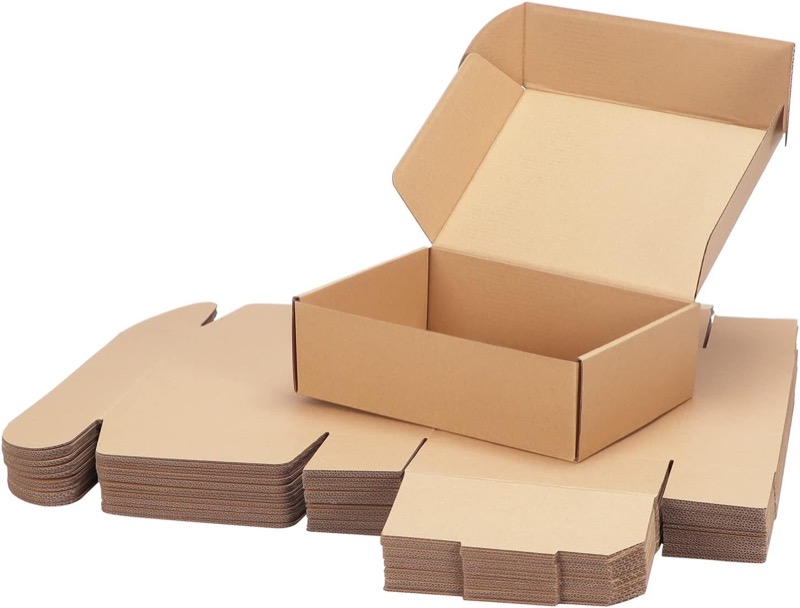
Plain corrugated shipping boxes, 25-pack, 10 × 7 × 3 in
A cheap way to test a packed size while your range is still moving, before you pay for custom printing. It is not a custom mailer — check the listing's internal dimensions and board against your own packed item.
Send the same request to every supplier
Quotes are comparable only if every supplier prices the same thing. A practical request for a beauty mailer:
- Style: FEFCO 0427 mailer, tuck front, no tape
- Internal size: L × W × D in mm, with the length defined
- Packed item: retail box or pouch dimensions, plus inserts
- Board: flute, outer liner white or kraft, liner gsm
- Outside print: CMYK plus Pantone reference for the logo, and the method (digital / flexo / litho-lam)
- Inside print: none / one colour / CMYK
- Finish: matte, gloss, foil, spot UV
- Extras: peel-and-seal strip, tear strip, insert
- Quantities: quote at two or three volumes
- Samples: structural and pre-production, with cost and whether it is credited against the order
- Packing: boxes per export carton, carton size, gross weight
- Lead time: production days after sample approval
- Price terms: EXW / FOB named port / DDP named address, Incoterms 2020
- Payment: on-platform with buyer protection if you use a marketplace
Ask each supplier to flag anything they would change and why. A supplier that suggests a different flute or a slightly different size to fit existing tooling is giving you useful information. One that quotes without a single question about what goes inside the box may not have read the brief.
Protect the order: platform terms and Incoterms
If you buy through a marketplace with buyer protection, that protection depends on what the order says. Record measurable details — specifications, quantity, unit price, quality standards or a referenced sample, packaging and labelling, and the delivery deadline — in the order before paying, and keep payment and communication on the platform. Payments made outside it usually void the protection, and coverage limits are set per supplier, so check that your order value sits inside the limit.
Inspection windows are short and often require action soon after the goods clear customs, and pre-shipment inspection is frequently optional — it has to be enabled when you place the order. Confirm the terms shown on your own order, because they change.
On terms: EXW means the supplier makes the goods available at its premises and you arrange everything after that, including export clearance. FOB means the supplier loads the goods at the named port and risk passes once they are on board. DDP means the supplier delivers duty paid — simple, but ask who the importer of record will be, because informal customs arrangements can create compliance problems for the buyer.
Always write the named place — "FOB Ningbo, Incoterms 2020" — and compare suppliers on the same term. Otherwise the cheaper quote may simply exclude costs the other includes.
Samples: what each type proves
| Sample type | What it is | What it proves | What it cannot prove |
|---|---|---|---|
| Structural / white sample | Unprinted box in your size and board | Fit, closure, board feel | Colour, print alignment, finishes |
| Digital print proof | Flat print of the artwork, usually CMYK | Layout, text, rough colour | Pantone accuracy, finishes, folded alignment |
| Pre-production sample | A 1:1 box made the production way | Colour, finish, alignment | Consistency across the full run |
Sample prices vary widely by supplier; many factories credit sample costs against a later order — ask, and get it in writing.
A sensible sequence is a structural sample first, because size is the costliest thing to change, then a pre-production sample once artwork is final. Pack the sample with the real retail item, filler and inserts; close it, open it, photograph each step. Keep the approved pre-production sample as your reference and name it in the order terms.
Test the box before ordering thousands
Pack the sample as a real order, drop it from waist height onto each face and corner, shake it, and leave something heavy on top overnight. If the retail box moves, the size or filler is wrong. If corners crush, consider B-flute or a heavier liner. If the lid pops open, the tuck flaps or dimensions need adjusting.
A home test is not a certification. The industry reference for parcel shipments is ISTA 3A, a general simulation test for individual packaged products up to 70 kg sent through parcel networks: atmospheric preconditioning, drops whose height depends on package weight, random vibration with and without top load, then a further drop sequence. One sample is enough for compliance, though several are recommended for design decisions.
A lab test earns its cost when a retailer requires it, when the product is expensive enough that a few per cent damage outweighs the fee, or before a large run. For light, robust items in a first 300-box order, a careful home test plus a pre-production sample is proportionate.
Sustainability claims: print only what you can show
Many beauty brands want an FSC logo or a recycled claim on the box. The Forest Stewardship Council uses three on-product labels: FSC 100% (all forest-based material from certified forests), FSC Mix (certified forests, verified recycled sources or controlled wood, with a minimum certified/recycled share) and FSC Recycled (all material verified recycled).
An FSC label can only be applied under a valid FSC certificate. A certified supplier does not automatically make your order certified, and you cannot add the logo to your own artwork. Ask for the supplier's certificate code, confirm in writing that your order will be produced and invoiced under it, and let the supplier apply the label as part of their artwork check. If they cannot confirm it, leave the logo off and describe the material plainly.
Common failure modes
- The mailer is slightly too big. The retail box slides, corners dent, DIM weight rises. Measure as packed and approve a structural sample with the real item.
- Colours come back darker than the screen. Usually kraft absorption, RGB files, or colour approved on a digital proof. Print on white, supply CMYK with named Pantone swatches, approve on a pre-production sample.
- Text lands on a fold or is trimmed. Design on the supplier's dieline, keep the 1/8 in safe zone from both cut and fold lines, and fold a paper proof.
- The reorder does not match the first order. Board, liner or ink drift between runs — record flute, liner gsm, Pantone references and lamination in the order, keep the reference sample, and send a photo of it with every reorder.
- The landed cost is far above the quote. Freight, duty, brokerage and samples were left out.
- Boxes crush in storage. Mailers are not built for high pallet stacks; keep flat boxes in their export cartons.
Pre-order checklist
- Packed retail item measured, largest version included
- Internal dimensions labelled L, W, D; external dimensions confirmed
- Box style and closure options agreed
- Flute, liner colour and liner weight written into the order
- Print method, CMYK and Pantone references, finishes listed
- Artwork on the supplier's dieline with bleed and safe zone
- Structural sample approved with the real item
- Pre-production sample approved and named as the reference
- Quantity based on usage and months of cover, not the MOQ
- Carton count, carton size and gross weight on the quote
- Incoterms rule with named place agreed
- Landed cost estimated, including freight, duty and brokerage
- Payment on-platform, inside the supplier's coverage limit
- Inspection plan for the delivery window
Questions small brands ask
Can I order fewer than 100 custom mailer boxes? Yes, usually through digital printing — some services accept 10, and 25–50 is a common digital minimum. Expect a higher unit price and CMYK colour rather than spot ink.
How long does an order take? On-demand services quote production plus domestic delivery. A factory order adds sampling rounds, production and international freight and customs. Ask for production days counted from sample approval.
Is kraft cheaper than white board? Often, but not always, and the bigger difference is appearance: kraft absorbs ink, so colours print warmer and darker — a real issue for pastel palettes.
Do I need a 32 ECT box? Not necessarily. ECT matters most for cartons stacked in storage and freight. For a light order shipped individually in a well-fitted mailer, fit, closure and flute choice matter more.