If your press-on fits before application but looks raised once you add an adhesive tab, check the tab before buying a larger nail. Its footprint, placement, and thickness all deserve attention. A wider press-on might hide an exposed edge while creating a new fitting problem. Start with the nail that fits, then establish whether the replacement adhesive works with it.
This matters when the original tabs run out. A refill sheet can look almost identical to the one in your kit yet contain different shapes or a different adhesive layer. The useful purchase is a repeatable match for your manicure, rather than the largest packet you can find.
Establish what changed after the dry fit
Select the intended press-on size without adhesive, following the nail maker's fitting directions. Check the side coverage and look at the profile. It should occupy its intended position without being forced flat. Keep a note of the finger and nail number before trying any refill tabs.
If the piece already rocks, pinches, or leaves an obvious gap, investigate the nail fit first. A tab is another component in the assembly; choosing a thicker one does not establish that an unsuitable nail shape has become suitable. Our guide to flat nail beds and the C-curve covers that separate fitting question.
The distinction appears in a community discussion about tabs and sizing. One wearer reports that adding tabs raises the press-on enough to reveal the natural nail and wonders whether to size up. That is a useful description of the problem, but the discussion does not establish a universal correction for every nail and adhesive combination.
Separate three observations: the plastic tip's coverage, the adhesive's boundary, and the height of the finished assembly. Exposed natural nail, exposed sticky material, and a raised profile are different findings. Photographing the same finger from above and from the side makes it easier to describe which one you have.
Choose the tab independently of the nail number
The number printed on a tab sheet identifies a position in that assortment. Do not assume it corresponds to a nail number from another brand. Your size 6 press-on may need a tab with a different label, and the correct selection may change when you switch refill products.
While the protective liners remain in place, compare candidate outlines with the natural nail. Look at length as well as width. A tab can appear suitable across the middle yet extend beyond a short nail or crowd the cuticle end. Check both hands rather than assuming that matching fingers require identical pieces.
Common tab application instructions specify a tab that stays off the skin and cuticle, and describe using a slightly smaller option to avoid excess at the edges. Use that as guidance for the product described, while checking the directions supplied with your own refill.
Do not compensate by choosing a tiny central patch with little contact area. Aim for the coverage the manufacturer specifies, contained within the intended nail surface. If every available option is either too large or markedly undersized, the assortment may be wrong for you.
Where trimming is expressly supported, follow the maker's method. Otherwise, ask before cutting or stretching a tab to invent another size. A refill that requires complicated adjustment on every finger is worth comparing with a better-shaped assortment before you reorder it.
Read a thickness claim carefully
Descriptions such as thin, jelly, and upgraded do not provide a common measurement standard. A stated 0.3 mm is more specific, but it still leaves questions. Does the number describe the adhesive alone or the sheet with its liners? How was a compressible material measured? Does the statement apply to the exact variant in your basket?
Unless the seller explains those points, treat the figure as a nominal listing specification. It cannot tell you exactly how high the finished manicure will sit. Press-on construction, the underlying fit, placement, and the way the product is applied still matter.
Do not calculate a new nail size from the advertised tab thickness. There is no verified conversion here from an extra fraction of a millimeter under the nail to a different width number. Check the assembled result instead, using the fitting and application instructions for the products involved.
For a small brand comparing samples, ordinary calipers can compress a soft tab and include its liners. A reading obtained that way should not be presented as a precise adhesive-layer thickness. Ask the supplier for its measurement method and tolerance, and retain the supplied specification alongside your own practical fit observations.
Follow one complete application method
Keep the refill's directions and the press-on maker's compatibility guidance together. Establish which surface receives the tab, when the liner comes off, how the nail is positioned, and how long it should be held. Do that before exposing ten sticky pieces on the table.
For example, the Olive & June Super Stick refill instructions connect tab selection to its wheel system and specify holding the applied press-on for 30 seconds. That is an instruction for that system, rather than a pressure or timing rule for every generic sheet.
A demonstration of Super Stick tabs with the same brand's Instant Mani nails is also useful because it shows a named combination. A tutorial's product identity matters: copying one motion from a video while substituting its adhesive may not reproduce the same result.
Online advice sometimes adds heat, another adhesive layer, or liquid glue around a tab. Only use such a combination when the relevant manufacturers support it and provide directions, including removal. Otherwise you have changed the adhesive system while trying to diagnose it.
An adhesive tab also differs from a UV-curable gel. Do not add a curing step simply because a listing calls the tab jelly or gel-like. Product terminology is not an instruction to place your hand under a lamp.
Check the result before repeating it across ten fingers
After confirming compatibility, try the chosen combination on one suitable finger as directed. Look for adhesive extending beyond the intended area, folds, or a conspicuously different seated position from the dry fit. Avoid repeatedly lifting and reseating the same exposed tab as though each attempt were a fresh comparison.
| Observation | Check next | Purchase implication |
|---|---|---|
| Adhesive extends onto skin | Outline, length, and placement | A different tab size or shape may be needed |
| Tip looked wrong before adhesive | Width and curvature of the press-on | Resolve nail fit before buying another refill |
| Position changes only after adding the tab | Tab placement and the assembled profile | Compare another compatible refill before changing nail size |
| One tab size empties first | Number of that size used per manicure | Compare usable sets rather than total pieces |
If an application is uncomfortable, stop the trial and follow the appropriate removal guidance. Do not use extra pressure to make an unsuitable combination look flatter. A comparison should not require enduring a poor fit.
For removal, retain the directions for both components. Being able to reuse a plastic press-on does not mean its worn adhesive tab is reusable. Use fresh tabs when the product calls for them, and inspect any nail intended for another wear according to its maker's guidance.
Retail and sourcing references
The following links are retail references for the refill formats discussed above. We may earn a commission from qualifying purchases through these links. Neither is an independently tested recommendation for your hands, and their catalog descriptions do not establish identical adhesive performance. Confirm the exact pack, the size layout and compatibility on the live page before ordering.
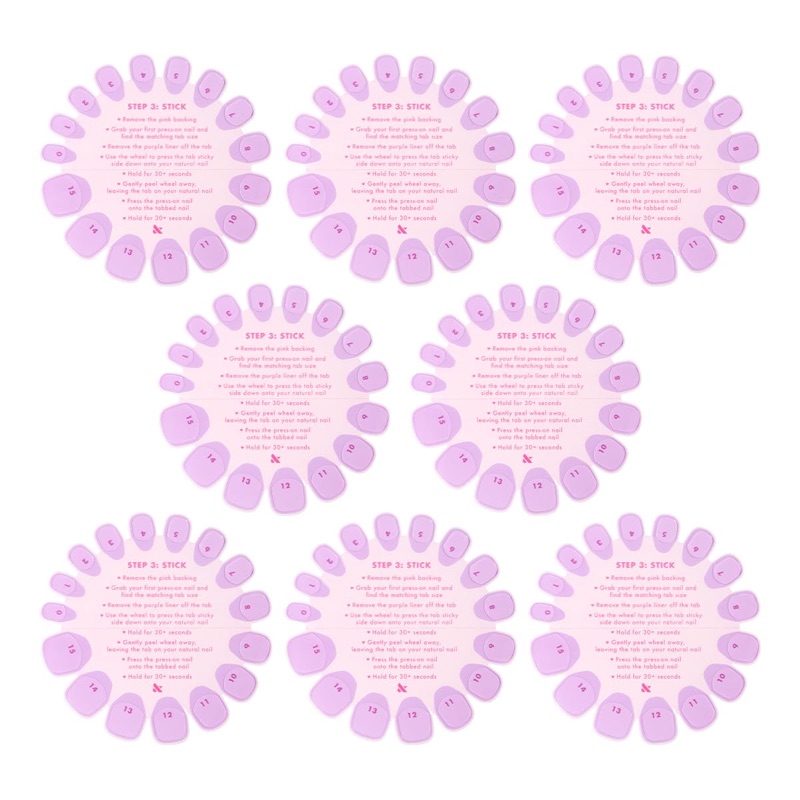
Super Stick press-on nail adhesive tabs, wheel set
A tab-wheel set designed around one brand's own press-on sizing and documented application method. A logical refill to check if you already use those nails and want to keep the same system — confirm the exact pack and compatibility before ordering.
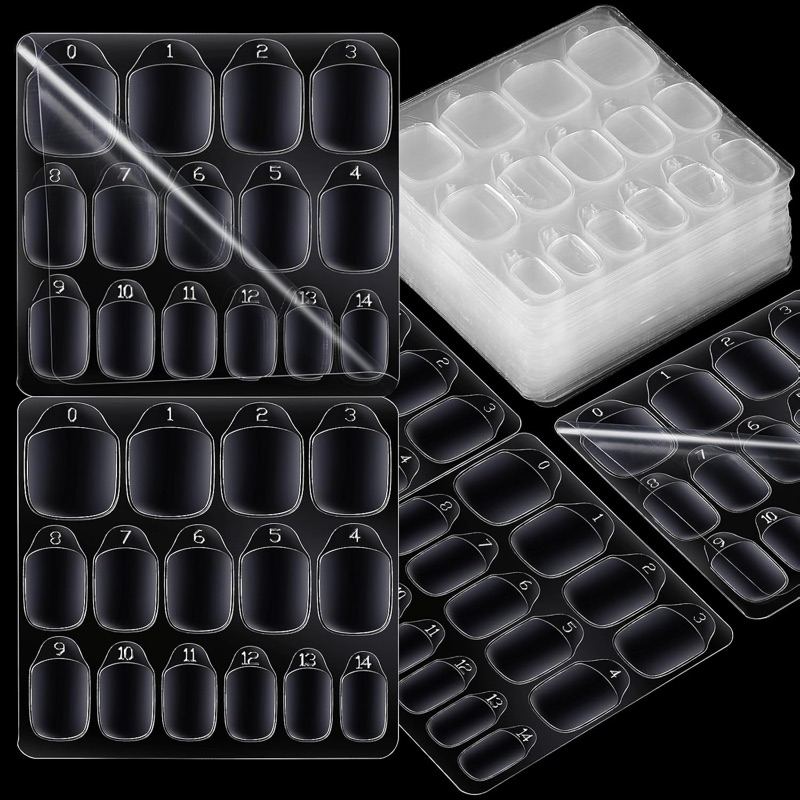
Press-on adhesive tabs, 600 pc across 15 sizes
A forty-sheet pack listed at 600 tabs across fifteen numbered sizes with a nominal thickness of about 0.3 mm. A sheet format to compare when you need more outline choices — fifteen sizes do not guarantee that the widths and lengths you need are included.
Card photos are the current marketplace listing images and may differ from the delivered product; confirm details on the live listing.
Count complete manicures before comparing packet prices
Total pieces can exaggerate useful stock when several fingers need the same tab size. Count the tabs required for your ten fingers, then compare that demand with the number of each usable size in the packet. The first size to run out limits the number of complete manicures.
Consider a fictional six-sheet pack. Each sheet contains two tabs in each of twelve sizes, giving 144 pieces overall. Your fitting record requires four tabs of one size and two each of three other sizes for a complete manicure. The packet supplies twelve of every size.
You can make three complete manicures before the most-used size is exhausted. Dividing 144 by ten would suggest fourteen, which ignores the assortment. This example assumes you cannot substitute or trim the remaining sizes and that no tabs are lost during application. It is an inventory calculation, not a prediction of wear time.
If that example packet cost $6 delivered, the cost would be $2 per complete manicure under those assumptions. Both the price and the assortment are illustrative. For a real purchase, use the delivered total and your own size requirements, allowing for any application losses you have actually observed.
Recount when changing nail styles or refill brands. You may be able to use different sizes, but that needs another fitting check. An old record is useful only when it identifies the products it describes.
Check the unit advertised on the pack too. A seller may count individual adhesive pieces, complete sheets, or circular wheels. A photograph of several stacked sheets cannot establish how many tabs of your most-used size arrive. Ask for a photograph of one complete sheet and the quantity of each size per pack. That answer makes the cost comparison possible without relying on the headline piece count.
Compare a matched refill with a numbered sheet
Two retail formats are worth considering for different starting points. Neither is an independently tested recommendation for your hands, and their catalog descriptions do not establish identical adhesive performance.
The Super Stick Adhesive Tabs Set is listed as eight tab wheels designed around the brand's press-on sizing, and its own site also identifies use with its Instant Mani press-ons. This is a logical refill to check if you already use those products and want to retain their documented application method.
The Teenitor forty-sheet adhesive tab pack lists 600 tabs across fifteen numbered sizes and a nominal thickness of about 0.3 mm. It provides a sheet format to compare when you need more outline choices. Fifteen sizes do not guarantee that the particular widths and lengths you need are included; examine the assortment and ask for dimensions where necessary. Follow this pack's own application directions rather than transferring the wheel system's method to it.
Neither a larger size range nor a longer advertised wear claim proves the better choice. Start with a modest quantity you can assess. A spare packet becomes useful stock after its fit and instructions work with your existing nails.
Keep the refill identity with the fitting record
A practical record needs the press-on brand, style, and size for each finger, followed by the refill brand and the tab selected. Add the pack variant or product reference. "Size 4 tab" becomes ambiguous once two different sheets are in the same drawer.
Keep unused tabs on their original liners in the packaging supplied. Retain any storage conditions and expiry information. Loose pieces without a product identity are difficult to reorder or compare, even if they remain visibly sticky.
For example, a useful entry might read "right index, nail style A size 7, refill B tab 5, no trimming." Those are example identifiers, not a recommended size pairing. If that finger later looks different, you can check the same combination instead of starting again with an unidentified sheet. Record left and right fingers separately when they differ. A quick photograph of the selected tabs beside the unopened pack helps preserve that connection.
Before buying the next packet, note which sizes you used up, which were unsuitable, and whether you made permitted adjustments. Record the result after removal as well as immediately after application. A combination that looks acceptable at first may still be inconvenient to remove or leave the nail unsuitable for the intended reuse.
What a small brand should specify for a refill
For a brand selling press-ons, a refill needs its own component identity. Record the tab supplier reference, assortment, pieces per size, liner format, and any stated thickness with its measurement basis. Link those details to the particular nail styles you have assessed, rather than calling the sheet universally compatible.
Ask for a sample of the actual refill configuration and the instructions that will accompany it. Compare the received pack with the approved sample before adding it to customer orders. If the adhesive or assortment changes, reassess the combination and update the customer directions instead of silently substituting a visually similar sheet.
Make the refill page explicit about what the customer receives. Show the size layout and distinguish individual tabs from sheets or wheels. Explain whether the purchase includes preparation accessories, and retain the manufacturer's removal instructions. These details help a repeat buyer obtain the same component without buying another entire application kit.
When a customer reports that a refill feels different, ask which nail style and adhesive pack were involved and whether the change was visible before or after application. Compare the records for those versions. This is more useful than immediately sending a larger nail or another packet from the same unidentified stock. If the refill cannot be matched to its source and version, keep that uncertainty visible while investigating the order.
For your own next purchase, keep the correctly fitting nail as the reference. Choose a compatible tab outline, check the assembled result, and calculate how many complete applications the assortment can supply. Once that combination works, recording its identity makes the next refill a straightforward repeat order.