A nail clipper is two small blades, a lever and a spring, and most households own several. It is also one of the easiest products in personal care to describe in vague, flattering language. "Surgical steel." "Razor-sharp." "Rust-proof." "Precision-ground." "Podiatrist-grade." "Ergonomic." "Cuts thick nails with ease." "Prevents ingrown toenails." Almost every listing uses some of these, and very few attach a measurement, a grade or a test.
The tool matters more than its price suggests. It goes against the skin around the nail, in a moist place, on a part of the body where small cuts can become infections for some people. Hygiene sources are blunt that nail tools should be cleaned before use and not shared. Foot-care sources say the shape of the cut matters. Neither is a claim about the clipper itself, but together they define what a clipper has to do well and bound what a seller should say.
This guide sets out what hygiene, foot-care and manufacturing sources say, where they are thin, and what a bench can and cannot check. Then it gives a screening test needing a loupe, a ruler, paper and a few hundred squeezes. It recommends no product and makes no claim about anyone's nails or feet. For related tools, see the eyebrow tweezer guide, bobby pins and press-on nail spares.
What a nail clipper is, and where it fails
A lever-type clipper has an upper and lower jaw whose edges meet; the lever presses the upper jaw down with mechanical advantage, and a spring opens it again. A manufacturer's process page describes the usual sequence: the steel is heated and quenched to harden it, the part that becomes the spring is softened by a separate heat step, the blade edges are ground, and the clipper is assembled. The same page says finished clippers are checked for sharpness by cutting test paper. One manufacturer's description, not a standard, but it points to a useful idea: a paper test is how a factory itself checks.
The common failure points are mechanical and visible to anyone who looks.
- Edge alignment. If the two edges do not meet along their whole length, the nail is crushed or torn at one end, leaving a ragged cut.
- Edge sharpness and durability. A new edge may cut well and dull after use. A review site says a good blade resists dulling; a reviewer notes dullness on a heavy-duty model after extended continuous use.
- Jaw opening. A narrow opening cannot take a thick nail in one bite, so the user bites twice and splits it. A foot-care clinic says standard clippers can compress and crack thick nails, leaving jagged edges.
- Lever and spring. Lever play makes the jaws close at an angle; a weak or fatigued spring leaves them sloppy.
- Corrosion. Edges that rust dull, stick and are hard to clean.
- Finish. Burrs and sharp outer corners catch skin; several buyer guides mention chamfered edges as a plus.
- Fit to the job. A small fingernail clipper is wrong for thick toenails; a large toenail clipper is clumsy on fingers.
None of this is mysterious, and all of it is testable. The difficulty is that listings do not test it.
What the hygiene sources say
The US Centers for Disease Control and Prevention has a short nail hygiene page. As we read it, it advises keeping nails short and clean, cleaning nail grooming tools such as clippers and files before use, sterilising tools before use in commercial settings where they are shared, not biting nails, and not cutting cuticles because they act as a barrier against infection. It also says a hangnail should be clipped with a clean, sanitised trimmer rather than ripped or bitten.
A consumer health site, citing the American Academy of Dermatology, says sharing nail clippers can transmit infections of the nails or surrounding skin, including nail fungus, ringworm and athlete's foot. It also says the risk is relatively small for a healthy adult sharing with a healthy adult, and recommends having your own set. For salons, the same article says the AAD recommends fully immersing tools in a liquid disinfectant for at least ten minutes. A dermatology trade publication says the main way infection spreads in nail salons is sharing improperly cleaned instruments.
Two cautions. First, a longer article on the same site says the CDC recommends not sharing clippers to prevent hepatitis C; we did not find that on the CDC nail hygiene page itself, and another consumer-health article notes the CDC has not reported actual cases of blood-borne infection transmitted this way. We would not repeat the stronger claim. Second, none of these sources says anything about clipper design beyond it must be cleanable. They are reasons to design for easy cleaning and to tell customers not to share — not reasons to make hygiene claims about a product.
We also found a page on a software-company domain claiming to summarise a newspaper article about tool sharing, with detailed claims about biofilms and an outbreak. We could not verify the article or the outbreak and did not use it.
What the foot-care sources say about the cut
Foot-care guidance is consistent on one point and loose on another.
The consistent point: cut straight across. A podiatry clinic's medically reviewed page says to cut toenails straight across and not curved or rounded at the corners, because curved cuts leave sharp corners that can dig into the nail grooves and cause ingrown nails. A toenail-clipper review site calls a straight edge the shape recommended to prevent ingrown toenails. A UK review publication recommends straight-edged clippers for anyone prone to ingrowns, because a curved clipper tempts the user to angle the sides, though it notes a curved blade makes a tapered fingernail easier. A nail-supply blog attributes a straight-across recommendation to the American Academy of Dermatology; we did not read the AAD page itself.
The loose point: blade shape. Some review sites recommend a slanted or angled blade, often quoted as 25 or 45 degrees, for reaching into side corners. Others say a straight edge is safer for people prone to ingrowns. Product-review opinions, not clinical findings. A seller should not say any blade shape "prevents" ingrown nails. The accurate statement: foot-care sources advise cutting straight across, and a straight-edged clipper makes that easier.
Thick nails. The podiatry clinic page recommends a wider jaw opening and more leverage for thick nails, and says softening the nail first reduces the force needed. It gives example figures in a product table, such as about 6 mm jaw width for a heavy-duty clipper and up to about 4 mm nail thickness. That is a clinic blog written alongside a clinic's sales pitch, so treat the specific figures as illustrative.
What none of this covers. We found no authority saying how thick a nail a given clipper should handle, how sharp an edge should be, or what a good lever ratio is. Anything labelled "podiatrist-grade" should come with the podiatrist's name and what they approved.
Steel claims: what can and cannot be said
Steel is the headline of almost every listing, so it is worth being careful.
Stainless or titanium. A review publication says clippers should have a stainless or titanium steel blade, that these are hypoallergenic and easy to clean, and that the rest of the clipper can be metal or plastic. A lifestyle shopping page says aluminium, tin and low-quality stainless are the cheapest and least durable. A B2B marketplace blog says stainless steel is mostly iron with typically 12 to 18 per cent chromium, that titanium is harder to machine and cannot be hardened to the same edge hardness, and that cheap aluminium clippers need replacing after 6 to 12 months while quality stainless lasts about a decade. That last claim is a marketplace blog with no cited test; treat it as indicative only.
Carbon steel. Retail pages say carbon steel holds a sharp edge but rusts if not dried and oiled, and one claims rust can appear within weeks in a humid climate. Plausible, general statements about the material, not tests.
"Surgical steel." We found no formal definition for consumer clippers. A reviewer's guide says marketing terms like "German steel" or "medical grade" without a grade number mean little, and that specific grades such as 420 are what to ask for. A brand site making high-carbon stainless nippers cites a hardness figure on the Rockwell scale and says its steel stays sharp for decades and never rusts. Brand claims: "never rusts" is not something any steel supports under all conditions, and the same brand family says elsewhere that care matters. Another brand page for a clipper concedes that even a corrosion-resistant steel can show minor surface rust after prolonged exposure to salt water, moisture or harsh chemicals. The honest position is that stainless resists rust and does not guarantee its absence.
Process terms. Review sites describe blades made by powder metallurgy as holding an edge longer than stamped steel. We found no independent test.
For a seller: ask for the steel grade for the blade and for the body in writing, plus a heat treatment description. Do not print "surgical steel" without a grade. Do not print "rust-proof" at all.
Terms the listing uses loosely
| Listing phrase | What it usually means | What to ask or check |
|---|---|---|
| "Surgical steel" | A stainless steel of unspecified grade | Grade for blade and body, with a mill or lab certificate |
| "Medical grade" / "German steel" | Sales language | The standard or grade it refers to |
| "Razor sharp" | It cut something at the factory | Paper and substitute cut quality, edge under a loupe, after 200 cuts |
| "Precision ground" / "hand sharpened" | The edge was ground | Edge uniformity along the whole jaw; consistency across units |
| "Rust-proof" | Stainless or plated | Humidity screen; no absolute claim |
| "Won't dull" | Hardened edge | Cut count to visible dulling on your protocol |
| "Cuts thick nails" | Wide jaw | Jaw opening in mm; test on a thick strip |
| "Ingrown nail clipper" | Straight or angled blade | Blade geometry; do not claim prevention |
| "Podiatrist-grade" / "recommended by podiatrists" | Marketing | The named professional and what they approved |
| "Ergonomic" | Handle shape | Lever length, grip force, trial by several hands |
| "Hypoallergenic" | Stainless or titanium | Material in writing; no defined meaning here |
| "Includes catcher" | A tray or magnet | Whether it attaches and stays, and whether it can be cleaned |
What goes wrong with these products
From the sources, our reading of construction and review patterns, these are the failures to screen for. We cannot give rates.
- Misaligned edges. Jaws that meet at one end and gap at the other.
- Dull or rolled edge. An edge that looks sharp and crushes instead of cutting after a few thick nails.
- Lever play. Sideways movement that makes the cut uneven.
- Spring fatigue. Jaws that no longer open fully or snap back.
- Rust spots. On blade edges or inside the pivot after damp exposure.
- Burrs and sharp outer edges. Catching skin or fabric.
- Pivot pin loosening. A riveted pin that works loose.
- Catcher fails. A clip-on tray that falls off, or a magnet that does not hold.
- Pack mismatch. A "5-in-1" set with a piece missing or a different grade.
- Misleading size. A "toenail" clipper whose jaw is too small for a big toenail.
Reading the results: pass, revise or fail
| Check | Pass | Revise | Fail |
|---|---|---|---|
| Count and identification | Matches listing | Minor wording mismatch | Missing or wrong pieces |
| Edge inspection | Smooth, no burrs | Cosmetic marks | Burr, chip or snag |
| Alignment | Edges meet; no light gap | Small gap in some units | Visible gap or large lever play |
| Jaw opening | Within tolerance across units | Some spread | Under the stated opening |
| Paper cut | Clean along whole jaw | Slight tear in one spot | Tears or folds |
| 100 cuts | No visible change | Slight rolling | Crushing or deformation |
| 500 cycles | Opening and feel unchanged | Slight change | Loose pin or weak spring |
| Humidity and cleaner | No spotting | Light spotting | Rust or finish loss |
| Handling | Comfortable for all testers | One tester struggles | Several struggle |
A single fail stops the order until the supplier fixes it. A revise belongs in the next sample round with the change written into the brief. Keep the photographs; they are the only reliable way to hold a supplier to the original.
The sample test: nine steps in an afternoon
These are our own screening procedures, not a standard. They find obvious problems before you commit to a quantity, and they are not a safety assessment. Use at least three units from different cartons and keep a record sheet with unit number, date and photographs. Never test a clipper on a person's skin.
1. Count and identify. Count and identify each piece against the listing, and record any steel grade printed on the clipper or insert. Weigh each unit to 0.1 g. Differences between units are the first finding.
2. Edge inspection. Under a loupe and good light, examine the full length of both cutting edges, the outer corners of the jaws and the pivot. Look for burrs, chips, uneven grinding, rough casting marks and sharp outer corners. Run a thin cotton cloth over the outer edges to see whether it snags. Photograph anything you see.
3. Alignment and closure. Close the clipper gently and hold it up to a light. A visible gap along any part of the edges means they are not meeting. Slide a strip of thin paper along the closed edges and record where it fits. Record lever play by holding the base and wiggling the lever.
4. Jaw opening and thickness. Measure maximum jaw opening with callipers. Cut strips from a thick plastic sheet or card of known thickness, or a nail-like polymer block if you can source one, and find the thickest strip the jaws accept. State it as "accepts a strip of X mm" — our own measurement, not a claim about nails.
5. Paper cut. Close the clipper on a single sheet of paper from a few angles. The edge should cut cleanly, without tearing or folding, along the whole jaw. This follows the manufacturer's own sharpness check. Photograph the cut edge.
6. Substitute cut. Use a consistent substitute: a strip of thick cardstock, a plastic card cut to a strip, or a clip of dried-out material you can source repeatedly. Make 100 cuts and compare the first and hundredth under a loupe. Crushing, tearing or deformation shows loss of sharpness. A rough ranking test; it is not a measure of clipper life on real nails.
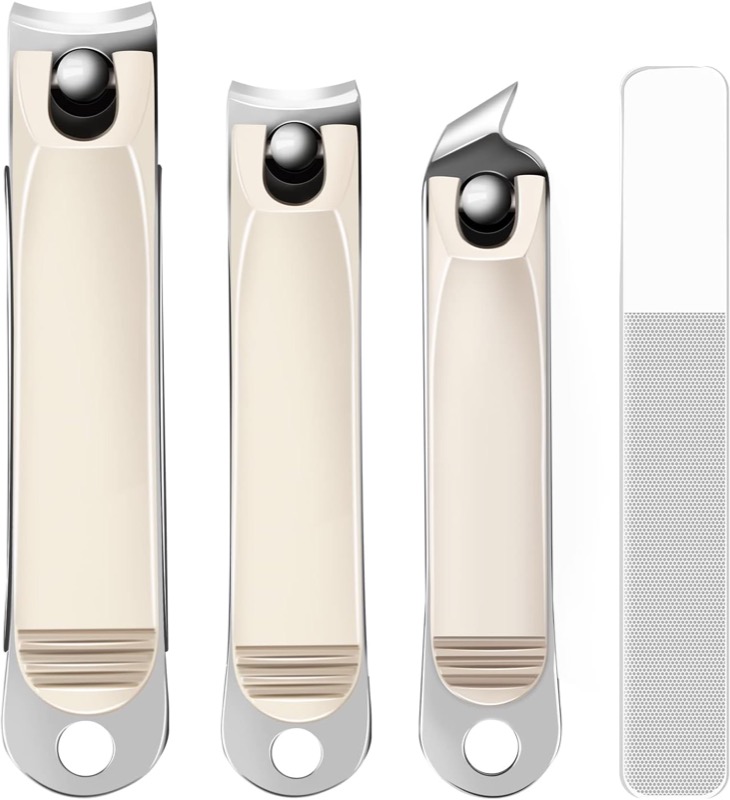
Nail clipper set with catcher, four pieces
A retail example naming a specific steel (420J2) alongside a catcher claim. A grade number is the one thing here that can be checked on paper — ask for the mill certificate that matches it.
7. Lever and spring fatigue. Squeeze and release 500 times. Measure jaw opening before and after, and check lever play, pin movement and any change in closing feel. Record any change.
8. Humidity and cleaning. Put one unit in a sealed bag with a damp towel for 72 hours, then inspect edges and pivot. Separately wipe a different unit with the cleaner you will recommend, five times, and record the cleaner, spotting and finish wear. A salt-spray test belongs in a laboratory.
9. Handling and grip. Have three people with different hand sizes close the clipper on the substitute material, and record how much force they feel they need, whether the lever digs into the palm, and whether anyone struggles to open it. Subjective, but this is how a clipper is used.
If the set includes a file, a catcher or an ingrown-nail tool, add: file surface under a loupe, catcher attachment over 20 cuts, and any sharp point on the ingrown tool examined and tested only on a substitute.
Variants: toenail, fingernail, sets and nippers
Fingernail clippers. Smaller jaw, curved edge common. Check the curve radius against the range of nails you target.
Toenail clippers. Wider jaw and longer lever. Straight edge is the usual foot-care advice. Test jaw opening and lever force carefully.
Multi-piece sets. More pieces, more places for one to be poor. Test every piece, not only the headline one.
Ingrown-nail tools. A pointed tool used near sensitive skin is a different risk from a clipper. Treat it separately and be careful with claims.
Cuticle nippers. The CDC page advises against cutting cuticles because they act as a barrier. A nipper listing should not encourage cuticle cutting, and should be written with your compliance adviser.
Travel and keychain clippers. Small size lowers leverage; test on the same strip and see how they feel.
Clippers with plastic bodies. Check the pivot and lever for flex.
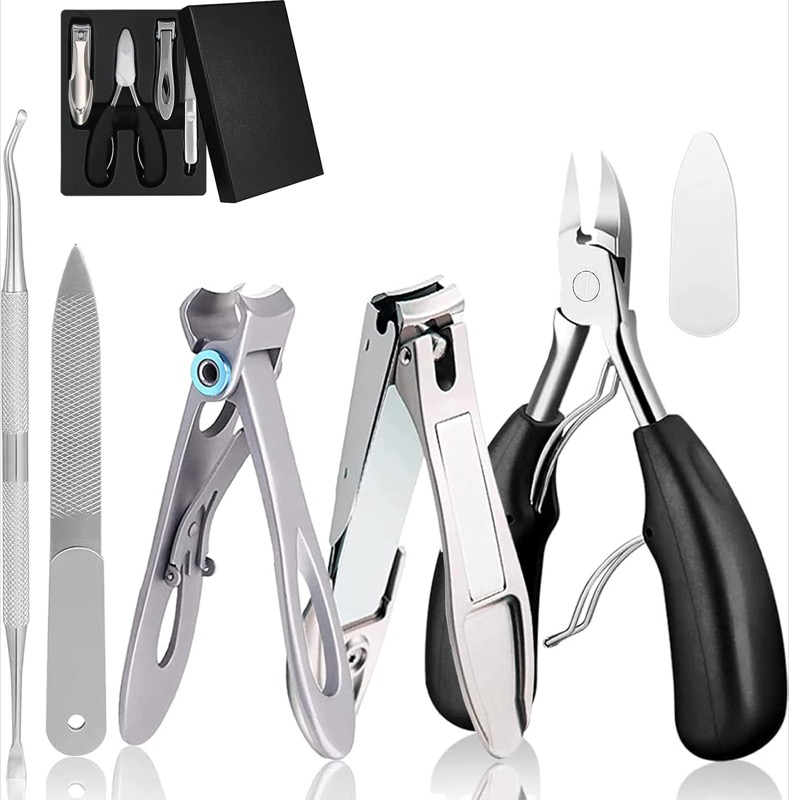
Heavy duty toenail clipper set, wide jaw
A wide-jaw build that states a 16 mm opening — a number you can check with callipers in a minute. It is also the format where lever force and spring fatigue show up first.
Packaging, safety and returns
Cover the edges. Package so the cutting edge cannot be damaged or injure the packer. A sleeve or blister helps.
Label the set. A multi-piece set should say what each piece is for and not suggest using a toenail tool on skin.
Hygiene note. Add a line telling customers not to share the clipper and to clean it before use, consistent with the CDC page. Do not make disinfection claims for the product itself.
Returns. A used nail tool is not resalable. Decide whether you refund, replace or both, and record the batch.
Complaint log. Log each complaint with batch, symptom and use time. A cluster of rust or dulling complaints is a signal to inspect stock. Any report of a cut or infection should be read by a person and not auto-closed.
The supplier brief
- Steel grade for blade, body and lever, with a mill or lab certificate; state the heat treatment and any surface treatment.
- Edge geometry (straight, curved, angled), radius and bevel angle, with a drawing.
- Jaw opening in millimetres, with tolerance.
- Lever type, pivot construction (pin, rivet or screw) and spring type.
- Edge finishing process and the check that confirms sharpness and alignment on every unit.
- Corrosion testing performed, with the method — for example a salt-spray hours figure if one exists.
- Surface finish and any coating, and whether it is nickel-plated, with a nickel-release report for markets that need one.
- Catcher or tray design, and how it attaches.
- Pack contents, piece by piece, with materials.
- Batch traceability and outgoing inspection plan.
- Packaging that protects the edge and the user.
- Any claims the supplier believes the product supports, with the evidence.
Apply your supplier selection and CPS process to the shortlist once samples pass the screening above.
What your listing can say
Write only what you tested or can show. Phrases we would be comfortable with, if true:
- "Stainless steel blade, grade X, with a straight cutting edge" (grade from a certificate).
- "Jaw opening X mm" (measured).
- "Straight-edged blade for cutting straight across, as foot-care guidance advises" — accurate and sourced.
- "Wipe dry after use and store away from damp" (care advice you have followed).
- "Includes N pieces: …" (counted).
- "Clean before use and do not share" (consistent with the CDC page).
Avoid unless you have evidence for each: "surgical steel" or "medical grade" without a grade; "rust-proof", "never rusts", "lasts a lifetime", "stays sharp forever"; "prevents ingrown toenails" or any treatment claim; "podiatrist recommended" or "dermatologist tested" without a named person and a document; "hypoallergenic" or "safe for sensitive skin"; "sterile" or "antibacterial"; and "razor sharp" without a tested edge.
We are not lawyers. These categories are cautious, not legal advice, and your market's advertising and product-safety rules may be stricter.
Frequently asked questions
Is a straight or curved blade better? Foot-care guidance says to cut toenails straight across, and a straight edge makes that easier. Review sites say a curved edge suits tapering fingernails. Neither is a clinical finding about the blade.
Is stainless steel always rust-proof? No. Stainless resists corrosion, but sources describe rust on stainless clippers in humid or salty conditions, and one brand page says so about its own steel. Keep clippers dry.
What does "surgical steel" mean? We found no formal definition for clippers. Ask for the grade number.
How sharp should a clipper be? We found no standard. A factory process page describes a paper test. Use it, plus a cut-count comparison with a reference clipper.
Can I sell one clipper for fingers and toes? You can, but jaw size, lever length and edge shape differ. Many sellers offer two. Test both uses before claiming both.
Should customers share clippers? The CDC advises cleaning tools before use and sterilising shared tools commercially, and the AAD, as reported by a consumer-health site, advises against sharing. Print "do not share".
What if a customer reports a cut or infection? Ask them to stop using the product, record the batch and symptoms, and advise seeing a health professional. Do not argue about cause. Ask the supplier for inspection records.
How long does a clipper last? One marketplace blog claims 6 to 12 months for cheap clippers and about ten years for quality ones, without a test. Do not print a lifetime.