Bobby pins are the cheapest hair accessory in the cabinet and, for a seller, one of the easiest to get wrong. A box of fifty looks like a commodity: a folded piece of wire with a coating. Listings treat it that way too, with a handful of confident phrases: "Strong hold." "No-slip grip." "Rust-resistant." "Nickel-free." "Won't damage hair." "Smooth ball tips." "Double-coated." The same words appear on pins that cost very little and on pins that cost several times as much, which tells a buyer nothing about which is which.
The category is interesting for a reason beyond grip. A bobby pin is a small piece of metal pressed against the scalp and hairline for hours, which puts it in a regulatory area most hair accessories avoid. Authorities in at least some markets list hair accessories among the metal articles covered by nickel-release rules. It also sits in a dermatological conversation about tension, because clips and pins are named in medical literature as a possible contributor to hair loss caused by pulling. A seller who writes "nickel-free" or "won't damage hair" has made a claim in both areas.
This guide explains what regulatory sources say about nickel and hair accessories, what dermatology sources say about tension, which claims can be checked on a bench, and sets out a screening test. It recommends no product and makes no claim about anyone's hair or skin. For other hold-and-tension accessories, see the claw clip sizing guide and the spiral hair tie test.
What a bobby pin is, and where it fails
A bobby pin is a length of wire bent double, with one flat arm and one crimped (wavy) arm, and tips that close against each other under spring tension. Retail guides describe the usual materials: carbon steel wire, bent, shaped and coated, which gives good spring and low cost; and stainless steel, which resists rust even without coating but costs more. Coatings vary: enamel or paint, nylon or plastic, rubberised or flocked finishes for grip, and plating. One retail guide notes steel pins can rust if the coating chips and can snag hair if damaged.
The same guides are consistent about where problems start.
Tips. Many pins have small ball-shaped or dipped tips that protect the scalp and hair. When the dip wears or chips, the bare wire end is sharp. A hair-care blog warns that old or dull pins with sharp edges can snag and damage hair and should be replaced periodically.
Coating. Coating is what the customer sees and feels, and it is the first thing to fail. It chips at the bend and the tips, and then the steel underneath rusts.
Spring. Pins lose tension with use. A pin that does not close firmly cannot grip, and one that has been over-opened stays bent. Retail guides say pins from cheaper sets lose tension quickly, but they do not provide data, so treat this as common wisdom and test it.
Size and gauge. Thin wire bends and kinks; thick wire holds more but is harder to hide and can pull. One magazine quotes a dancer saying thicker pins give a tighter hold.
None of these is mysterious, and all are testable. The difficulty is that the listings do not test them.
Nickel: the claim with regulatory weight
This is the point most sellers of hair accessories have not considered, and the one that matters most if you ship to the UK or Europe.
Nickel is a common contact allergen. In the European Union and, after Brexit, in the United Kingdom, REACH rules restrict nickel release from articles intended to come into direct and prolonged contact with the skin: not more than 0.5 micrograms per square centimetre per week, with a stricter 0.2 limit for post assemblies inserted into piercings. Compliance is assessed with a European reference test method, EN 1811. A UK trading-standards guidance site says the rules cover products such as earrings, wristwatches, rivets and zips, and lists metal components of jewellery and imitation jewellery, and hair accessories, among the items in scope. A Danish environmental authority's fact sheet says the regulations cover a number of metal products designed to come into direct contact with the skin, naming jewellery, watches, hair clips, mobile phones, zips and studs, and adds that products containing nickel often carry a nickel-free coating such as gold plate or enamel. The UK guidance says a product may contain more nickel where a coating keeps release under the limit, and ties that to a minimum of two years of normal use. The Danish authority says the analysis report documenting compliance must be kept for five years.
Three cautions.
First, we are not describing the law. These are summaries from official guidance pages and an encyclopedia-style reference. Whether a specific pin counts as an article in "direct and prolonged contact" depends on how it is worn, and that is a judgement for a compliance adviser in your market. A clinical paper in the contact dermatitis literature notes the regulation did not define "prolonged contact", and that the European agency concluded it means contact of potentially more than ten minutes on three or more occasions within two weeks. A pin worn all day easily exceeds that.
Second, "nickel-free" and "nickel release" are different claims. A pin made of nickel-containing steel may release little nickel through a good coating, and a pin with no added nickel may still contain traces. The regulatory test measures release, not content. If you write "nickel-free" you imply content; if you write "complies with EN 1811" you imply a test report. Neither should appear without the document behind it.
Third, coatings matter, and they wear. The UK guidance links compliance to the coating staying effective for a minimum period of normal use, which is why the wear tests below matter. A pin that complies when new and loses its coating at the bend within weeks is a problem on both the dermatology and the compliance side.
If you do not sell in those markets, you may face other rules or none; the United States, for example, was described by one reference as having no federal standard equivalent to the European nickel rule. We did not research each market. Ask a compliance adviser and your lab before you list.
Tension, traction and "won't damage your hair"
The American Academy of Dermatology Association describes traction alopecia as hair loss from hairstyles that pull on the hair, notes that if a hairstyle hurts it is too tight, and advises varying styles and wearing tight ones for short periods. A review of 19 studies by Johns Hopkins researchers, published in the Journal of the American Academy of Dermatology and summarised by the university, found a strong association between scalp-pulling styles and traction alopecia, and concluded the condition is entirely preventable and that early intervention can stop or reverse it. A federal practitioners' journal article states that traction alopecia can be caused or made worse by hair clips and bobby pins that hold styles in place. A dance magazine quotes a dermatologist advising people to change styles and take hair down after class, and a stylist saying a low bun is less damaging than a high one and thicker pins give a tighter hold.
What this means for a listing: a pin does not cause or prevent hair loss on its own; how and how tightly it is used does. A seller can describe a pin's construction honestly, say that smooth tips and an intact coating are designed to reduce snagging, and add advice consistent with the dermatology sources (do not wear tight styles all the time; remove them if they hurt; see a dermatologist for hair loss). A seller cannot say "no damage", "won't cause breakage" or "safe for daily use" as a guarantee. A retail blog's argument that pins are not inherently bad for hair, with damage only from sharp edges, rough removal and repeated tight styling in one place, is a reasonable reading — but it is a retailer's, not a study.
Terms the listing uses loosely
- Rust-proof / rust-resistant. Say rust-resistant only with a test. "Proof" is stronger than any steel earns. Stainless steel is described as resisting corrosion even without coating, but it depends on the grade, and cheap listings do not name one.
- Nickel-free. A compliance document or nothing.
- Hypoallergenic. No agreed meaning. A hair-accessory review site observes metal pins can aggravate nickel allergy and notes a non-metal alternative. A reviewer's remark. Do not use the word without a test.
- No-slip / grip coating. A rubberised, flocked, textured or matte finish. Retail guides describe such finishes as adding friction on fine or slippery hair. The effect depends on hair and pin, so test it against a standard swatch and report the numbers.
- Double-coated / no-chip finish. Needs an abrasion or chip test. Ask what the coating is, how many layers and how thick.
- Ball tips. A dip or a ball at the end. It protects only while it stays on.
- Won't damage hair / gentle. A guarantee nobody can give.
- Professional / salon quality. No standard. Ignore.
- Spiral, U-shaped, French and crinkled pins. Different forms, different weaknesses. U-shaped pins have no spring; spiral pins can tangle.
What goes wrong with these products
- Chipped tips. The tip dip comes off and the bare wire is sharp.
- Coating wear. Paint cracks at the bend, flakes in hair, or transfers colour to hair and hands.
- Rust. Orange spots after humidity or contact with wet hair.
- Weak or lost spring. The arms do not close, or the pin stays open after use.
- Slipping. The pin works out of fine or slippery hair.
- Sharp edges. Burrs at the cut ends or bend.
- Bending and kinking. Thin wire that deforms when pushed into thick hair.
- Wrong count or mixed sizes. Fewer pins than listed, or sizes that differ from the listing.
- Colour mismatch. Colours that do not match the photographs.
- Nickel reactions and compliance gaps. Customer reports of irritation, or no document for markets that need one.
Reading the results: pass, revise or fail
| Result | Pass | Revise | Fail |
|---|---|---|---|
| Count and sizes | Matches the listing | Wording mismatch; fix the listing | Fewer pins or wrong sizes |
| Nickel documents | Report in hand for the market | Report missing; drop nickel wording | Report shows release over the limit |
| Tips and edges | Intact dips, no burrs | Minor burrs; request polishing | Bare or sharp ends |
| Coating | No chips after 200 cycles | Light wear at the bend | Chipping or colour transfer |
| Spring | Force stable, no permanent set | Wide spread between pins | Loss of tension or cracks |
| Grip | Peak force meets your threshold on both swatches | Fine swatch low; state the hair type | Pins slip from both swatches |
| Removal | No broken hairs | A few caught hairs | Hair dragged out or fibres left |
| Rust | No spots after 72 hours | Light staining at the bend | Rust or lifting coating |
| Volunteers | Comfortable | Complaints fixed by instructions | Scratching, pain or reactions |
Treat a failure on nickel documents (for markets that need them), bare sharp tips or rust as a stop. They matter most for skin and for compliance.
Variants: U-pins, spiral pins, jumbo pins and mixed packs
Different forms of the basic pin fail differently, so a test plan for one does not cover another.
U-shaped and French pins. These have no spring; they hold by friction and the way hair wraps around them. Listings for wrapped, crinkled versions emphasise a coating that runs the whole length, so there are no tips to chip. That moves the risk to coating abrasion along the shaft. Run the insertion cycles and look along the whole pin, not just the ends, and test grip with the pin inserted the way a hairdresser would use it.
Spiral pins. A coil is gentler to insert in some hair types, according to a hair-care blog, but it can tangle on removal. Run the removal test with a longer swatch and count tangles, and check that the coil does not unwind when opened.
Jumbo or extra-long pins. More wire means more leverage, so check spring force and resting gap again, and confirm the pin does not kink when pushed into a thick swatch. Heavy pins can also pull on fine hair, so run the volunteer panel with someone who has fine hair.
Decorative pins. Pins with pearls, stones or enamel add small parts and a join between head and shank. Pull on the decoration with a gauge, soak it in water for ten minutes, and see whether it loosens. Check the metal under the decoration against the same nickel and coating questions. Decorative parts are also the usual place for compliance questions about other metals, so ask a compliance adviser what applies to the finished article.
Mixed colour and size packs. A pack of fifty in five colours is five products. Sample each colour, because colour fastness and coating adhesion often differ between a black and a gold finish, and check that pack counts match the listing for each colour and size.
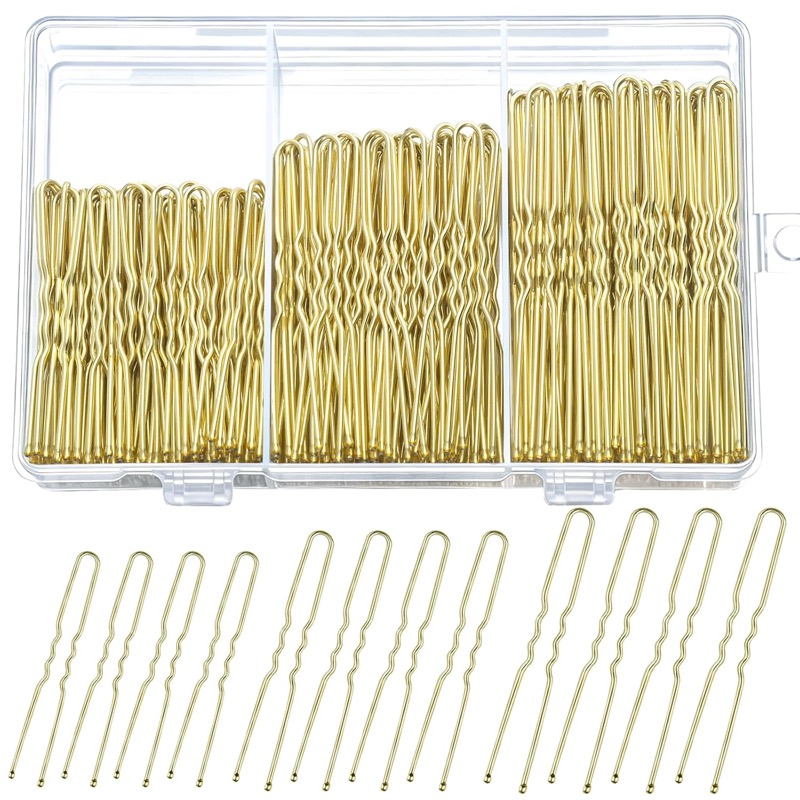
Multi-size hair pin set, 210 pieces
A mixed pack is several products in one box: sizes, finishes and pin shapes all vary. Sample per size and per colour, because spring force and coating wear do not carry across a mixed carton.
The sample test: nine steps in an afternoon
These are our own screening procedures, not a standard. They compare samples with each other and with what you plan to claim. Use at least ten pins per model from each of three different cartons, because variation between pins is the risk. A loupe, callipers, a spring gauge or luggage scale, a standard hair swatch and a sealable bag are enough for most steps. Nickel release and coating thickness need a laboratory.
1. Count, size and gauge. Count pins in each pack and compare with the listing. Measure length, the open gap at rest, wire diameter at the straight arm and the bend, and weigh ten pins. Record the spread. Compare mixed-size packs with the sizes stated. Check colour against the listing photos in daylight.
2. Material and nickel documentation. Ask the supplier in writing for the wire material, coating type and any plating. For markets with nickel rules, ask for a nickel-release test report to EN 1811 on the finished pin, with a date and a lot. As a screen, a nickel spot-test kit of the kind a Danish authority mentions as available from chemists can show whether a surface releases detectable nickel, but it cannot substitute for the reference test, so do not publish a spot-test result as a compliance claim. Keep documents with the batch record.
3. Tips and edges. Under the loupe, inspect every tip on ten pins from each carton. Record bare ends, uneven dips, burrs, sharp corners and cracks at the bend. Draw the tips lightly across a nylon stocking and across a hair swatch and note snags. Photograph defects against a ruler.
4. Coating adhesion. Scratch the coating lightly with a fingernail at the bend, then rub with a damp cloth and an alcohol wipe, and look for colour transfer. Push each pin into and out of a hair swatch 200 times, then check tips and bend again. Count pins with chipped coating, exposed metal or flaking.
5. Spring and fatigue. Measure the force needed to open the pin to a fixed gap with a spring gauge. Open and close it 500 times to that gap and re-measure force and resting gap. Record permanent set (the pin staying more open) and any cracks. Compare within and between cartons.
6. Grip test. Fix a standard hair swatch or a length of wig fibre firmly, pin it with a pin pushed in to a fixed depth, and pull the pin out in the direction hair would pull it with a spring gauge. Record the peak force. Use two swatches: a fine, slippery one and a thicker one. Repeat after the 200 insertions in step 4. A rubberised or textured pin should show a higher force than a smooth one on the fine swatch; if it does not, the claim fails. This measures a pin against a swatch, not against a person's hair.
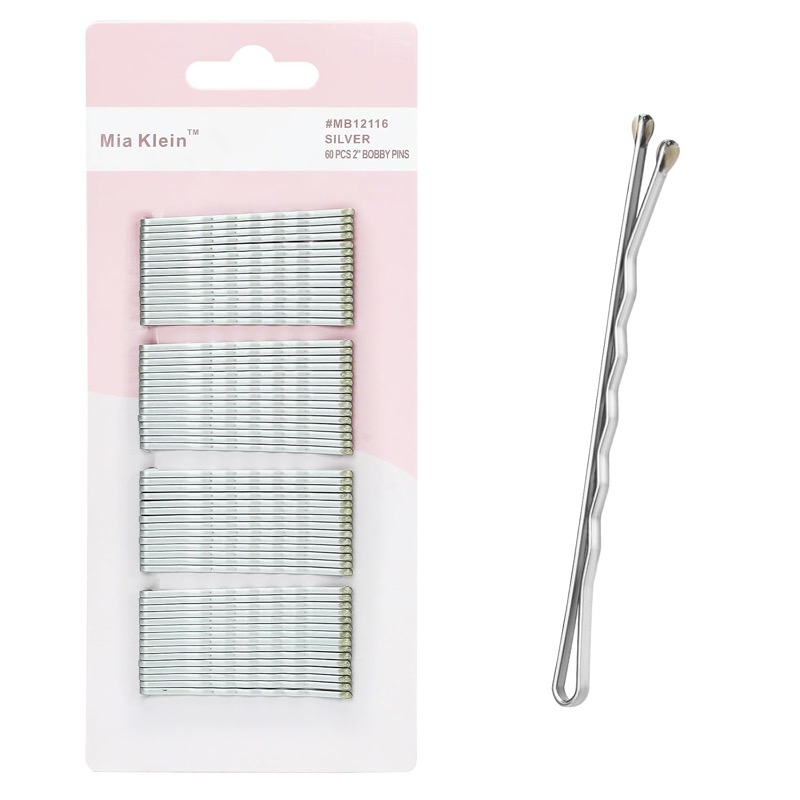
Crimped bobby pins with ball tips, 60 pack
A retail example with the wording this guide examines: ball tips, long-last coating, strong spring. Each of those maps onto one of the bench tests below — tips under a loupe, coating after 200 insertions, spring force after 500 openings.
7. Removal and snagging. Pin a damp swatch, let it dry, and remove the pins in a fixed way. Count broken hairs and hairs caught in the pin. Look at the tips again. A pin that drags hair out or leaves fibres in the bend is a defect, whatever the grip.
8. Rust and humidity. Put pins in a sealable bag with a damp (not wet) paper towel for 24 and then 72 hours at room temperature. Separately, pin damp swatches and leave them in a closed bag for 24 hours. Look for orange spots, staining, bloom and coating lifting, especially at bend and tips. Dry and re-inspect. A crude screen: it does not prove a grade and does not replace a salt-spray test if you plan to claim corrosion resistance.
9. Volunteer panel. Give packs to at least eight adult volunteers with a range of hair types. Ask them to wear a style with the pins for a day, in different positions, and report grip, comfort, snagging, scratching, any pain or tightness at the scalp and any irritation. Tell them to avoid tight high-tension styles, take pins out if the style hurts (the dermatology advice we cite), and see a professional for hair loss or skin reactions. A usability check, not a study, and it cannot show the absence of damage.
Packaging, display and returns
Pins are small and light, which makes packaging decisions look unimportant, but they affect how the product arrives and how customers judge it.
Tangling. Loose pins tangle in a bag, and a customer who has to untangle fifty before using one will remember it. Cards, trays or small boxes keep them separate and protect the tips.
Bent pins in transit. A flat card in a thin mailer can bend. Run the drop test with the packed unit and check for pins bent out of shape.
Counting. Pack counts are easy to get wrong in a factory. Count a sample from each carton and keep the numbers.
Display tests. If you sell on cards, check that pins do not slide out of the slots, that the coating does not rub off onto the card, and that the card does not stain pale hair colours.
Returns. Because pins are cheap, returns are often not worth processing, but complaints still carry information. Keep a log by batch and review it for patterns such as chipped tips, rust or colour transfer from one batch.
The supplier brief
- The wire material and grade, and the coating system with layers and thickness.
- A nickel-release report to EN 1811 on the finished pin, with lot and date, if you sell where the rules apply.
- The tip finish and how it is applied, with adhesion data.
- The spring specification: wire diameter, opening gap and force.
- The grip finish (rubberised, flocked, textured) and its test data on a standard swatch.
- Any corrosion or humidity test results, with method.
- The colour fastness of dyed or painted coatings.
- The pack configuration, counts and sizes, and a packing list.
- Packaging that prevents tangling and bending, with a carton drop test.
- Minimum order quantity, lead time, sample policy and replacement terms, on the quotation and not in chat.
What your listing can say
- Material: the wire and coating you can confirm, such as "steel wire with a nylon coating", without a grade you cannot document.
- Dimensions: length, wire diameter, open gap and counts as measured.
- Grip: "textured coating tested on a fine hair swatch" and the result if you want to share it, not "no-slip".
- Rust: "tested in humid conditions for 72 hours with no visible rust" if true, otherwise leave it out. Do not say rust-proof.
- Nickel: "complies with EN 1811, report on request" only with a report. Otherwise nothing.
- Hair care: "smooth finished tips. Remove if the style feels tight or painful." Add a line from the dermatology advice.
- Care: keep dry, do not leave pins in wet hair for long periods, and discard pins with chipped coating or exposed ends.
Avoid "nickel-free", "hypoallergenic", "rust-proof", "won't damage hair" and "salon quality" without evidence for each.
Frequently asked questions
Do bobby pins cause hair loss? Dermatology sources say traction alopecia comes from tension, and one medical article says clips and bobby pins can cause or worsen it when they hold tight styles. Pins are not the only factor, and tight styles worn daily matter more.
Do hair accessories fall under nickel rules? Official guidance in Denmark and the UK lists hair clips or hair accessories among the metal articles covered when they come into direct and prolonged skin contact. Whether a given pin does depends on use. Ask a compliance adviser.
What does "nickel-free" mean? It is ambiguous. The legal test measures release, not content. Use a document, not a word.
Does a coating make a pin safe for people with nickel allergy? A coating can reduce release while it lasts. The UK guidance ties compliance to a minimum of two years of normal use, so test wear. We make no claim about any person's allergy.
Why do my pins slip out of fine hair? Smooth metal gives little friction on fine hair, and retail guides recommend textured, flocked or rubberised finishes. Test grip on a swatch.
Is stainless steel better than carbon steel for pins? Retail guides say stainless resists rust without coating and keeps spring longer but costs more. The grade matters, so ask for it.
How many times can a pin be reused? We found no standard. Pick a number from your fatigue test, such as 500 openings, and state what you tested.
What if a customer reports scalp irritation? Ask them to stop using the pins and see a professional if it persists. Record the batch and the coating, and ask your supplier for the nickel report.