A nail file is the cheapest thing in a manicure kit and the one with the strongest opinions attached. Glass files promise to "seal" the nail edge. Emery boards are the old reliable that some nail specialists now tell people to throw away. Metal files are the pointy ones in the bottom of a travel kit. Diamond-coated, crystal, nano, sapphire, double-sided, Czech: the results page for "nail file" is mostly adjectives.
This guide sets out what dermatology sources actually say about files; where those sources disagree (filing direction and grit are the big two); which common listing claims have no published study behind them that we could find; and what to check when the file arrives. It does not recommend a brand and it is not medical advice: if your nails split, lift, change colour or hurt, a dermatologist is the right person to ask.
For related reading, see nail clippers and surgical steel, foot files and pumice stones, mini nail file kits and the press-on nail fit checklist.
The short version
- The American Academy of Dermatology (AAD) advises filing in one direction, because filing back and forth can weaken nails. Its general nail tips also say to keep nails free of snags "by filing with an emery board".
- A well-known nail dermatologist, Dr Dana Stern, says cardboard emery boards can create tiny openings at the nail tip and recommends glass or crystal files instead. She also sells a glass file under her own brand, so read that advice with that in mind.
- We found no controlled study comparing glass, emery and metal files. The case for glass rests on clinical opinion and on magnified photographs that appear in brand-linked articles.
- Grit numbers are a convention, not a safety standard. Sources split between "never coarser than 180" and "never coarser than 240" for natural nails.
- Glass files are not graded by the same numbers as paper files. A seller says so directly, so a glass file's grit is something to judge by feel and by the seller's description.
- Metal files get the worst press, but the criticism comes mainly from shopping and salon-supply pages, not clinical research.
- Whatever you buy, a file that is shared, damp or caked with nail dust is a hygiene problem. Replace cardboard files when they go soft or dirty, and wash and dry reusable ones.
What these files are
Emery board. A thin paper or cardboard-cored strip coated with abrasive. A fashion-media explainer describes the common salon version as a paper file with a layer of foam between two abrasive sides. The classic orange board is a cheap disposable version.
Glass or crystal file. A strip of tempered glass with an etched, textured surface. A magazine article says glass files were first developed in the Czech Republic in the late 1990s, typically from tempered Bohemian glass. Sellers sell them as "Czech crystal" or "Czech glass".
Metal file. Usually stainless steel with a cut or stamped texture. A shopping guide describes them as effective but liable to cause breaking or peeling.
Diamond-coated file. A metal blank with diamond particles bonded to the surface. One beauty writer found a diamond glass file as effective as an emery board for rounding a tip and gentler to use. One person's experience, not a test.
Buffer or block. A foam-cushioned block with one or more abrasive sides, used for smoothing the nail surface. A salon-supply guide says buffers can be coarser than files because the cushioned layer gives more protection.
Mylar or "washable" files. A plastic-film backing with abrasive on both sides. A salon brand's guide calls its Mylar file more suitable for natural nails because its surface is less abrasive — a brand opinion about its own product.
What dermatology sources say
The AAD: file in one direction, and emery boards are named
The AAD's page of dermatologists' tips for healthy nails says to cut nails straight across with sharp scissors or clippers, round them slightly at the tips for maximum strength, and keep nails shaped and free of snags by filing with an emery board. A separate AAD release on trimming nails, quoting nail specialist Dr Shari Lipner, gives the filing instruction in more detail: smooth uneven or rough edges using a nail file or emery board, and always file in the same direction, because filing back and forth can weaken nails. The release also recommends disinfecting your tools, leaving cuticles alone and keeping nails short, noting short nails stay cleaner and break less often. The AAD's own page says well-groomed short nails are less likely to harbour dirt and bacteria that can lead to infection.
Three things follow. The AAD names the emery board and does not recommend replacing it with glass — it is a general-public page, not a product comparison. The strongest, most consistent point is direction: one direction, and not sawing. And disinfecting tools is part of the same guidance, though the page does not say how.
Dr Stern: glass over cardboard
Dr Dana Stern is a New York dermatologist who specialises in nails. In a public radio feature, republished by several stations, she says glass or crystal files create a smooth, sealed edge, while cardboard emery files can lead to breaks, splits and peeling. She is the only expert quoted on file type in that article. In an interview with a fashion site, she says glass files are best suited to the free edge, to shape and shorten, and that unlike other files they can be used safely in any direction. She also says that under a microscope, an emery-filed nail looks like a mountain range. In a separate piece republished by a nail trade site, she says many files and traditional emery boards can be too abrasive for natural nails, causing microscopic tears at the tip that lead to breakage and early polish chipping.
Context matters, and we say so plainly. The same fashion-site piece identifies her as the founder of a nail-care brand, and a nail-industry article describes her launch of her own glass nail file priced at $10. The radio feature itself did not disclose that. This does not make her advice wrong, and a specialist with a commercial product still has clinical experience. It does mean the claim comes from someone who benefits if you buy a glass file, and that is a different category of evidence from a study.
Other dermatologists in the press
A dermatologist quoted in a WebMD tips feature says the old-fashioned orange emery boards are too harsh, causing small fissures and cracks that lead to breakage and tears. She recommends a smooth, fine file, not sawing back and forth, and filing in one direction, slowly and evenly.
A New York dermatologist quoted by a beauty site says that if repeated trauma reaches the nail bed — the plate the nail grows on — the damage can be irreversible. The same article quotes another source saying a glass file can be used in multiple directions where an emery board cannot, and that glass files last longer because they can be sterilised.
A nail-brand founder quoted in a reposted beauty article says crystal files are gentler and suit brittle nails, but that in most cases a good emery board should be your file of choice, and that either should be swapped out every few months. We read that in a blog repost, so treat it as a minor data point.
What none of these amount to
We searched for a trial or laboratory study comparing glass, emery and metal files on natural nails and found none. What the sources offer is dermatologists' clinical impressions, magnified photographs shown in articles connected with a glass-file launch, and marketing statements about "sealing keratin layers".
That does not mean the claims are false. Filing a nail edge with a smoother abrasive plausibly leaves a smoother edge. It does mean that "clinically proven" or "dermatologist tested" next to a glass file should make you ask: tested how, by whom, and compared with what?
Where sources disagree
1. Glass or emery?
| View | Who says it | Evidence offered |
|---|---|---|
| Emery boards are the standard | AAD tips page; a nail-brand founder in a beauty article | General public guidance; professional experience |
| Cardboard emery files cause splits, glass is better | Dr Stern; a dermatologist in WebMD; a dermatologist on nail-bed damage | Clinical opinion; magnified images; some connected with brand products |
| Metal files are worst | Shopping guides, salon blogs | Not clinical; no study found |
A fair reading: nobody we found says an emery board is dangerous if used lightly in one direction, and nobody found a trial showing glass is better. If your nails split or peel, the dermatologists' consensus leans to a fine glass file or a very fine-grit board. If your nails are fine, the AAD's plain advice stands.
2. Direction
The AAD and Dr Lipner say always file in the same direction, and the WebMD dermatologist says the same. Dr Stern says glass files can safely be used in any direction. A shopping blog tells readers a gentle seesaw motion can work with a high-quality glass file but one-direction filing is safer for people who struggle with peeling or splitting. A nail-technician site says experienced techs sometimes use a very light back-and-forth stroke with high-grit glass files.
Our own working rule, a suggestion and not a standard: file in one direction regardless of the file, unless a dermatologist who knows your nails says otherwise. It costs nothing and sits inside the AAD's advice.
3. How coarse is too coarse?
Grit is the number on the file: the higher the number, the finer the abrasive. The sources agree on that and disagree on where to stop.
| Source | Advice for natural nails |
|---|---|
| A nail-science education site | Never coarser than 240 on natural nails; 180 may be right for toenails or thicker nails. Another page on the same site records a reader being told never to go below 180 and asking whether that is scientifically supported, which shows how informal the convention is |
| A salon-supply retailer | Never coarser than 240 on the surface of natural nails; 180 is fine for shaping the edge; buffers can be coarser because they are cushioned |
| A nail-supply guide | Never below 180 for natural nails; 240+ for finishing |
| A nail technician quoted by a shopping site | 180 or higher on natural nails; she goes as low as 100 on artificial nails |
| A trade-supply blog | 240 as a gentle choice; 180 for shaping |
So the lowest number suggested for natural nails is 180 and the safest-sounding is 240. The salon-supply guide and the nail-science site draw the line at 240 for the nail surface and allow 180 for shaping the free edge. All of these are trade and retail sources, not studies. Our own suggestion: 180 is the floor, 240 is the sensible default, and if your nails peel, start finer.
On glass specifically, one seller explains that classic grit numbering does not work the same way for glass, because the grit is formed from the body of the file rather than manufactured and attached separately. It describes its standard file as "fine, somewhat medium", with a higher grit than most emery boards and a lower grit than metal files. Brand statement. The practical point: a number printed on a glass file cannot be assumed to mean what the same number means on paper. Shopping guides do give numbers for glass, for example 200 to 220 for a set of small and medium files, and one brand lists 240. Treat those as rough descriptions.
Terms the listing uses loosely
| Term | What it can legitimately mean | What it does not tell you |
|---|---|---|
| Czech glass / genuine Czech crystal | Glass of Czech origin, or in the style of it | We found no certification scheme for the term |
| Crystal | Usually the same tempered glass | Not lead crystal; the word is marketing colour |
| Nano, diamond or sapphire | A finer or differently coated abrasive | Any measurable grit; whether it is solid or coated |
| Seals the nail edge / seals keratin layers | A claim about the edge being smoother | Any published test or study of effect |
| Dermatologist developed / recommended | One or more dermatologists were involved | Who, and whether they sell it |
| Lifetime / forever | The material is durable | That glass cannot chip, crack or shatter |
| Antibacterial / bacteria shield | A coating or material claim | Which test, against what; we cannot verify it |
| Medical grade stainless | A seller's phrase | Any standard for a manicure file |
| 100/180 grit | Two sides with different coarseness | Which is which, unless it is printed |
| Washable | You can rinse it | That the core will not swell if soaked |
What to look for before you buy
What are you filing? For natural nails, the AAD's guidance is the starting point. If you have press-ons, gels or acrylics, a coarser side (100 to 180) can be reasonable for thick product on the edges, and a nail artist quoted by a shopping site uses a 100-grit side on the sides of press-ons for fit and a 180-grit side to buff before glue. Keep those for product, and use a finer file on your own nail.
Is the abrasive described? A printed grit, or at least "fine" and "medium", and whether both sides are the same. A listing that says only "professional" or "crystal" has told you nothing.
Is the construction stated? Tempered glass, paper board, steel, plastic backing. If a glass file is shown with no information about the glass being tempered, ask.
Is there a case or sleeve? Glass breaks when dropped. A salon-supply blog says the risk of shattering makes glass unsuitable for professional use, and a shopping roundup records a reviewer whose mini file arrived broken in transit. A hard case or padded sleeve is part of what you are paying for.
Size. Small files fit in a bag but give less working surface. A large file is easier to control for the free edge.
Single or double-sided. If the sides differ, the listing should say which is coarse.
Do the reviews help? Search "rough", "chipped", "shattered", "peeling", "no longer gritty" and "smooth". Reviews are not evidence, but a pattern is a signal. Be wary of reviews that read like the product description.
Is the price proportionate? One dermatologist's glass file was launched at $10, and a retailer's guide describes glass as high-performing, durable and sometimes expensive. Price tells you little about the abrasive, but compare like with like.
What a higher price should buy
Price does not prove quality, and we found no test ranking glass files by price. A higher price can reasonably buy a stated grit or a clear description of the etch on a file with consistent texture; tempered glass with smooth, finished edges that do not catch your skin; a case that protects the file; a returns policy covering a file that arrives chipped; and honest wording, with no "cures", "repairs" or "strengthens" claims for what is a shaping tool. A file does not strengthen nails; the suggestion in the sources is that a smoother edge may reduce splitting.
What it should not buy is a longer list of adjectives.
Checks to run when it arrives
Our own suggestions. None is a standard, and none replaces medical advice.
Inspect the file. Check for chips along the edges, hairline cracks, an uneven etch (shiny patches where texture is missing) and any sharp corners. A cracked glass file can cut skin. For a board, check the abrasive is evenly bonded and the core is not warped.
Run a thumb test on the edge. Draw the file lightly across the pad of your finger. It should feel gritty and consistent, not slippery in places and rough in others.
Test on a scrap first. If you have a spare press-on or an old nail clipping, file it and look at the edge in good light. The edge should look smooth. A snagging or flaking edge says the file is too coarse.
Try one nail, one direction. File one nail from the side toward the centre, in a single direction, with light pressure. The edge should be smooth, the nail not hot from friction, and nothing peeling.
Check for dust and smell. A chemical smell on arrival is a reason to air it and, if it persists, to ask the seller what the coating is.
Clean it before first use. Wash a glass or metal file with soap and warm water and dry it. The AAD says to disinfect tools; the sources do not give a method, so follow the care card if there is one.
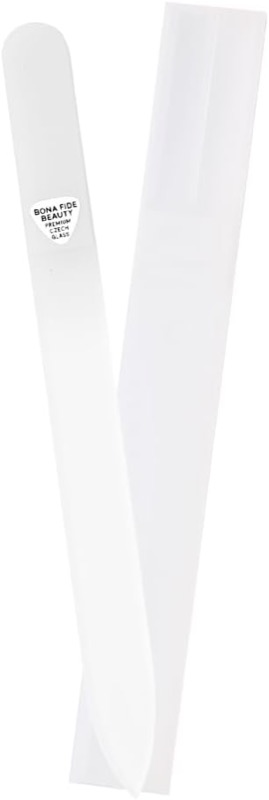
Czech glass nail file with hard case
A retail example that carries the exact wording this guide examines: etched grit, 'seals the nail's keratin layers', made in the Czech Republic. The case matters here — glass files break, and one that arrives chipped is a return.
Keep the packaging and receipt until you have used it a few times.
Keep it, query the seller, or send it back
| What you see | What it suggests | What we would do |
|---|---|---|
| Chips, cracks or a split along the edge | Damaged in transit or poor manufacture | Return it; do not use it |
| Uneven etch with smooth patches | Inconsistent abrasive | Ask the seller; return if it is on the working area |
| Edge looks ragged after filing | Too coarse or damaged | Try a finer file; query the seller if it was sold as fine |
| Sold as fine but feels like sandpaper | Description does not match | Return it |
| Smooth, even, gentle on the edge | Nothing wrong found | Keep it |
| Chemical smell that does not fade | Possible coating or adhesive | Ask what it is; return if no answer |
| Cardboard board soft or damp from the box | Moisture damage | Return it |
| Nails start to peel or split with use | The file or technique may not suit | Stop, try a finer file and one-direction filing; see a dermatologist if it continues |
Using and looking after a file
- One direction, light pressure. The single most consistent piece of advice across the dermatology sources.
- Do not file hard to remove length. The AAD advice is to cut with clippers or scissors first, then file to shape. A dermatologist interviewed by a beauty site agrees: clip first, file second. Filing is for smoothing.
- Do not file wet nails. A shopping blog warns wet nails are more vulnerable to bending and splitting. A blog, not a study, but consistent with the general view that nails absorb water and soften. Dr Stern advises gloves for prolonged wet tasks.
- Keep buffing gentle and occasional. Dr Stern says a light buff after cutting can promote shine, but overdoing it can thin and weaken the plate.
- Leave cuticles alone. Both Dr Lipner and Dr Stern say not to cut or remove them; removing them can leave the nail open to infection.
- Clean the file. A nail-technician site says skin oils, nail dust and old polish build up in the grit of cardboard files, which makes the tool less effective and can spread fungus if shared. We found no clinical study of file hygiene, so this is professional opinion.
- Do not share files. A fashion site notes you can toss disposable boards after use and that reusable files should be cleaned. If you share with family, give each person their own.
- Replace cardboard files when they soften or get grubby. Sources give "every few months" at the loosest. Treat that as a ceiling.
- Store glass in its case. The easiest way to avoid chips.
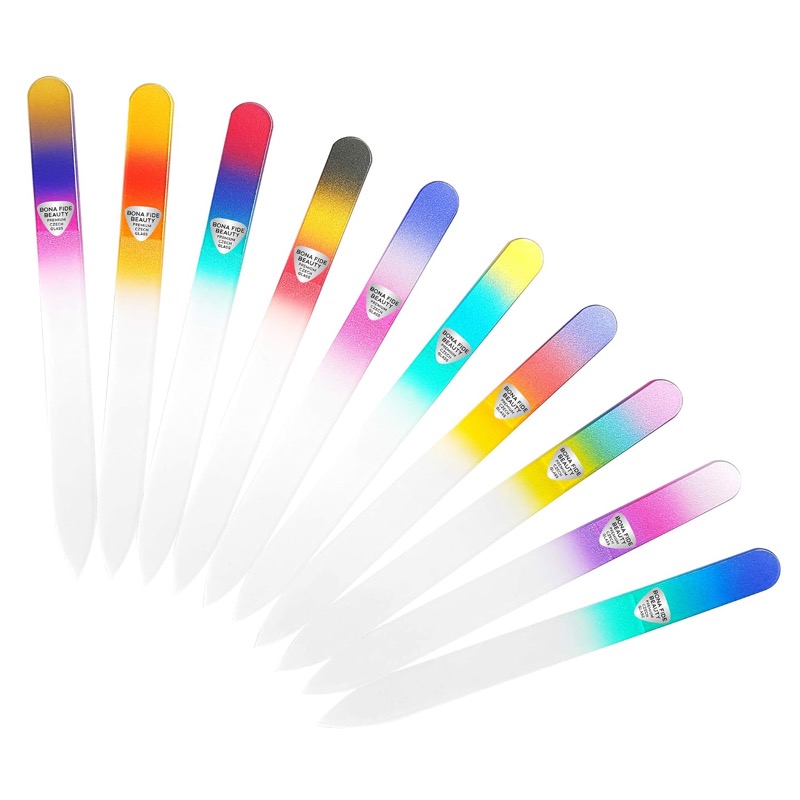
Czech glass file set, ten pieces
A multipack format worth understanding before you buy: one glass file lasts, so ten is a gifting or resale quantity. Check the sizes and sleeves in the pack rather than the count.
When to see a professional
Mayo Clinic and the AAD both say changes in the nails can be a sign of something other than rough handling. Book a dermatologist rather than relying on a guide like this one if you notice nails getting thinner or thicker; dents, pits or grooves; a nail pulling away from the skin around it; bleeding, swelling or pain around the nail; colour changes, dark lines or green spots; or nails that do not grow.
If you have diabetes or poor circulation, the AAD says it is especially important to seek treatment for any nail problem.
What your listing can say
If you sell files, this is the wording that holds up.
Safe to print, if true:
- "Tempered glass, etched surface, 135 mm" — construction facts you can photograph.
- "Fine grit, both sides" or "180/240, coarse side marked" — if you can state which is which.
- "Includes a hard case" — a design fact.
- "Rinse and dry after use; do not share."
- "File in one direction with light pressure" — consistent with the AAD's advice and cheap to print.
Avoid unless you hold evidence for each: "seals the keratin layers" or "seals the nail edge" (no published test we could find), "clinically proven", "dermatologist developed" without naming whether that dermatologist sells the product, "strengthens nails", "cures splitting", "lasts a lifetime" for glass, "antibacterial", "medical grade stainless", and "Czech crystal" used to imply a certification that does not exist.
One honest option is to describe the surface rather than promise an outcome: "fine etched grit that leaves a smoother edge than a coarse board" is a claim about the abrasive, not about nail biology.
We are not lawyers, and this is not legal advice. Your market's rules may be stricter.
Frequently asked questions
Are glass nail files better than emery boards? Some nail dermatologists say so, and none of the sources we read found a study. The AAD names the emery board in its general advice. If your nails peel or split, a fine glass file is a reasonable thing to try.
Can I file back and forth with a glass file? Dr Stern says glass files can safely be used in any direction. The AAD says to file in one direction because sawing can weaken nails. Our default is one direction.
What grit should I use on natural nails? Sources split between 180 and 240 as the lowest number. 240 is the safer-sounding choice. For artificial nails a coarser side is common.
Do glass files "seal" the nail? That is the term used by one dermatologist and by sellers. We found no published study measuring it.
Is a metal file bad for nails? The shopping and salon sources say metal files are harsher and more likely to cause breaking or peeling. We did not find clinical research on this.
Are glass files hygienic? A reusable non-porous file can be washed, and the sources say glass can be cleaned and sterilised more easily than cardboard. We found no clinical study. Wash and dry any reusable file, and do not share it.
How often should I replace an emery board? Sources suggest every few months at most, and sooner if it is soft, dirty or worn. A disposable board is meant to be thrown away.
Does "Czech" mean better? It tells you where the style of file originated. We found no certification for the term.
What if the file arrives chipped? Do not use it. Return it.
Can I use my nail file on my toenails? Toenails are thicker, and a nail-science site says 180 may be right for them. Use a separate file for feet.
I wear press-ons. Which file should I use? A coarser side is commonly used on the press-on itself. Use a finer file on your own nail and keep the two apart.