A pair of tweezers has about as few moving parts as a tool can have: two arms, a joint, two tips. Yet listings carry some of the most confident language in beauty accessories: "Surgical-grade stainless steel." "Hand-filed, perfectly aligned tips." "Precision slant." "Calibrated tension." "Never needs sharpening." "Antibacterial." "Medical quality." Buyers read these as promises that the tweezers will grip a single fine hair every time without slipping, pinching skin or rusting in a bathroom drawer.
Most of those promises can be tested on a bench in an afternoon with a loupe, a sheet of white paper, a spring gauge and a bag of damp air. A few cannot. A seller who knows which is which can write a listing that survives scrutiny and answers fewer complaints.
This guide explains what "surgical steel" does and does not mean, what the trade says about hand-filed versus machined tips, what dermatology sources say about tweezing and tool hygiene, and sets out a screening test for samples. It recommends no product and makes no claim about anyone's skin or brows. For the eye-area tools that sit alongside tweezers, see why a lash applicator pulls clusters and the lighted mirror guide.
What a tweezer is, and where it fails
Every pair has the same anatomy. The arms are two strips of metal joined at the heel. The tips (also called pads or jaws) meet at the far end, and the grip area is where fingers press. Tweezers work as a spring: squeezing closes the tips, releasing opens them. The way the arms flex, and where, decides how the tips behave.
Tip shape comes in three common designs according to retail guides: slant, point and a finer precision tip. A beauty retailer's guide calls the slant the workhorse for general brow shaping and the point a specialist for fine detail and ingrown hairs, with the trade-off that a point needs a steadier hand. A magazine-style review says a pointed tip is inherently sharper than a slant and needs better alignment to avoid bending in use. Another source adds pointed tweezers can double as a hazard and need care. These are reviewers' and retailers' descriptions, but they agree, and they point to the three places tweezers fail.
Alignment. If the two tips do not meet flat and parallel, they leave a small gap and fine hairs slip through. A retailer's guide says poor tip alignment is the primary culprit behind tweezers that tug, and gives a simple check: hold the closed tips to a light source and see whether light passes between them. An affiliate review site says even a 0.1 mm gap will let fine hair slip. Treat that figure as a reviewer's rule of thumb, not a standard, but the principle is sound and testable.
Tension. The springiness of the arms. Too stiff and the hand tires and the tips close with too much force; too soft and the tips will not hold. One reviewer notes tension weakens with daily use, and an eyebrow expert quoted in a roundup says to look for good "bounce back". Both anecdotal. The test is to measure the force and repeat it after cycling.
Finish. Burrs, rough edges, sharp corners, uneven plating. Rough tips snag hair and skin, and a sharp point can puncture. Finish is also where coating problems show: a decorative gold or rose-gold layer that flakes or wears at the tips.
"Surgical stainless steel": a marketing phrase, not a grade
This is the single most common material claim in the category, and the easiest to get wrong.
Reference sources agree there is no formal definition. A widely used encyclopedia entry says the most common "surgical steels" are austenitic 316 and certain martensitic grades such as 440, 420 and 17-4, and that, because there is no formal definition, makers and distributors often apply the term to any corrosion-resistant steel. A medical-information site makes the same point from the other side: surgical grade properly refers to alloys meeting specific standards for use in the body and in medical devices — mainly ASTM F138 and ISO 5832-1 for implant-grade 316L — and outside medical device manufacture the term has no regulated meaning. Its example: a kitchen knife labelled surgical steel may be 316 or even 304.
The distinction the trade draws is between grade families.
- 300-series (austenitic) steels such as 304 and 316 have excellent corrosion resistance, and tips less durable than the 400 series. A scientific-supplies catalogue says 400-series stainless tweezers have good corrosion resistance and harder, more durable tips, are mildly magnetic, and are much harder than the 300 series. An industrial seller's article describes 304 as the most common grade, with 18% chromium and 8% nickel, and 316 as adding molybdenum for better chloride resistance, noting some buyers treat "316" as shorthand for "surgical".
- Instrument-maker guidance draws a line between premium, intermediate and "floor grade" instruments made from the same family of steel to looser specifications. A precision-tweezer manufacturer states plainly that its standard stainless alloy is magnetic and cannot be sterilised, and lists other alloys with differing corrosion resistance. "Stainless" covers a range.
Magnetism is not a quality test. Sources describe 400-series steels as mildly magnetic and some precision-tweezer alloys as non-magnetic, so a magnet can hint at a family but cannot prove a grade.
What you can honestly say depends on what you can show. "Stainless steel" is a fair description if the supplier confirms it. A specific grade ("304", "316L", "420") should come with a material certificate or a laboratory analysis (XRF or optical emission) of your sample. "Surgical steel" or "medical grade" should either be dropped or backed by a statement of which standard the steel meets and a certificate for the batch. A seller who writes "316L" without a certificate has made a claim the supplier may not be able to support.
Two related cautions. First, a decorative coating — titanium nitride, rose gold, black — sits on top of the base steel and does not change what the steel is. Ask what the coating is and how thick. Second, nickel is a common contact allergen in jewellery and some metal goods. We did not research how nickel rules apply to tweezers in any particular market, so ask a compliance adviser and do not use "nickel-free" or "hypoallergenic" without a test report.
Hand-filed or machined: what the claims are
"Hand-filed tips" appears in an enormous share of listings. Retail and review pages treat it as a mark of quality: it implies a person finished each pair so the tips meet evenly. Reviewers on an affiliate site say hand-filed tips indicate a quality-control process that machine-stamped tweezers skip. A leading brand describes its slant tweezers as having perfectly aligned hand-filed tips.
A competing brand makes the opposite argument: it states that belt-sanding by hand leads to poor pad and tip alignment, that its own tips are machined on precision CNC equipment so alignment is built into the process, and that its flex point sits at the rear of the arms so the tips stay parallel under pressure. The same brand's FAQ concedes hand-filing can produce excellent tweezers but introduces variation between pairs, which is why premium brands inspect every unit under a microscope.
Neither is independent evidence. They are brands arguing for their own process, and they agree on the thing a buyer can use: variation between pairs is the risk, and inspection is the remedy. So a seller should not rely on "hand-filed" or "CNC-machined" as a quality claim. Instead, test the alignment of every sample you receive, and write into the purchase specification how you will check incoming batches.
Hygiene and safety: what dermatology sources say
Tweezers touch skin, sometimes broken skin, so cleaning matters — and so does knowing when not to use them.
A dermatologist at a regional health system says tweezing facial hair is not the method dermatologists prefer, lists hyperpigmentation, folliculitis and potential scarring among the risks, advises against tweezing near moles, acne and ingrown hairs because it can worsen inflammation, and says both the skin and the utensils should be clean and areas with an infection avoided. Another dermatologist quoted by a hair-care site says picking at ingrown hairs or hairs that have not reached the surface may do more harm than good, that sharp tweezers can puncture skin, and that tweezers should be cleaned before and after use with an alcohol swab. A third, quoted in a lifestyle article, says cleaning tweezers with alcohol before use makes removing hairs safer, and that very deep ingrown hairs should be left to a professional.
On frequency, a brand-run beauty site says tweezers should be cleaned regularly, that cleaning after every use is fine, and that once a week is probably more realistic. We treat that as a brand view. A hair-removal expert quoted elsewhere recommends antibacterial soap, hydrogen peroxide or rubbing alcohol. Everyone agrees on the principle; sources differ on the schedule.
For a seller this means two things. The care instructions should say tweezers are cleaned with a wipe or soap and water, and dried. And the listing should not imply tweezers sterilise, are "antibacterial" or are "medical". A precision-tweezer maker's own materials note says some stainless alloys cannot be sterilised. Do not claim sterility, and do not claim a coating kills bacteria unless you hold a test report specific to the coating and method.
Terms the listing uses loosely
- Surgical / medical grade. Drop it or document it.
- Precision. No tolerance attached. Replace with a measured alignment figure or a description of how every unit is inspected.
- Perfectly aligned. Pairs vary. Say "inspected for alignment" only if you inspect every unit or a defined sample.
- Calibrated tension. Meaningless without a force value and a test. If you measure tip-closing force, report the range.
- Never needs sharpening. A claim about wear you can test only by cycling. Tips do blunt or burr with use, and some manufacturers offer sharpening. Brand guides recommend storing tweezers upright so the edges are not dulled by rubbing in a makeup bag.
- Anti-bacterial / antimicrobial. No evidence in the sources we read. Leave it out.
- Non-slip grip. A coating or texture. Test it with wet and oily fingers.
- Titanium / gold / rose gold. A coating or colour. Ask what and how thick, and test abrasion.
- Ceramic tips. Some listings offer ceramic tips as a feature that will not bend. We found no independent evidence, and we would test them for chipping. Treat them as a different product with a different test plan.
What goes wrong with these products
- Misaligned tips. A visible gap, or tips that overlap sideways.
- Twisted arms. The two arms are not in the same plane, so the tips cross or scissor.
- Weak or uneven tension. Tips do not close firmly, or one arm stays bent after squeezing.
- Rough tips. Burrs, pitting or sharp corners that snag hair or skin.
- Over-sharp points. Point-tip tweezers that can puncture, with no tip cover.
- Coating wear. Gold or black plating wearing off at the tips or in the grip area.
- Rust spots. Orange dots or staining after bathroom humidity.
- Tips that bend. Soft metal that deforms after a drop or a stiff hair.
- Grip problems. A polished finish that slips with wet fingers.
- Wrong material or marking. Steel that does not match the stated grade, or markings that do not match the packaging.
The sample test: nine steps in an afternoon
These are our own screening procedures, not a standard. They compare samples with each other and with what you plan to claim. Use at least five pairs per model from different cartons, because variation between pairs is the main risk. A 10× loupe, a white card, a spring gauge, a ruler and a sealable bag are enough for most steps. Material grade and coating thickness need a laboratory.
1. Contents, dimensions and labelling. Check pieces against the listing: tweezers, tip cover, case, cleaning cloth. Measure overall length, tip width and weight, and record the marking on the tweezers. Compare any stated size, tip shape and angle with the sample. Photograph the markings next to a ruler. A marking that differs from the listing is a flag.
2. Tip alignment: the light-gap test. Close the tweezers gently and hold the tips up to a bright light against a white card. Look for light passing between the tips, and record where and how wide. Then look at the tips edge-on under the loupe for sideways offset and overlap. Score each pair as aligned, slight gap, or visible gap, and photograph the worst pair. Repeat after the cycling in step 5. Treat the 0.1 mm figure some reviewers quote as a rule of thumb, not a pass level, and set your own acceptance limit from your sample data.
3. Grip test on fine hair. Tape a card with 20 single strands of fine human hair, or fine thread, across it, lightly stuck at one end. For each pair, try to grip and pull each strand in a fixed way, recording how many succeed on the first attempt, how many break the hair, and how many slip. This measures the practical outcome of alignment and tip finish. It is a comparison between pairs, not a measure of how they will work on a person's brows.
4. Tension. With the tweezers resting on a flat surface and the tips on a spring gauge pad (or a luggage scale and a small lever), measure the force needed to close the tips fully and the force to hold them closed. Record both. Compare pairs. Note any pair where one arm stays bent after release. If you plan to say anything about tension, use these figures.
5. Cycling. Squeeze shut and release 2,000 times at a steady pace, by hand or with a simple jig. After 500, 1,000 and 2,000 cycles, repeat the light-gap test, the grip test on 10 strands and the tension measurement. Record any permanent set, loss of tension and change in alignment. Drop each pair three times from counter height onto a hard floor and re-inspect.
6. Tip finish and safety. Under the loupe, inspect the full length of both tips for burrs, pits and sharp corners. Draw the closed tips lightly across a nylon stocking and across the back of a gloved hand and note snags. For point-tip designs, check whether a tip cover is supplied and fits securely. Record anything sharp enough to puncture skin and decide whether it needs a cover and a warning on the packaging.
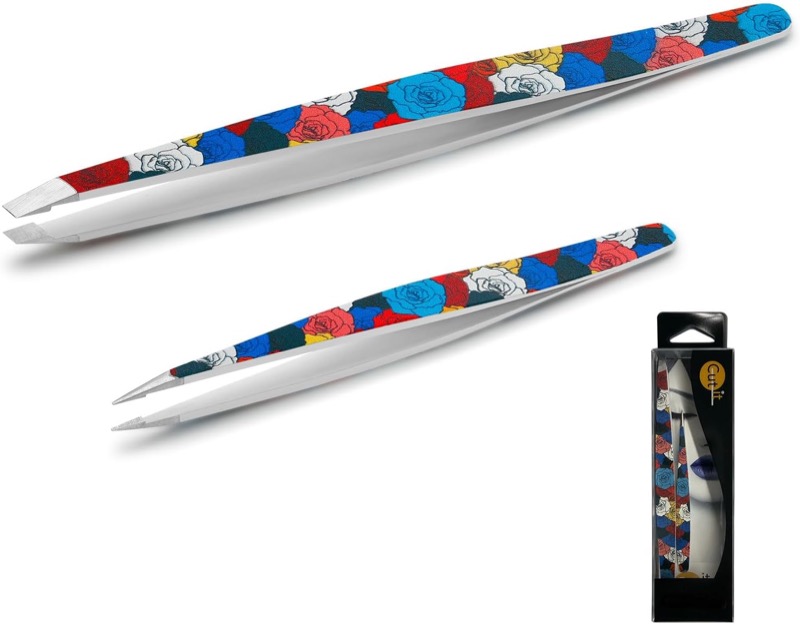
Slant and pointed tweezer set, 420 stainless
A retail example that names its steel grade in the listing — which is the claim to test first. A grade number is only meaningful with a material certificate or an analysis of your sample.
7. Corrosion and humidity. Wipe each pair with a dry cloth, then place it in a sealable bag with a damp (not wet) paper towel for 24 hours at room temperature, and again for 72 hours. Look for orange spots, staining and tarnish, especially at the joint and the edges of any coating. Then wash with soap and water, dry and re-inspect. A crude screen that catches poor finish and low-grade steel. It does not prove a grade, and does not replace a standard salt-spray test if you plan any corrosion claim.
8. Cleaning and coating. Clean each pair 20 times the way your instructions say: an alcohol wipe, then soap and water, then drying. Look for coating that dulls, flakes or transfers colour to the wipe, and for changes in tip alignment. Rub the grip area with a wet fingertip and an oily fingertip and note slipping. If the steel is coated, ask the supplier for the coating type and thickness, and have it measured if you plan any claim.
9. Volunteer panel. Give pairs to at least eight adult volunteers with a short protocol: use on brows or small areas of facial hair for a week, clean before and after each use, and report comfort, how often the tweezers slip, whether the tips ever pinched skin, and how the coating looks at the end. Tell them to avoid tweezing near moles, acne, inflamed or infected areas, which the dermatologist quoted above advises against, and to stop if skin is irritated. This is a usability check, not a study, and cannot show anything about hair growth or skin.
Reading the results: pass, revise or fail
| Result | Pass | Revise | Fail |
|---|---|---|---|
| Contents and labels | Matches the listing | Wording mismatch; fix the listing | Wrong tip shape or missing parts |
| Alignment | No visible gap; no sideways offset | Slight gap on some pairs; tighten inspection | Visible gap or crossed tips on several pairs |
| Grip on fine hair | Most strands gripped first time | Several slips; check tip finish | Many slips or breaks |
| Tension | Within your range; arms spring back | Wide pair-to-pair spread; set a tolerance | One arm stays bent or tension collapses |
| Cycling | Alignment and tension hold at 2,000 cycles | Slight loss; state a limit | Alignment or tension fails |
| Tip finish | Smooth tips; cover supplied where needed | Minor burrs; request polishing | Sharp or rough tips with no cover |
| Corrosion | No spots after 72 hours | Light staining on coating edges | Rust or pitting |
| Cleaning and coating | No change after 20 cleans | Slight dulling | Flaking or colour transfer |
| Volunteers | Comfortable | Complaints fixed by instructions | Pinching, irritation or slipping |
Treat a failure on alignment spread, tip finish or corrosion as a stop. They are the defects customers notice first, and some — a sharp unprotected point — are safety issues.
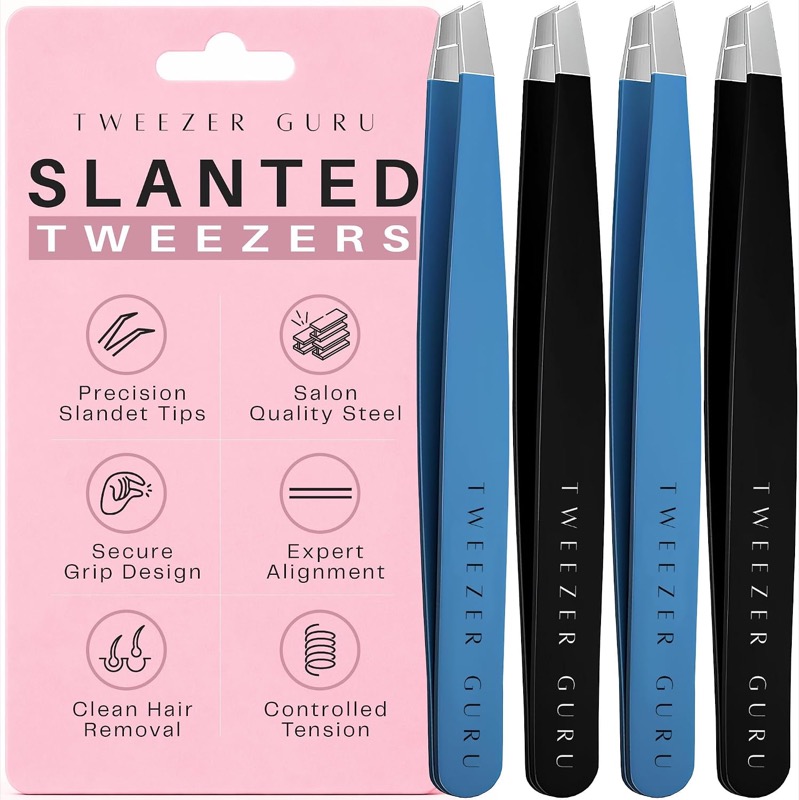
Stainless steel slant tweezer set
A set with several tip shapes puts the alignment test to work: every pair in the set needs the light-gap check, because a set is assembled from more than one production run and the spread between pairs is the risk.
The supplier brief
- The base steel grade, with a material certificate or laboratory analysis for your batch, and the standard the steel meets.
- The coating, if any: type, thickness, process, and any test for abrasion and corrosion.
- The tip shape, angle and width, and a drawing with tolerances.
- How tip alignment is checked on every unit or a defined sample, and the acceptance limit.
- The tension specification and the test method.
- The finishing process for tips and edges, including deburring and polishing.
- A tip cover or case, and its material.
- Any cycling or drop testing they have done, with results.
- Care instructions they have tested, including whether the tool can be wiped with alcohol.
- Minimum order quantity, lead time, sample policy and replacement terms, on the quotation and not in chat.
What your listing can say
- Material: "Stainless steel" if confirmed. Add a grade only with a certificate. Skip "surgical" and "medical grade" unless you can name the standard and show the document.
- Tips: the shape and angle you measured, and "each pair inspected for alignment" only if that is true.
- Tension: the force range you measured, if you want to mention it.
- Coating: what it is, in plain words, with a care note about alcohol wipes if you tested them.
- Care: wipe with an alcohol pad or wash with soap and water before and after use, dry thoroughly, store upright or in the supplied case, and keep the tip cover on point tips.
- Safety: a short note to avoid tweezing near moles, acne or irritated skin and to see a professional for deep ingrown hairs, consistent with the dermatology advice we found.
Avoid "antibacterial", "sterile", "never needs sharpening", "hypoallergenic" and "perfectly aligned" without evidence for each.
Frequently asked questions
Is surgical stainless steel a real grade? Reference sources say there is no formal definition outside medical device standards, and the term is often applied to any corrosion-resistant steel. If you want to use it, name the standard and keep the certificate.
Does a magnet show whether tweezers are good steel? No. It can hint at a steel family, since 400-series steels are described as mildly magnetic, but it cannot prove a grade.
Are hand-filed tweezers better than machined ones? Brands argue both ways. Both sides acknowledge variation between pairs, so inspect every batch and let your own measurements decide.
How do I check alignment at home? Close the tips and hold them up to a light. If light shows between them, or they are offset sideways, they are misaligned. That is the same check a retailer guide recommends.
How often should tweezers be cleaned? Dermatologists quoted in consumer articles recommend cleaning before and after use with an alcohol swab. A brand-run site suggests weekly is realistic. State the instruction you tested.
Can I call tweezers antibacterial? Not without a test report that matches the claim. We found none in the sources we read.
Should tweezers have a tip cover? For pointed tips, yes. Tips are sharp enough to puncture skin, according to dermatology comments, and a cover also protects the alignment.
What if a customer reports a skin reaction? Ask them to stop using the product and see a professional if it persists. Record the batch and the coating, and ask your supplier about the material. We make no claim about allergies.