Earrings are the one accessory that spends hours pressed into a wound. A pair of studs sits in a channel of healed (or not quite healed) skin, wet with sweat, shampoo and the odd bit of moisturiser, and it stays there from morning until you remember to take it out. If you are sensitive to nickel, that is close to the worst possible way to meet a metal. It is also why the words on an earring listing matter more than the sparkle in the photo: "hypoallergenic", "nickel-free", "surgical steel", "gold-plated", "925". Some of those words mean something precise. Some mean whatever the seller wants them to.
This guide sets out what medical sources and a piercers' association say about metals, what the European Union's nickel rules actually measure, where reputable sources disagree (surgical steel is the big one), which labels nobody defines, and what to look at when the earrings arrive. It does not recommend a brand and it is not medical advice: if you think you are reacting to your jewellery, a dermatologist can tell you what is going on.
For nickel and metal claims elsewhere in your kit, see bobby pins, nail clippers and surgical steel and eyebrow tweezers.
The short version
- Nickel is the most common metal behind jewellery rashes, and earrings, earring backs and watches are named by dermatologists as some of the biggest culprits.
- "Hypoallergenic" has no legal definition we could find. The US Food and Drug Administration says so for cosmetics, and a jewellery encyclopedia says the same of EU and UK law. Treat it as a mood, not a specification.
- Names of materials are more useful than adjectives. Implant-grade titanium to a named standard — ASTM F136 is the one piercers quote — is what both piercing sources and many dermatologists point to for known sensitivity.
- "Surgical steel" is where sources disagree. Mayo Clinic and the American Academy of Dermatology list it as acceptable; piercing-focused sources say it covers many alloys, some containing nickel, and ask for the exact grade.
- The EU limit for nickel release from anything inserted into a pierced ear is 0.2 micrograms per square centimetre per week. A listing saying "tested to EN 1811" or "REACH compliant" is making a checkable claim, and you can ask for the report.
- Plating hides the base metal, not forever. Ask what is underneath, and check the earring back as well as the post.
- The home nickel test is useful when it turns pink and weak when it does not. A published study found it missed more than a third of nickel-releasing earring parts.
What nickel allergy is, and why earrings are the classic case
Mayo Clinic describes nickel allergy as an immune system reaction that usually causes an itchy rash where the metal touches the skin. It lists jewellery for piercings, rings, bracelets, necklaces and watches among the usual sources, along with clothing fasteners such as zips, snaps and bra hooks. It says nickel allergy is most often associated with earrings and other body-piercing jewellery that contains nickel, and notes that women have a higher rate of the condition, probably because they are more likely to have piercings.
An American Academy of Dermatology (AAD) release, quoting a board-certified dermatologist from the University of California, San Francisco, makes the same point more plainly: if you are allergic, the best way to avoid symptoms is to avoid nickel, but that is hard because nickel is in many household items. She names earrings, earring backs and watches as some of the biggest culprits. The AAD also says to see a board-certified dermatologist if a rash blisters, becomes infected, or comes and goes.
Two features are worth knowing before you shop.
Once you react, it is generally a long-term problem. Mayo's advice is that avoiding nickel prevents repeat reactions, and that treatments reduce symptoms. Neither source describes a way to stop being allergic. A dermatology clinic's blog (a commercial source) says the reaction is delayed, appearing 24 to 72 hours after contact. Treat that timing as a rough guide only. It matters in practice because a new pair can feel fine on the day you buy it, and the rash can arrive after you have thrown the packaging away.
How common it is depends on who you ask. An older report of the AAD's own journal, repeated in a trade article, cited around 5.8 per cent of US adults testing positive in other studies. A jewellery brand, quoting the AAD, gives a much larger figure for North America, above 18 per cent. We could not reconcile the two and do not know which population, test or year each describes. The practical point survives either figure: a meaningful share of the people you sell to, or buy for, will react to nickel.
What is actually in cheap earrings
The best-known study of this question is the "San Francisco earring study", published in the Journal of the American Academy of Dermatology in 2008. According to the AAD's summary and a trade-press report, researchers bought 277 earrings from 34 different stores and artists in San Francisco in October 2007. About 31 per cent — 85 earrings — contained nickel. Earrings priced under $50 were more likely to contain it, but the report found no price point or country of origin that guaranteed presence or absence. A separate part of the AAD summary reported that nearly 43 per cent of earrings bought in one neighbourhood tested positive.
Three cautions before drawing conclusions from that.
- It is old. The earrings were bought in 2007, before most of today's online marketplaces existed.
- It is local. All purchases were in one US city.
- It is a screen, not a ban. It tells you the risk was real and did not track price neatly. It does not tell you what you will find on a marketplace listing today.
What it does support is the habit the rest of this guide builds on: do not use price as a proxy for safety in either direction. A cheap pair may be fine, and a pricey pair with a vague description may not.
What "hypoallergenic" means (and does not)
The FDA's consumer page on the word, which is about cosmetics rather than jewellery, says hypoallergenic cosmetics are products that manufacturers claim produce fewer allergic reactions than other products. It adds that there are no federal standards or definitions governing the term, and that manufacturers are not required to submit evidence. A historical FDA account explains why: the agency issued a rule defining the term in 1975, and a federal appeals court struck it down in 1977 because the agency had not shown consumers understood the word that way.
Jewellery is not a cosmetic, so that page is not a ruling on earrings. We found no US federal definition of the word for jewellery either, and a jewellery retailer's reference page states the word has no legally defined meaning in EU or UK law and is not the same as passing the EU nickel test. That page is commercial, so we treat it as consistent with the picture rather than proof of it.
There is a complication. The AAD's own consumer guidance advises wearing jewellery that is "nickel-free, hypoallergenic, or made from" a list of named metals, and an earlier AAD-published tip sheet from the San Francisco study said to look for the words "nickel-free" or "hypoallergenic" on labels. So a dermatologist group has used the word as a pointer while the FDA says it has very little meaning. The two are not contradictory if you read the AAD advice as "look for the label, then check the metal", which is how the later advice is built: the named metals are the substance and the adjectives are the packaging.
Our own working rule, a suggestion and not a standard: treat "hypoallergenic" as a prompt to read the material line, never as a substitute for it. If the listing offers only the adjective, the listing has not told you anything yet.
What the nickel rules measure
The EU's nickel rules are the most detailed public benchmark for jewellery, even outside Europe, because sellers often cite them. They sit in Annex XVII of the REACH regulation, and the UK has carried them into UK law. Three points matter to a shopper.
There is a stricter limit for the part that goes in your ear. The restriction says nickel must not be used in post assemblies inserted into pierced ears and other pierced parts of the body unless the rate of nickel release is less than 0.2 micrograms per square centimetre per week. For other articles that touch skin for prolonged periods, the limit is 0.5. A UK local authority's guidance for traders explains that the post assembly includes the part designed for insertion into the pierced hole plus any parts that hold it in and against the wound, "such as the ball or butterfly". In other words, the back counts.
It is a release limit, not a content limit. The original 1994 directive set a limit on nickel content in post assemblies — below 0.05 per cent by mass. It was replaced by a release test, because the content figure did not predict whether nickel was released. A European Commission document explains the change: in the absence of conclusive data on the levels of nickel that induce sensitisation, the content limit was replaced by a migration limit of 0.2 micrograms per square centimetre per week, measured with the standard test method EN 1811. That test puts the item in artificial sweat for a week and measures how much nickel dissolves.
Coatings must survive normal use. The restriction requires that where an article has a non-nickel coating, the coating must keep nickel release under the limit for at least two years of normal use. This is the formal version of a common-sense worry: that a thin plated layer over a nickel-containing base will wear through.
What this does not tell you is whether a given listing complies. Sellers outside the EU have no obligation to meet it. Within the EU and UK, importers carry the same obligations as manufacturers, according to the jewellery retailer's reference page. Neither fact tells you what is in your basket. Both give you a sensible question: "Has this item been tested for nickel release to EN 1811, and can you send the report?" A seller who has the report will usually say so up front. A seller who has not will often answer with another adjective.
We did not find an equivalent federal nickel-release limit for jewellery in US law, so US shoppers do not have a government test to point to. If a listing claims compliance with one, ask for the document.
Which metals do health sources point to?
| Source | Metals named for people avoiding nickel |
|---|---|
| Mayo Clinic | Nickel-free stainless steel, surgical-grade stainless steel, titanium, 18-, 22- or 24-karat yellow gold, nickel-free white gold, sterling silver |
| American Academy of Dermatology (UCSF dermatologist) | Nickel-free or hypoallergenic jewellery, surgical-grade stainless steel, 18-, 22- or 24-karat yellow gold, pure sterling silver, platinum |
| Association of Professional Piercers (as relayed by Healthline and brand pages) | Implant-grade titanium first; also implant-quality steel, gold of 14 karat or higher that is nickel- and cadmium-free, and niobium |
Three things stand out.
Nobody recommends "silver-coloured". Every list names a material, usually with a purity. That is the standard to hold a listing to. If it says "silver-tone", "gold-tone", "alloy" or "metal", you do not yet know what you are buying.
Yellow gold of 18 karat and above appears in both medical lists. Mayo and the AAD both name 18-, 22- and 24-karat yellow gold. The piercers' side, as relayed by a body-jewellery brand, quotes a lower floor of 14 karat for gold that is nickel- and cadmium-free and alloyed for biocompatibility. Both can be true: the medical lists are cautious about purity, the piercers' guidance is about the alloy.
White gold is a trap, and "nickel-free white gold" is worth reading twice. Mayo specifically says "nickel-free white gold", which implies some white gold is not. A jewellery reference page explains that white gold was historically bleached with nickel and that post-directive white gold is principally palladium-bleached. That is the retailer's account, so treat it as context. The practical rule is to ask what whitens the gold.
The piercers' view: titanium and standards
The Association of Professional Piercers (APP) is a non-profit safety organisation. Healthline reports that implant-grade titanium is the material most piercers recommend for initial piercings, and that it is nickel-free. It describes implant-grade as titanium certified for medical use and meeting standards set by ASTM International or the International Organization for Standardization. The designations to look for are ASTM F136, ISO 5832-3 and ASTM F67.
A body-jewellery brand adds a fine point: many companies can claim to use implant-certified titanium, but they should also have verifiable mill certificates proving the grade. A different brand's guide makes the same distinction from the other side: the APP sets jewellery guidance and material criteria but does not certify jewellery brands, and a standard such as ASTM F136 is a material specification, not a promise about any finished design or your individual tolerance. These are commercial sources with an interest in selling titanium, but their caveats are reasonable and consistent with each other.
What this gives you in practice:
- "Implant-grade titanium, ASTM F136" is a specific, checkable claim.
- "Titanium" alone is less informative. Several grades exist, and a "titanium-plated" or "titanium-coated" item is a different construction from solid titanium: a coating over another base does not establish that the post and back are solid implant-grade titanium.
- "Medical grade", "surgical grade" and "hypoallergenic titanium" are adjectives, not standards.
- Trade-offs are real. Titanium can cost more than steel, and a brand guide notes it is also lightweight, which some people like in a heavy design and others find too flimsy.
One more thing the piercing sources raise is fresh piercings. If yours is not fully healed, Healthline suggests skipping sterling silver until it has, and the piercing studio is the right place to ask about your own ear. Mayo advises checking that a studio only sells hypoallergenic jewellery and can provide documentation of metal content — the same "show me the paperwork" principle applied at the counter.
Where sources disagree: is "surgical steel" safe?
This is the single most argued-over phrase on earring pages.
What the medical sources say. Mayo Clinic and the AAD both list surgical-grade stainless steel among metals to choose if you want to avoid nickel reactions. Mayo's wording is "nickel-free stainless steel, surgical-grade stainless steel", treating them as two entries.
What the technical facts are. Several seller pages state that the common grade 316L contains roughly 10 to 14 per cent nickel. They argue the nickel is tightly bound and release is low, and one UK retailer says its 316L steel releases 0.02 micrograms per square centimetre per week, presented as well under the 0.5 limit for general skin contact. Another seller gives "less than 0.1 to 0.3". These are sellers arguing for their own products, and the figures are not independent test results we could verify. If a listing quotes a number like that, ask which test report it comes from.
What the cautious sources say. A body-jewellery brand notes that "surgical steel" describes a broad category rather than one guaranteed alloy, that some steel alloys contain nickel and may not suit someone with a known nickel allergy, and that ASTM F138 steel and ASTM F136 titanium are different implant materials: a generic "surgical" label shows compliance with neither. A separate seller describes "lower-grade" stainless as having a less stable structure and higher nickel release. The piercing-focused pages generally put titanium first for severe sensitivity and treat steel as acceptable for most people.
What an old study adds. A paper hosted by the US Centers for Disease Control on nickel leaching from stainless steel consumer goods found that some alloys gave a negative spot test while still leaching nickel. We cite it only for the idea that a negative simple test is not proof.
| Position | Who holds it | What to do with it |
|---|---|---|
| Surgical stainless steel is acceptable for nickel-sensitive people | Mayo Clinic, AAD | A reasonable option, particularly if you have tolerated steel before |
| "Surgical steel" is too vague to rely on; ask for the grade and release data | Body-jewellery brands, piercing sources | Ask for the grade (316L, 316LVM, ASTM F138) and any release report |
| For known or severe sensitivity, titanium is safer than any steel | Piercing-focused and brand sources | Reasonable if you have reacted to steel; commercial interest on the brand side |
Our own suggestion, not a standard: if you have had a clear nickel rash, buy solid titanium to a named standard or solid gold of a stated karat and alloy first. If you have only ever had mild irritation, a steel earring with a stated grade and a release report is a fair thing to try, with a short first wear.
Gold-plated, vermeil, gold-filled and "gold-tone"
Plating is where wording matters most and customers get caught most, because the surface looks the same whatever is beneath.
The US Federal Trade Commission publishes jewellery guides (16 CFR Part 23) setting out how sellers may use these terms. We could not open the guide text directly, so these descriptions come from secondary pages and a historical copy, and sellers' pages are commercial.
Vermeil. A base of sterling silver coated with gold of at least 10 karat fineness, of a minimum thickness commonly given as 2.5 microns.
Gold-filled. A layer of gold mechanically bonded to a base metal, where the gold makes up at least one-twentieth of the weight of the whole article.
Gold plate or gold electroplate. A gold coating applied by electroplating. The sources say the guides do not set a minimum thickness for this, but that the karat should be stated. Brand sources put typical thicknesses at a micron or less.
Gold-tone, gold colour. Not a gold claim at all.
What this means for nickel:
- Plating over an unknown base is the risk. The EU rule says a coating must keep nickel release under the limit for two years of normal use, the regulator's way of saying coatings wear and the base matters. Earrings in daily use are rubbed by hair, towels and pillows.
- Vermeil gives you a known base. By definition it is sterling silver, which Mayo and the AAD both list, though the AAD says "pure" sterling silver. The label "925" tells you the silver share; it does not tell you what the other 7.5 per cent is, and a brand's table makes the same point about other fineness marks.
- Gold-filled has a thick gold layer but sits over a base metal. A brand source that favours gold-filled says the layer is in the range of 50 to 100 microns, which is a sales claim; ask for the base metal.
- Plated posts with plain backs. Many earrings advertise a plated front and ship with a steel or brass back. The earring back is part of the post assembly in the UK guidance, and the AAD lists earring backs among the biggest culprits.
A rule of thumb, again our own: a listing that names a base metal and a plating thickness is more trustworthy than one that names only a colour.
Terms the listing uses loosely
| Term | What it can legitimately mean | What it does not tell you |
|---|---|---|
| Hypoallergenic | The seller thinks it is less likely to cause reactions | Anything about metal, nickel release or testing |
| Nickel-free | Possibly "no nickel added", possibly "passes a release test" | Which of those; whether the back is included; trace nickel |
| Lead and nickel safe / compliant | Possibly a US marketplace phrase | Which standard; ask for the report |
| Surgical steel | A steel the seller considers suitable for the body | The grade; the nickel content; the release rate |
| Medical grade | The seller's preference | Any specific standard |
| Implant-grade titanium | Titanium meeting an implant specification | Whether it is the whole earring or only the post; mill certificate |
| Sterling silver / 925 | At least 92.5 per cent silver | What the rest is |
| Gold-plated | A gold layer on a base metal | Thickness; base metal |
| Gold vermeil | Sterling silver base, gold of at least 10 karat, minimum thickness | Karat and thickness beyond the minimum |
| 14K / 18K | The gold share of the alloy | Which other metals; whether white gold is nickel-bleached |
| Tested | Something was tested | What, by whom, to which standard |
| Dermatologist recommended | At least one dermatologist said so | Who, on what evidence; no standard definition |
One source we read says the equivalents of "dermatologist tested", "allergy tested" and "dermatologist recommended" have no standard definitions either. That source is a consumer-advocacy organisation writing about cosmetics, not jewellery, so apply the point cautiously — but the logic carries over: a phrase nobody has to substantiate cannot substantiate anything.
What to look for before you buy
Most of the useful checking can be done on the listing page.
Is a material named for every part? Post, front, back and any hoop wire. If only the "earring" is named, the back is unknown. The back sits against skin all day and is part of what regulators call the post assembly.
Is the material specific? Titanium with a standard (ASTM F136, ISO 5832-3 or ASTM F67), steel with a grade, gold with a karat, silver with a fineness. The more specific, the better.
Is the plating described? Base metal and thickness, or a statement that the piece is solid.
Does the listing mention a test? If it says it was tested for nickel release to EN 1811 or REACH, is there a report or a lab name? If it says nothing, that is not a fault in itself, but do not assume.
Is the returns policy long enough for a delayed rash? Remember the 24-to-72-hour timing, which is a rough figure. A return window shorter than a week gives you little time to find out.
Do the reviews help? Search "rash", "itch", "green", "turned my ears" and "peeling". Reviews are not evidence, but a pattern is a signal. Ignore star averages, which mix up wearers with no sensitivities and those with several.
Is the size right for your ears? A brand guide notes discomfort is not always an allergy: post length, gauge and surface quality matter too. A post that is too short presses on the skin, and one too thick may not slide through a small hole. Choose size first, then material.
Checks to run when it arrives
Our own suggestions. None is a standard, and none replaces medical advice.
Match the delivery to the listing. Material, stamps, plating description and number of pairs. Photograph the package and any card.
Check the marks. Stamps such as 925, 14K or 18K usually appear on posts or backs. A stamp is a seller's marking, not an independent test.
Inspect the finish. Look at the post and back under a bright light or magnifier. Rough casting seams, pits or flaking plating are warnings. A flat-backed or smooth ball back is gentler on skin than a sharp one.
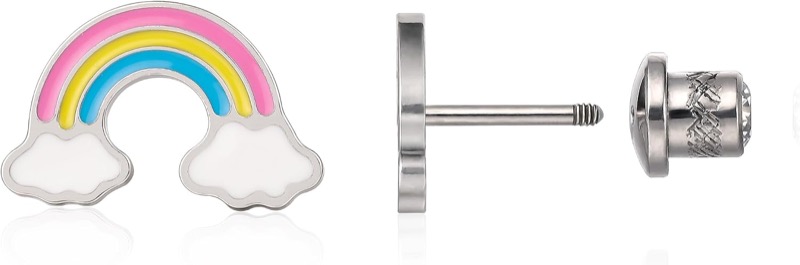
Implant-grade titanium studs, ASTM F136
A listing that names the standard rather than the adjective — the one material claim a shopper can ask a seller to document. Gauge and post length are stated too, which are the other two numbers that decide comfort.
Test the nickel, if you choose. Mayo says home kits are available. The classic kit uses dimethylglyoxime on a cotton swab, which turns pink or red in the presence of releasable nickel. Read the next section before trusting a negative.
Wear them briefly the first time. A short first wear, at the start of a day when you can remove them, lets you watch for itch or redness. Reactions can be delayed.
Keep the packaging and receipt until you have worn them over several days.
What a higher price should buy
Price does not prove safety, and the San Francisco study found no price point that guaranteed the absence of nickel. A higher price can reasonably buy a named solid material (titanium, 14 to 18 karat gold, platinum) rather than a colour; documentation, such as a mill certificate or a release test report; a better-finished post, smooth and burr-free, with less surface to corrode; a back made from the same material as the post rather than a stock steel butterfly; and a returns window with a customer service address that answers.
What it should not buy, and what you should resist paying for, is a thick-looking design in an unnamed alloy, or a "medical grade" badge with no standard behind it.
The nickel spot test: useful, but limited
A 2010 study in the journal Contact Dermatitis compared the dimethylglyoxime spot test with the standard EN 1811 method on 96 metal components from earrings bought in San Francisco. It found the spot test's sensitivity was 59.3 per cent and its specificity 97.5 per cent. In plain terms: when the swab turned pink, nickel was almost certainly being released; when it did not, the earring could still release nickel above the limit, and the test missed about four in ten nickel-releasing parts. The authors concluded it may serve well for screening.
A later paper on an electrochemical method adds that the swab test depends on pressure, area and duration of wiping, which raises the chance of a false negative. A product listing for a kit says to rub the swab firmly in a circular motion for five seconds and that it turns pink if nickel is present. That is a seller's instruction, not a protocol.
So use it like this: a pink swab is a reason to return the item; a clean swab is mild reassurance, not a certificate. Test the back and any clasp separately, and test somewhere inconspicuous, because the reagent can affect the finish of some metals and plastics.
Keep it, query the seller, or send it back
| What you see | What it suggests | What we would do |
|---|---|---|
| Swab turns pink on post or back | Releasable nickel present | Return it; do not wear it |
| Listing says solid titanium or gold but the stamp, weight or colour is off | Description may not match | Ask the seller; return if no clear answer |
| Plating chips or wears during the return window | Base metal exposed | Return it |
| Item matches the listing, smooth finish, swab clean | Nothing wrong found | Keep it and wear it briefly first |
| Rash or itching after wearing | Possible reaction | Stop wearing the pair; see a dermatologist if it blisters, looks infected or recurs |
| Listing quoted a test report and the seller cannot supply it | Claim unsupported | Return it |
| Back is a different metal from the post, undescribed | Unknown material against the skin | Query the seller, or replace the back |
Using and looking after earrings
- Do not keep wearing a pair that irritates you. The AAD's advice to avoid nickel is also the simplest treatment. An AAD tip sheet from the San Francisco study said to see a dermatologist if symptoms did not improve within three to five days of not wearing jewellery.
- Use a gentle clean. Piercing and jewellery brands give care instructions; we did not find a consensus from medical sources on specific cleaners, so this belongs to the seller's care card and your dermatologist.
- Do not rely on nail varnish or barrier coatings as a fix. A jewellery brand's blog points out that clear nail polish wears off, putting you back in direct contact. A published study of barrier coatings found some products gave negative spot-test results after soaking in saline, but that was a test of the coating, not a clinical trial of people wearing earrings.
- Rotate your pairs. Our suggestion: if you wear one pair every day, a reaction is easier to trace to it; with several pairs you can work out which is the problem.
- Keep fresh piercings to the piercer's advice. Healthline's summary of the APP position is that implant-grade titanium suits initial piercings. Ask the studio what they use and whether they hold documentation.
- A reaction can have other causes. A brand guide notes post length, gauge and surface quality matter, and that discomfort is not always an allergy. Sleeping on them, a new piercing, sweat or product residue can all look similar. A dermatologist can tell the difference, and patch testing is how nickel allergy is formally confirmed.
When to see a professional
Book a dermatologist or your doctor if you notice a rash that blisters or weeps; redness, swelling, heat or pus around the piercing; a rash that goes away and comes back; a reaction that spreads to other areas such as the neck or wrists from other jewellery or a watch; or a rash that does not clear after you stop wearing the earrings. The AAD's own advice is to see a board-certified dermatologist if the rash blisters, becomes infected or comes and goes.
What your listing can say
If you sell earrings, this is the wording that survives scrutiny.
Safe to print, if true:
- "Implant-grade titanium to ASTM F136" — with a mill certificate you can send on request.
- "316L stainless steel, nickel-release tested to EN 1811 (report available)" — only with the report in hand.
- "Sterling silver (925) with 18K gold vermeil, minimum 2.5 microns" — vermeil has a defined meaning; use it precisely.
- "Hypoallergenic" — only if you accept that it is undefined, and never as the only claim on the page.
- "Nickel-free" — only if you can state what it means: no nickel added to the alloy, or a release test result.
Avoid unless you hold evidence for each: "medical grade", "surgical grade" without a specific grade, "surgical steel safe for nickel allergy", "dermatologist recommended" without a named dermatologist, "nickel-free" when only the post is certified and the back is a stock steel butterfly, "tested" without naming the test, and any claim that a coating makes an item safe forever.
We are not lawyers, and this is not legal advice. Advertising and product-safety rules differ by market, and in the EU and UK the nickel restriction is law, not a marketing choice.
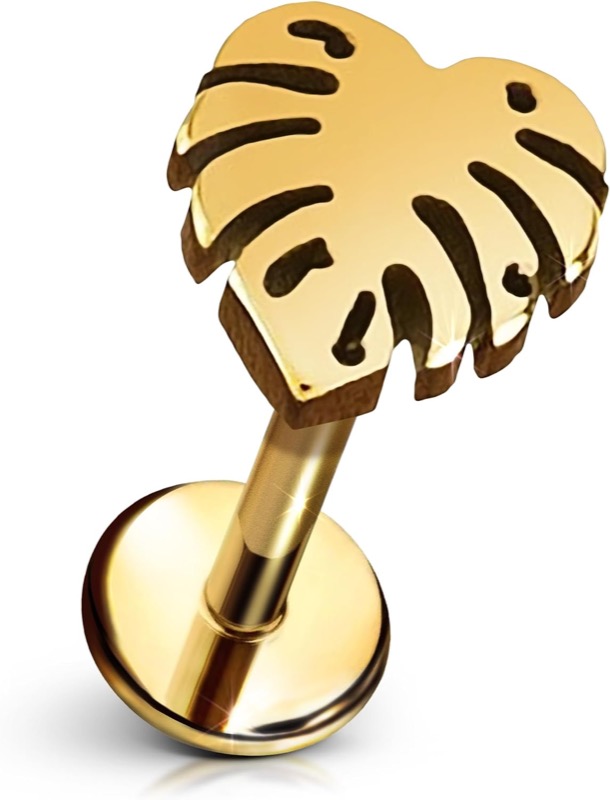
Titanium flat back stud, ASTM F136
A second titanium listing, this one a single earring in a flat-back design. Reads as an example of how much a listing can specify when it wants to — standard, gauge, closure and plating, rather than one adjective.
Frequently asked questions
Is "hypoallergenic" the same as "nickel-free"? No. "Hypoallergenic" has no legal definition we could find, and "nickel-free" can mean no nickel added or a release test passed. Ask which.
Is surgical stainless steel safe if I am allergic to nickel? Mayo Clinic and the AAD list it as acceptable. Piercing sources and body-jewellery brands say the phrase covers different alloys, some containing nickel, and recommend titanium for known sensitivity. The grade and release data decide it.
Is titanium always safe? Implant-grade titanium to a named standard has no nickel and is widely recommended for sensitive skin. The sources say the grade matters and that no material guarantees against every reaction.
Are gold-plated earrings safe for nickel allergy? It depends on the base metal and the plating thickness. Wear exposes what is underneath, and the EU rule asks coatings to hold for two years of normal use.
Is sterling silver safe? Mayo lists sterling silver and the AAD lists "pure" sterling silver. The 925 mark tells you the silver share, not the other 7.5 per cent. Healthline suggests skipping sterling silver in a fresh piercing until it heals.
Does white gold contain nickel? Some does. Mayo's wording is "nickel-free white gold", and a reference page says palladium-bleached white gold became the norm after the EU directive. Ask what whitens the gold.
Does a higher price mean nickel-free? No. The San Francisco study found no price point that guaranteed presence or absence, though earrings under $50 were more likely to contain nickel.
Do I need to test my earrings? You do not have to. A home swab test is cheap and a pink result is informative. A negative result is not proof, because the published sensitivity was about 59 per cent.
What is EN 1811? The European test method for nickel release. It soaks the item in artificial sweat for a week and measures how much nickel dissolves, with the limit for pierced-ear posts at 0.2 micrograms per square centimetre per week.
What if the seller says "REACH compliant"? That is a claim about the EU rule. Ask for the report, and ask whether it covers the post and the back.
Can I wear earrings that give me a rash if I put varnish on them? Sources say clear coatings wear off. Ask your dermatologist before relying on one.
I only get a reaction sometimes. Is it still nickel? It might be, but sweat, new piercings, product residue and post length can also cause irritation. The AAD advises seeing a dermatologist if a rash comes and goes.