A salon display has a specific job: let a customer compare designs quickly, and let staff retrieve the matching retail set without confusing a sample with the product being sold. A clear acrylic board suits a consultation table, a refillable book travels between locations, a printed card fits a compact counter.
The format matters less than whether the display stays readable, replaceable, and tied to a stock record. That last part is where most buying decisions go wrong, because a display is usually chosen for how it looks empty.
For the mounting-adhesive side of the same problem, see display card adhesive residue — the surface that holds a sample is also the surface that fails first.
Start with the salon interaction
Decide where and how the display will be used before comparing products.
- Reception browsing: the customer needs a fast view of designs and a clear path to the matching set.
- Technician consultation: samples need to be holdable beside the client's own hand.
- Mobile artist: a book that closes securely and survives being carried.
One display rarely does all three well. Write the interaction down in plain language: will customers handle samples themselves or will staff present them? Does the display stay on a counter, live in a drawer, or travel? Does the customer choose a design only, or also length, shape, finish and size family?
Those answers decide whether samples are mounted in rows, on removable cards, or in a book that opens flat.
Keep the task narrow. A sample display is a presentation and selection aid. It is not the retail package, a size kit, an inventory system, or proof that the sample matches every set in stock. Decide which of those jobs it must do and specify the rest separately.
Choose a format that supports replacement
- Flat acrylic board. Easy to place on a counter and show a small collection at a glance. Before choosing it, check whether the sample attachment can be replaced without damaging the board, whether it stands steadily, and whether the usable area fits the label you need.
- Display book or binder. Holds more designs and travels well; good for appointments or multi-location teams if pages can be removed and reordered. The trade-off is browsing: a full book gets awkward, and sleeves reflect light and hide surface detail. Ask how many usable pages are included, whether inserts use a standard size, and whether the closure stops pages bending in transit.
- Card or swatch strip. Simple and light; fine for a few featured designs or a seasonal selection. Weak if the range changes often and individual samples cannot be replaced or relabelled.
These are format tendencies, not guarantees. Listings use "display book", "storage album", "swatch card" and "sample board" loosely, so ask for photos of the exact configuration and a written component list: stand, sticks, adhesive, label cards, sleeves, fasteners — or only the empty board.
Set the sample range before ordering the holder
Do not pick a holder by the largest number of slots it advertises. Decide how many designs need to be visible at once and what the customer is comparing. A 60-slot board can look efficient, and still fail if each sample is too small to identify or the labels cannot be read at counter distance.
Build the range around choices. For a ready-to-wear collection, show the actual design and SKU staff can retrieve. For a consultation tool, group by the distinction being decided — short versus long, rounded versus tapered, plain versus embellished — and label any mix of sample types.
Keep one record per mounted design: display position, design name or code, shape, length, finish, retail SKU and current availability. If the sample is a visual reference rather than the production item, say so internally and give staff a way to confirm the live SKU before taking payment. A sample without a traceable code becomes a guessing game once the person who built the board has gone.
Then plan for change. Styles sell through and get discontinued. Ask whether one sample can be removed and remounted without replacing the whole board, how replacement pages or cards are ordered, and whether the numbering stays stable when a slot is reused. If the format is not refillable, compare the cost of replacing a board against how often your range actually changes.
Make samples visible and secure
Check legibility from the customer's real viewing position — above the counter board, and in the staff member's hand for a book. Test whether the page lies flat, whether the spine blocks the edges, and whether overhead lighting glares across glossy or chrome finishes.
Compare sample and label size in use. A code that is readable to the person who assembled the board may be useless to staff working quickly. Use a short name or SKU that maps to the point of sale, and keep the label close enough to its sample that it cannot be attributed to the neighbour when pages shift.
Test retention with the exact mounting method supplied. Press-on tips get mounted with putty, double-sided adhesive, magnetic holders or a proprietary system, and a method that holds a gel swatch may not hold a long decorated press-on. Mount a short, a long and a decorated tip, then turn the board, carry the book and open and close it several times. Record whether samples shift, rotate, lift, or leave residue — a handling check for your own use, not a durability standard.
Inspect contact points too. Adhesive can mark a sample, lift a decoration or make removal difficult. Staff should be able to swap a design without bending the tip or damaging a reusable page. If the mount is proprietary, ask whether spares are sold and at what price; a holder that only works with one consumable creates a replenishment problem later.
Separate appearance from product representation
Colour shifts under warm salon lighting, daylight and phone cameras. Gloss, glitter, chrome and translucent finishes are especially angle-sensitive. Place samples under the lighting where customers browse and compare them with the packaged product or a current control set.
A display can identify a design, but it should not be the only source of product information. Staff or a nearby card should state what the retail set includes, how the customer chooses a size, and whether the shown sample is one size or a presentation-only tip. Sample tips may be glued to a holder, painted for reference, or built from a different blank than the stock product; if so, that belongs in the staff instructions.
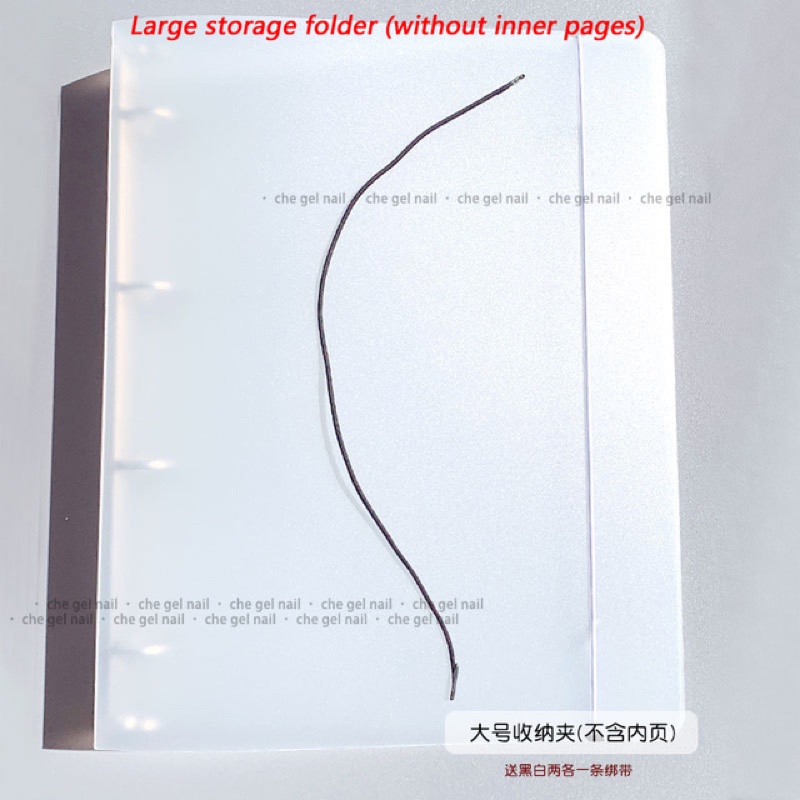
Frosted nail-tip display and storage book
A wholesale display book listed in large and small versions, sold as a holder rather than a finished display. Confirm page count, insert size, label area and whether pages can be reordered separately.
Listing photos typically show the empty holder; inner pages and sample sticks may be sold separately.
Record for each sample whether it is a saleable nail, a blank tip, a decorated reference or a mock-up. If a shape or finish changes, update both the label and the product record. Do not promise that the display matches the retail colour or size unless you have compared it with the current SKU.
A display also creates a service boundary. It helps compare options; it does not prove that a set will fit a particular customer or wear for a stated number of days. Keep selection language practical and make application advice match the product's real instructions.
Request a useful sample and quote
Describe the intended use and ask for comparable options: display type, open and closed dimensions, number of samples, sample size, mounting system, label area, material, colour, logo placement, included accessories, replacement parts, quantity and destination.
Ask for the holder, the sample pieces and the label cards to be priced separately where possible. That is how you find out whether an attractive display price excludes the parts that make it usable. Also ask for sample fee, customization charge, logo setup, shipping, minimum order by design or colour, lead time, packing quantity, and whether replacement inserts can be ordered later.
The useful question is not "can you customise it" but "which components can change without changing the rest of the display?" A replacement page, a different label card and a standard mount are what make a display survivable across seasons.
Test the display before a rollout
Approve one physical sample in the exact configuration you plan to use, loaded with the planned number of representative designs — not empty holders. Include a long or embellished sample if the range contains them. Check that the board stands, the page turns, the closure works, labels stay aligned, and each design is easy to remove and return.
Then hand it to a staff member who did not assemble it and ask them to find a named design using only the labels and the buying sheet. Watch for guesses, lifted samples and second lists. If that task is slow, change the order, the label size or the grouping before producing more boards.
Run a handling sequence that matches the setting: move the counter board between storage and display, or carry the closed book to an appointment and open it several times. Inspect afterwards for shifted samples, bent pages, loose fasteners, scuffed finishes and detached labels. Do not call this a shipping test; if displays are mailed between branches, pack and test that separately.
Turn approval into a reorder record
Save the accepted display's supplier, model, dimensions, material, page or slot count, mounting system, label template, sample list, date and photographs. Record which parts are replaceable and how they are ordered.
Before reordering, compare the new unit with the reference: format, usable area, attachment method, label location and included components. Ask the supplier to identify any change in material, finish, page layout, magnet, adhesive or packaging. A listing title is not a version number.
The best display is the smallest system that lets a customer compare relevant designs and lets staff retrieve the matching set without confusion. Choose the interaction first, test the loaded holder under real salon conditions, and keep the sample map with the reorder record.