A satin-lined cap answers a real problem: a wearer wants the shape of a baseball cap without a rough interior against her hair. The fabric name does not answer the next questions — whether it fits over the style she actually wears, whether it stays put, and whether it survives the wash.
That gap matters when you are buying the cap, not just wearing it. A sample can photograph well and still fail on the first wear: crown too shallow, lining stopping at the wrong seam, a label catching strands, an adjustment range that only works when the hair is flat.
This guide treats the cap as a complete object to sample. It covers the checks worth running on the styles you intend to serve, and it pairs with the fibre questions in silk or polyester satin — satin is a weave, not a fibre.
A satin lining is only one part of the product
Listings sell the lining because it is easy to name. Fit, crown depth, contact points and care are what decide whether the product works.
None of that means a lining is unimportant. It means a lining claim has to hold up on the inside of the actual cap: which panels are covered, where the fabric stops, and what a wearer's hair touches when the cap shifts.
This is a sourcing guide, not evidence that any lining prevents breakage. Translate wearer complaints into testable specifications, then confirm them on the sample.
1. Choose one wear profile before choosing a cap
Do not start from "one size fits all". Start from a wearer and a routine: loose curls, a twist-out, short locs, low braids, a puff through an opening, or a flatter everyday style. One cap pattern will not serve all of them equally well.
Pick the two or three profiles that matter for the first product, and say explicitly which are outside its fit promise. Then write a short wear brief: intended hairstyle, approximate volume, how the hair is arranged under the crown, typical wear duration, and whether the wearer expects to adjust during the day.
This is the step that prevents the classic sampling error — sending one cap to one tester with flat hair, receiving "fits well", and treating that as evidence for braids. The test condition is part of the result; record it beside every measurement.
2. Measure the cap where the wearer feels it
Ask for the finished internal circumference range, not the exterior size. Record the smallest and largest usable settings of the actual closure, the adjustment method, and whether the strap end will contact hair. A buckle, hook-and-loop tab, snapback, elastic panel and stretch band all behave differently; "adjustable" does not mean a comfortable continuous range.
Then measure crown depth on the physical sample with a repeatable reference — for example from the top seam to the lower front edge at centre — and use the same points on every sample. A crown can be roomy at the top and shallow at the sides, or deep at the front and tight at the back.
Note whether the cap is structured or unstructured, because that changes how the crown holds shape under hair. Do not copy another brand's numbers as a universal minimum; build your own record of head measurement, hairstyle, closure setting, crown depth and a simple fit rating.
3. Check the lining map, not just the word satin
Turn the sample inside out and draw the lining map. Mark which crown panels are lined, whether the lining reaches the lower seam, what covers the sweatband, and where the lining stops at the back opening.
Note exposed twill, mesh, seam allowances, labels, embroidery backing and loose threads. Hair touches all of those when the cap shifts or comes off.
Ask what the supplier means by satin. Satin names a weave; it does not identify a fibre. The lining may be polyester satin, silk satin, or another combination. Put the required composition in the purchase specification and ask for a label or documentation that supports whatever claim you plan to print — and do not upgrade a supplier's "silky" wording into silk.
Coverage matters as much as material. A narrow strip across the front band is not a lined crown; describe partial lining accurately and show the zones in a photo or diagram.
4. Inspect seams, labels and the back opening
Run fingers, or a fine-tooth comb, over every surface that touches hair. Look for rough seam ridges, exposed stitch ends, sharp tag corners, adhesive backing, snagging hook-and-loop tape, and lining edges that roll outward. Dense embroidery and stiff backing can create a hard patch against the forehead.
Check the back opening separately. A cutout may suit a ponytail or puff, but the edge, closure and strap can still press on or catch hair. Watch how the wearer puts the cap on and takes it off; that motion is when most snagging happens.
Approve a decorated sample, not a blank: embroidery density, backing and patch edges change the interior feel. Record the artwork position and the backing that was approved.
5. Run a wear test across hairstyles and movements
Keep the test small but controlled. Ask a few wearers who match the profile to try the same cap under the same basic conditions. For each person, record the style worn, initial adjustment, pressure points, whether the cap shifts, and whether the lining contacts the areas it should.
Ask them to wear it through ordinary movement — walking, turning the head, looking down, taking it on and off twice. Do not substitute an intense workout unless the product is sold for that use.
Separate the observations. "It slides" points at closure or head shape; "it sits high" at crown depth; "it presses on the puff" at internal room; "the band rubs" at the sweatband or a seam. The tester should not have to diagnose the cause — your job is to match the report to the physical sample.
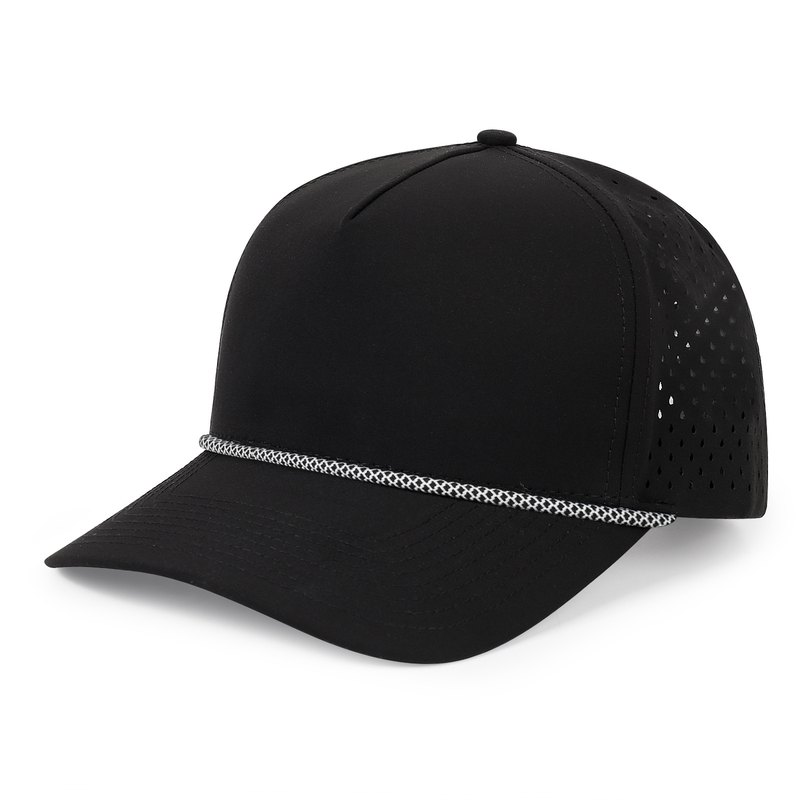
Custom 5-panel satin-lined baseball cap
A wholesale cap offered with custom embroidery and a satin lining option, the construction this guide is written to sample. Confirm lining coverage, fibre content, crown depth and closure range before treating it as a match.
Card photo shows the exterior only; the lining is the part you have to inspect on a physical sample.
6. Wash the sample according to the care promise
Before writing "machine washable", "hand wash only" or "colourfast", get the intended care method and test the decorated sample that way. Check for colour transfer, lining distortion, seam puckering, closure damage and fit change. Let it dry as instructed, then try it on again.
An informal sink test does not support a broad colourfastness claim. One sample, one wash and one detergent do not establish performance across colours or lots. For a first small batch, state the care instruction confirmed for the approved sample and ask the supplier what evidence backs anything wider. If the lining is a contrasting colour, press a damp white cloth against it and document what happens — as a screening check, not a laboratory result.
If the cap changes shape or becomes uncomfortable after care, stop and fix the cause. A cap that only works new will generate returns once customers wash it.
7. Turn a good sample into a purchase specification
Make the approved sample a reference rather than a memory. Give it a code and record the date, style, colour, fabric description, closure, lining map, labels, decoration, measurements and care test. Keep a physical reference if you can, and photograph the interior and the measurement points.
Write tolerances only after agreeing how the supplier measures each feature. A tolerance copied from another cap may be wrong for a soft unstructured crown, a stretch band or a hand-sewn lining. For a pilot order, agree which checkpoints are inspected on every unit and which are sampled from the lot, and get the acceptance rule in writing.
A useful request for quotation includes the cap profile and panel count, finished circumference range and closure type, crown depth measurement points, lining map, fibre composition, sweatband construction, label and embroidery details, colours, care instructions, sample charges, minimum order by colour, lead time, packing and the defect-reporting process.
8. Approve production against the version you tested
Before a repeat or larger order, compare the pre-production sample with your approved reference: model, panels, lining coverage, closure, labels, colour and decoration. Repeat the critical measurements and re-test the areas that changed.
If the factory substitutes a lining fabric or a closure because the original is unavailable, require a revised sample and a new approval. A visually similar cap is not automatically the same fit or the same contact surface.
On arrival, inspect from more than one carton if the order is packed that way. Compare colour, seams, lining map and closure function with the reference, photograph defects with lot details, and ask for a corrective action before selling. Keep customer feedback tied to the version, because a later revision can fix one complaint and create another.
A compact sample scorecard
One row per sample version, one column per decision. Pass, revise or reject beats a vague overall impression.
| Check | What to record | Revise or reject if… |
|---|---|---|
| Wear profile | Style and volume tested, expected use | The test group does not match the claim |
| Fit | Circumference range and crown depth at agreed points | It only fits flat hair or a single tester |
| Lining | Coverage map, fibre claim, documentation | The map does not match the description |
| Contact points | Snagging, rough edges, tag or backing contact | Hair catches in normal use |
| Closure | Adjustment range, hair catching, strap end | It slips or traps hair through the range |
| Wear test | Stability, pressure and heat comments | Uncomfortable after ordinary movement |
| Care | Method tested, changes documented | It deforms or bleeds in the stated care |
| Production control | Reference sample, version code, artwork, checks | Any of those is undefined |
A failed check should produce a specific next action: deepen the crown, revise the closure, extend the lining, move a label, change the care instruction, or narrow the advertised wear profile. "Make it better" gives the supplier nothing verifiable to do.
Approve the cap only when fit, lining coverage, contact points and care have been checked on the hairstyles you intend to serve. The best first sample is not the one with the most embroidery or the lowest quote. It is the one whose wearer, construction and checks are clear enough that the next batch can match it.