A sleep mask looks like the simplest product in the drawer: a small piece of fabric and a strap. It is also one of the easiest to get wrong. The satin face that looked luxurious in the photo can be a thin layer over foam. The "total blackout" claim can fail at the nose. The strap that felt snug in week one can go slack in week three, and a wearer who tightens it to stop light leaking ends up with a headache and a red line across the forehead.
This guide separates the material words from what is actually in the product, explains what is known and what is marketing about light blocking, and sets out a short sample test for light leaks, strap recovery and washing you can run with a lamp, a ruler and a few volunteers.
A sleep mask is a comfort accessory. How it affects any individual's sleep is a separate question this article does not answer.
Four layers, four questions
A listing that says "silk sleep mask" usually describes a product with at least four parts, each of which can be made of something different:
- The face fabric — what you see, and on many designs what touches the skin.
- The padding or filling, which gives thickness and blocks light.
- The inner or back layer, which may or may not match the face.
- The strap, which may include elastic, hook-and-loop, a buckle or a tie, plus the stitching that joins it to the mask.
When a title says "silk", it rarely says which of these it refers to. The rule is the same as with satin bonnet material claims: a fibre-content claim is only useful if it names the layer it covers.
For each sample, write down four answers:
- What fibre is the face fabric, and is the figure a percentage or a vague word?
- What is inside, and what does it do (foam, polyester wadding, a blackout layer)?
- What touches the eyelid and lashes — face fabric, back layer or foam?
- What is the strap made of, and does it contain latex?
If the supplier cannot answer them in writing, treat the rest of the description as unverified.
"Silk", "satin" and "silky": what each word claims
Silk is a fibre. Satin is a weave — a way of arranging threads so one face is smooth and glossy — and a satin weave can be made from silk, polyester, nylon or other fibres. So "satin" tells you about the surface, not the fibre, and "silky" or "silk-feel" tells you about marketing intent, not content.
A listing needs a composition statement next to the headline. "Face: 100% polyester satin; filling: polyester; strap: nylon and spandex" is a defined comparison point. "Luxury silk-like satin" is not.
In the United States, textile products that fall under the Textile Fiber Products Identification Act must be labelled with the generic names and percentages of the fibres they contain, and a product can be treated as misbranded if it is falsely or deceptively labelled or advertised as to fibre name or amount. Whether a particular eye mask falls inside the Act's scope depends on how the product is classified, which this guide cannot settle. The useful point is simpler: do not write "silk" on a product page unless you hold fibre-content documentation for the layer you are describing, and ask a compliance adviser about labelling in your market.
A mask can honestly be "silk face, polyester back" or "polyester satin face, cotton back". What matters is that the claim matches the part that contacts skin, and that the page makes it clear.
What the light-blocking claims are built on
"Blackout" and "100% light blocking" are the most common claims on mask listings. It helps to separate what is known from what is not.
What research shows. A small laboratory study delivered individually calculated doses of light through the closed eyelids of volunteers using a prototype light mask. Compared with a dark control night, melatonin was suppressed by 36 per cent after sixty minutes of exposure at the start of the night, 45 per cent in the middle and 56 per cent at the end. The study was preliminary and used very bright, carefully calibrated narrow-band light, so it shows that light reaching the eye through closed lids can have a biological effect under those conditions. It does not tell you how much a mask helps in an ordinary bedroom, and it compared no commercial mask.
What is mostly marketing. Retailer and supplier blogs make strong claims about contoured masks — that flat masks press on the eyelids all night, that this disrupts REM sleep, and that cups fix it. These statements come from sellers rather than controlled studies. More careful consumer guides say simply that the best shape depends on face shape and sleeping position: back sleepers may find cups comfortable, some side sleepers prefer a thin flat design.
For a brand, describe what you built and what you measured. "Contoured eye cups that rest away from the lids" is a design description. "Improves sleep quality" is a health claim a sample test cannot support.
Where light actually gets in
Whatever the shape, light leaks at the same few places. The gap at the nose bridge is the most common cause, with the cheek edges and temples next: the mask has to bridge a concave nose, a convex cheek and a tilting forehead, usually with one flat piece of fabric.
Common design fixes include a nose flap or notch, extra fabric along the lower edge, a contoured face, and a strap that pulls evenly rather than at one point. Each has trade-offs: a nose flap that is too stiff lifts at the cheek; a wide lower edge presses on the cheekbones; a deeper cup adds bulk that a side sleeper's pillow can push out of place.
One mistake is worth naming because it appears among buyers and sellers alike: tightening the strap to cure a leak. That raises pressure on the face and the back of the head and does not fix a mask whose shape does not meet the face. If a mask only blocks light when it is uncomfortably tight, it has a design problem, not a strap problem.
A repeatable light-leak test
This is an in-house screening test, not a standard. Its job is to compare candidates under the same conditions and find obvious leaks.
You need a room that can be made dark, a bright lamp or phone torch, a camera, a tape measure and at least five volunteers with different face shapes. Each wears the mask as they would to sleep, with the strap adjusted to comfortable rather than tight.
| Step | What to do | What to record |
|---|---|---|
| 1. Daylight baseline | In a bright room, eyes closed, mask on: report any visible light at each edge | Where light appears: nose, cheeks, temples, brow |
| 2. Dark-room lamp pass | In a dark room, shine a lamp or torch at the face from the front and each side at a fixed distance | Whether the wearer sees a glow, and where |
| 3. Camera check | With consent, photograph the mask edge under the torch from several angles | Visible gaps between mask and skin |
| 4. Movement | Turn onto each side, then back, as if in bed | Whether the mask shifts and opens a gap |
| 5. Pillow check | Repeat the side turn with a pillow pressed to the mask | Whether the pillow moves the mask or deforms the cups |
| 6. Comfort log | After thirty minutes, record pressure marks and strap tightness | Comfort notes, not a sleep score |
Test every sample with the same volunteers and sequence. If the same leak shows on three or more wearers, it is a design issue. If it shows on one, note the face shape and decide whether your target customer looks like that person.
Do not publish a light-blocking percentage unless you have a measured method behind it. A single light-meter reading at one point is not a rating.
The face fabric: how smooth, how clean
A satin face is chosen for its feel, which says nothing about behaviour in use. Check on the sample:
- Snagging. Run a clean fingertip and the edge of a ring or nail over the face. A satin that snags easily will look rough fast.
- Colour transfer. Rub with a white cloth, dry then slightly damp. If dark satin leaves colour, it can stain skin, lashes or a pillowcase. The same rub logic applies as in the cosmetic bag lining test.
- Edges. Look closely at the binding or hem. Rough or stiff edges irritate the skin around the eyes.
- Skincare and makeup contact. Dab moisturiser and a little foundation on the fabric, leave them overnight, and see what remains. Satin picks up oils and can stain.
If the mask is meant for use with lash extensions or sensitive skin, have a wearer test that specific scenario. A mask that suits a bare face may drag on lash extensions, and you cannot predict that from the fabric description.
Padding: what is inside matters more than it looks
The filling decides weight, heat, bulk and, to a large degree, how much light gets through the fabric itself. It may be polyester wadding, foam, or a layered blackout fabric. Dense or layered materials block light better than thin porous ones, and a thin translucent fabric can leak light however good the fit — hold the mask up to a bright lamp and look through it before you worry about the edges.
- Light through the body. If you can see the lamp as a glow through the centre, the fabric is letting light through whatever the edge fit.
- Compression. Press the cups and release: does it recover, or stay dented? A mask that loses shape in a few washes will leak around the nose.
- Heat. Wear it for half an hour in a warm room; some wearers find padded masks hot.
- Smell. Open the packaging in a closed room. A strong chemical odour from foam or adhesive is a reason to ask questions.
The strap is where most masks fail
Masks often fail at the strap, because it is the part that stretches, rubs and is washed. Three design families, three failure modes:
- Fixed elastic loop — simple and cheap, fits some heads and not others, and a single size can be too tight or too loose.
- Adjustable elastic with a slider or buckle — fits more heads, but more parts to break or catch hair.
- Hook-and-loop or tie — easily adjustable; hook-and-loop catches long hair and wears out, ties can slip.
Wider, contoured bands spread pressure over a larger area and are less likely to create a pressure point behind the ears, according to consumer guidance — design reasoning rather than measured evidence.
Latex: ask before you order
The elastic inside a strap is not always what the page implies. It can be based on spandex (elastane), polyester, or natural rubber latex, and natural rubber latex can cause allergic reactions in some people. Suppliers sell both: some elastic is polyester and spandex labelled latex-free, other cord is polyester with natural rubber.
For a mask that sits on the face and head for hours, ask the supplier to name the elastic's composition in writing and confirm whether it contains latex. Do not write "hypoallergenic" or "latex-free" until you have that confirmation for the actual strap in the sample.
Strap recovery: a home test
Elastic stretches and then fails to return. You can look for early signs:
- Mark a 10 cm section on the relaxed strap with a fabric pen or tape flag.
- Stretch to the length you would reach on a large head, hold ten seconds, release; repeat fifty times.
- Rest for an hour, then re-measure the marked section.
- Repeat after a wash cycle if the product is machine washable.
Record the starting length, the length after rest, and what you did. If the strap has permanently lengthened visibly, or the stitching has opened at the join with the mask, mark it revise or fail.
Also write down the strap range — the shortest and longest lengths it can comfortably reach — measure each volunteer's head circumference, and note who falls outside it. A product that fits three of five testers is a product with a fit range you should state on the page.
Wash test and care label
If the product is sold as washable, test it as it would be washed. Many satin and padded masks are hand-wash only, and the listing should say so plainly.
- Read the sewn-in care label, if any. Do not invent a stronger instruction than the supplier gives.
- Wash three to five times using the method on the label.
- After each wash, check shrinkage, seam strength, colour bleeding on a white cloth, padding shape and strap stretch.
- Pay particular attention to the join between strap and mask, and to any adjuster.
- With only a few samples, wash one and keep one as an unwashed reference. Photograph both.
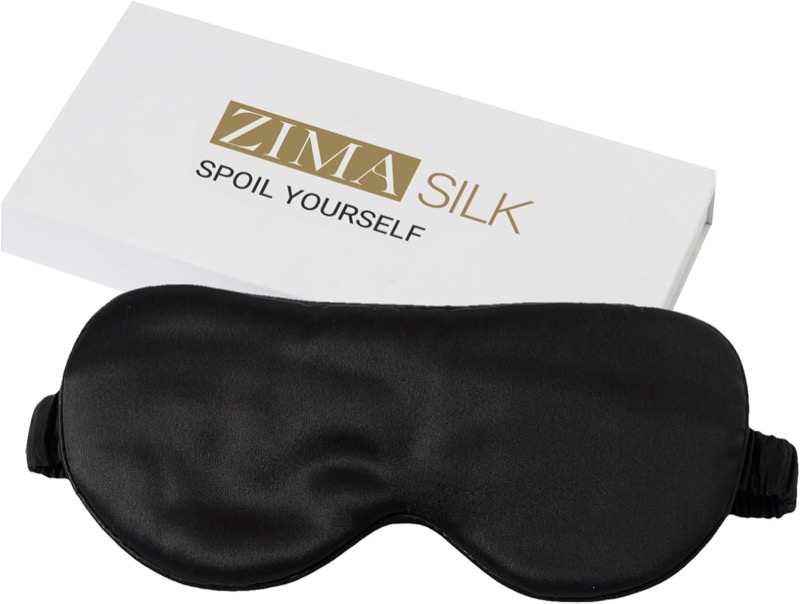
22 momme mulberry silk sleep mask
A retail example with a stated momme weight, silk filling and a buckle adjuster. The momme figure only helps if the listing also names the layer it describes, so check the composition lines before treating it as a spec.
Skin contact and claims you should not make
The product sits on the face, which raises wording questions this guide cannot resolve for your market:
- Skin-friendly, hypoallergenic, non-irritating are claims about biological response. Avoid them unless you hold documentation and understand what it supports.
- Health or sleep claims — that the mask treats insomnia, migraines or dry eyes — are health claims. Describe the design and let customers decide.
- Eye safety: a mask with a warming, cooling or electronic feature is a different product category with additional safety questions.
- Children: if the mask is made for or marketed to children, product-safety rules may be stricter. Ask a compliance specialist before listing.
A narrow, true description sells better than a broad one that returns.
Choosing and recording your volunteer panel
Fit and light tests are only as good as the people doing them. Pick volunteers who differ in the ways that matter: nose bridge height, face width, head size, hair volume, sleeping position. If your target customer is a side sleeper with thick hair, make sure at least two of five volunteers are exactly that.
Record each volunteer's head circumference, usual sleeping position, whether they wear lash extensions or glasses at night, and any skin sensitivities — then record results against the same row. When a leak or discomfort appears, you can see whether it belongs to a type of face or to the mask.
Keep the sequence identical for every sample, change one thing at a time, and keep the photographs. A folder of dated images from the first sample, the revised sample and the production sample is the most persuasive record you can show a supplier.
Pass, revise and fail: write the rules first
| Area | Pass | Revise | Fail |
|---|---|---|---|
| Material disclosure | Fibre content stated per layer in writing | One layer unclear | Supplier will not specify |
| Light through body | No visible glow through the centre | Slight glow in thin areas | Lamp clearly visible |
| Light at edges | No leak on four of five wearers | Nose leak on some, fixable | Same leak on most wearers |
| Pillow and movement | Stays in place on side turn | Shifts but recovers | Opens a gap or slides off |
| Colour transfer | No visible colour on dry cloth | Slight transfer wet only | Visible transfer dry |
| Strap recovery | Returns to marked length after rest | Slight permanent stretch | Visible lengthening or seam opening |
| Strap range | Fits all volunteers in the stated range | Fits most; range stated | Fits few |
| Latex and elastic | Composition and latex status confirmed | Confirmation pending | Latex present and not disclosed |
| Wash result | No change after the stated washes | Minor fading | Seam failure, shrinkage, bleeding |
| Comfort | No pressure marks for most wearers | Marks on some | Marks and complaints for most |
One sample passing is a first step, not a green light. The table separates a mask that needs a design detail changed from a supplier that cannot meet the brief.
The supplier brief
Keep it short, specific and answerable:
- Product definition: shape (flat, contoured, cupped), target size range, strap type, and the sleep positions the mask is designed for.
- Materials: fibre content for face, filling, back layer and strap, as separate lines, with weights where possible.
- Elastic: composition, width and latex status confirmed in writing.
- Closure hardware: adjuster or buckle type, its material, and whether it contacts the face or hair.
- Documentation: colour fastness to rubbing for the face fabric, wash instructions, and compliance statements relevant to your market.
- Samples: at least two of the final construction per size, plus a loose cutting of the face fabric for rub and stain tests.
- Change control: a commitment to tell you before changing fabric supplier, filling or elastic.
If you source through a trade platform, keep the answers in the platform's message system. When a reply says "same as picture", ask again specifically: "what is the fibre content of the layer that touches the eyelid?"
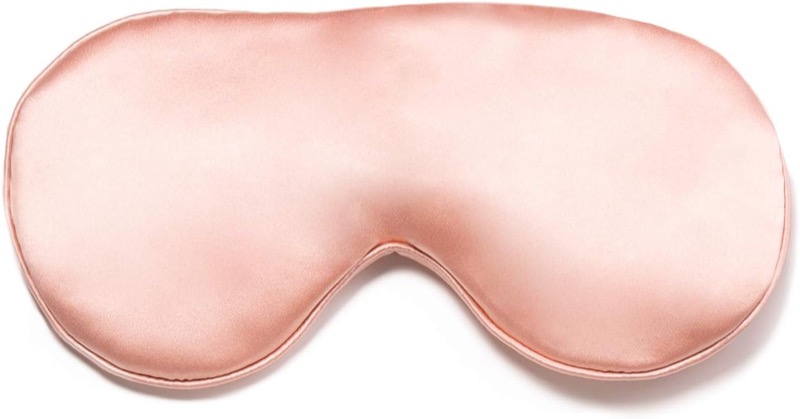
25 momme mulberry silk eye mask
A second silk build at a stated 25 momme, useful for comparing how the same claim is worded across listings. Momme describes silk weight; it says nothing about the strap, the filling or the fit range, which still need their own answers.
What your listing can say
Match the claim to what you tested.
- Say what the fabric is, layer by layer, and put the composition ahead of any "silky" wording.
- Describe the shape factually ("contoured cups", "nose notch", "adjustable strap") rather than by outcome.
- If you ran a lamp test, describe it as it was ("tested with five wearers in a dark room") rather than as a rating — and do not use "100 per cent blackout".
- Give the strap's adjustable range in centimetres, and say who it may not fit.
- State the care method you actually tested.
- Avoid medical and sleep-outcome claims.
Frequently asked questions
Is a silk mask better than a satin mask? They are not the same kind of comparison. Silk is a fibre and satin is a weave, so a mask can be silk satin or polyester satin. What matters for a seller is that the claim matches the documented fibre.
Is a contoured mask better than a flat one? The independent evidence is thin and most strong claims come from sellers. Comfort and fit are the realistic deciding factors, and they depend on face shape and sleeping position.
Why does my mask let light in at the nose? It usually reflects a mismatch between a flat piece of fabric and the shape of the nose bridge. A nose notch, a flap or a different shape can help; tightening the strap usually makes it worse.
Can I say my mask helps people sleep? It is safest not to. That is a health outcome a sample test cannot support.
How many samples should I test? At least two of the final construction, a loose cutting for destructive tests, and five volunteers of different face and head sizes for fit.
What should I do about latex? Ask for the strap's composition in writing and ask directly whether it contains natural rubber latex. If the supplier cannot say, do not claim latex-free.