A spiral hair tie is a coil of smooth plastic that looks like a telephone cord. It costs pennies to make, it is sold in tubs of eight, ten or twenty-four, and its listing says more than almost any other accessory: "No damage." "No crease." "No pulling." "Waterproof." "Patented coil design that spreads pressure." "Holds thick hair." "Hair-friendly." Almost every phrase reads as a measured result, and almost none comes with a method.
That is a problem twice over. First, the claims are about hair, and hair is where customers notice and remember damage: broken strands around the hairline, a dent after a long day, a tie that slid out of a bun on the train. Second, the real failures of the product are ordinary and testable: a coil that stretches out in two weeks, a colour that transfers from a black tie to a clear one inside the tub, a tie that is too small for thick hair. One reviewer of a well-known coil tie says the black coil had visibly stretched out after two weeks; another says two ties in a pack picked up dark marks from the black ties touching them.
This guide separates the claims with some support from the ones without, summarises what dermatology sources say about ponytails and tension, and sets out a repeatable hold, stretch-recovery, snag and colour-transfer test. It recommends no product and makes no promise about anyone's hair. For the fabric-covered alternative, see why silk scrunchies go loose and silk scrunchies on fine hair.
What dermatology sources actually say
Start with the one body of guidance that exists. The American Academy of Dermatology lists pulling hair back tightly, in a ponytail, bun or cornrows, among habits that can damage hair, and advises wearing hair loosely pulled back and using covered rubber bands made especially for styling hair, or a style that does not pull. Its page on hairstyles that pull explains traction alopecia — hair loss from constant pulling — and lists tightly pulled buns, ponytails and updos among styles that can cause it when too tight. It adds a rule worth printing on any insert: if a hairstyle feels painful, it is too tight. Warning signs for changing a style immediately include pain, stinging, crusts on the scalp and "tenting" of the scalp, and early signs to watch monthly: broken hairs around the forehead, a receding hairline, and patches of loss where hair is pulled. Mayo Clinic says the same in shorter form: hairstyles that pull the hair tight can cause traction alopecia, and tension from rubber bands, barrettes and braids should be limited. A Cleveland Clinic article on shedding suggests leaving hair down as much as possible, avoiding rubber hair ties, and using looser ponytails or scrunchies, which have a lighter hold.
Notice what these sources do not say. None says a coil tie is safer than a covered elastic, a scrunchie or any other tie. The advice is about tension and frequency: how tight, how often, and for how long. The designs they name are covered bands and scrunchies, not plastic coils. We did not find a controlled study comparing spiral ties with other hair ties for breakage, creasing or hair loss.
The strongest claim a spiral-tie listing can reasonably make is therefore a design claim: the coil spreads holding force over a longer length of hair than a single thin loop. One brand explains the logic this way, saying the spiral disperses tension across the coil and that the material is thermoplastic polyurethane (TPU). That is a plausible engineering argument, and it is also a brand statement. It is not evidence that a given tie is gentler, and "prevents breakage" has no support in the sources we found. Hair damage depends mostly on how tightly the tie is wound, how many times it is wrapped, how it is removed, and how often it is worn.
Six terms the listing uses loosely
Spiral, coil, phone-cord. These describe the shape. They say nothing about wire diameter, number of turns, free length or stiffness. Two coils that look identical in a photo can behave very differently. Ask for outer diameter in millimetres, filament diameter, number of turns and free length.
TPU, plastic, silicone. Listings use "plastic" to cover several materials. A retail guide lists some coil ties as polyurethane, others as "plastic" or "rubber", and one brand's pages say BPA-free TPU. Ask for the material by name, with hardness (Shore A) and a laboratory identification report. A coil that is too hard will not stretch to fit thick hair and may dig in; one that is too soft loses shape fast.
No damage. This means different things: no snag on removal, no dent, or no breakage over months. Each is a separate test, and the last cannot be established with a sample test at all. We would not use the phrase in a listing.
No crease. A crease is a bend or dent left after removal. Creasing depends on tension, hair type, wear time and whether hair is damp. A coil reduces the pressure line compared with a thin band — that is the point of the design — but "creaseless" is an outcome claim. Test it and say what you tested.
Waterproof / water resistant. TPU and similar plastics do not absorb water the way fabric does. One brand describes its material as not soaking in moisture or product. That is a reasonable description of a non-absorbent plastic, and it is a material property, so it is easy to test. "Waterproof" is stronger than the product needs; "non-absorbent" is more accurate.
Strong hold / holds thick hair. Hold depends on the ratio of the coil's size and stiffness to the volume of hair. Customers with thick hair complain about this more than anything else, and listings often show a fine-haired model. A review on a major retailer's page says the tie did not hold securely, and a shopping guide lists "cannot hold thick hair" among the cons of one popular coil. Print a size and a hair range.
What goes wrong with these products
- Stretching out. The coil elongates permanently and no longer grips. One reviewer estimates about six weeks of use per coil; another says the tie lost shape in two weeks. One customer's experience, not a rate, but it points at what to test: permanent set after repeated stretching.
- Wrong size. A coil too small for the customer's hair, or so large it slips. One listing review calls size the biggest disappointment.
- Colour transfer. Dyed ties staining pale ones in the same tub, or staining light hair. The reviewer who found black marks on two clear ties is a reminder that pigment can migrate on contact.
- Snagging on removal. Edges of the filament, mould seams or a rough surface that catches fine hair.
- Odour and tackiness. A plastic smell on opening, or a surface that becomes sticky with sweat, oil or heat.
- Heat distortion. Coils left in a hot car or hot bathroom that go soft or fuse.
- Claims on the box. Damage, crease and hair-health claims with no support, and "non-toxic" or "BPA-free" with no document.
Reading the results: pass, revise or fail
| Result | Pass | Revise | Fail |
|---|---|---|---|
| Dimensions | Within a small tolerance across pieces and packs | Wide spread in diameter or turns; ask for tighter control | Pieces differ so much that sizes cannot be stated |
| Smell, surface, edge | No odour after 24 hours, no snags | Odour that fades in a few days; add a note | Strong odour that persists, or any snag |
| Stretch and recovery | Little permanent set after 100 cycles | Noticeable set; change material or hardness | Large permanent set; coil no longer grips |
| Hold on tress | Holds both bundle sizes at a stated force without slipping | Holds the small bundle only; state a hair range | Slips on a typical bundle |
| Wear and release | Light or no dent on your reference hair | Dent on damp hair; add a use note | Deep dent in dry hair |
| Removal and snag | Few strands caught, comparable to a covered elastic | More strands than reference; revise the surface | Many strands caught |
| Colour transfer | No colour on pad or on light ties | Slight transfer to oil; pack colours separately | Visible transfer in the pack |
| Heat, water, ageing | No warping, fusing or tackiness | Softening at high temperature; add a storage note | Warping or fusing at ordinary temperatures |
| Volunteer panel | Comfortable, no pain, sensible size choices | Complaints fixed by size or instructions | Pain, tenderness or scalp tenting |
Treat a failure on stretch, hold or colour transfer as a stop, because those are the problems customers report. Treat the rest as a prompt to change the listing before changing the product.
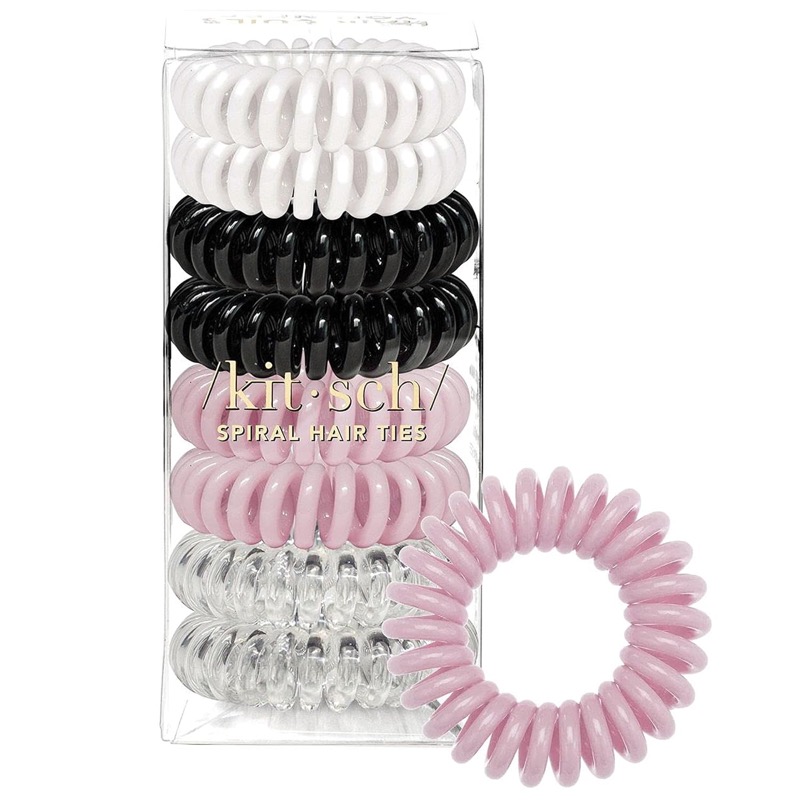
Spiral coil hair ties, 8 pack, basics
A second pack to compare: same construction family, different colourway and a lower price point. Colour and price are the easy differences to see; permanent set and hold force are the ones that decide whether the tie lasts a month.
The supplier brief
- The material by name (for example TPU), Shore A hardness, and a laboratory identification report.
- Filament diameter, number of turns, outer diameter and free length for each size, with tolerances.
- The colourants used, whether pigments are tested for migration, and how coloured ties are packed to avoid contact.
- Their own stretch-recovery or fatigue data, if any, with method, stretch ratio and cycle count.
- Whether ties are made by extrusion and winding or by moulding, and how cut ends are finished.
- A declaration for any "BPA free", "non-toxic" or "latex free" statement, naming the substance, the test and the date. Ask a compliance adviser what your market requires for products worn in contact with hair and skin.
- Packing: what the tub or bag is made of, how many are inside, and whether colours are separated.
- Heat and storage limits, and the temperature at which the ties deform.
- Minimum order quantity, lead time, sample policy and replacement terms, on the quotation and not in chat.
The sample test: nine steps in an afternoon
These are our own screening procedures, not a standard. For fabrics, ISO 20932-1 (elasticity of fabrics, strip tests) and ASTM D4964 (tension and elongation of elastic fabrics) define how to cycle a specimen, measure force and elongation, and calculate permanent deformation and recovery. Those methods are written for fabric strips and loops, not plastic coils, so we borrow their ideas — cycle the specimen, then measure how much shape it lost — without claiming to follow them. Use at least ten pieces of each model from different packs. Record room temperature and photograph any failure with a ruler in frame.
1. Material and dimensions. Ask for the material name, Shore A hardness, filament diameter, number of turns, outer coil diameter and free length. Measure these yourself with callipers on every sample and record the range. A wide spread between pieces is a quality problem even if the average is fine. Weigh each tie; weight differences point to different batches or fillers.
2. Smell, surface and edge check. Open a sealed pack and smell it straight away, then again after 24 hours in a sealed bag. Inspect each tie under a lamp and loupe for mould seams, flash, rough patches and burrs. Run a tie through a sheer nylon stocking and a clean cotton pad and watch for snags. Any snag means a rough edge that will catch hair.
3. Stretch and recovery. Measure free length. Stretch to a stated multiple of free length (for example three times) between two hooks, hold 30 seconds, release, wait one minute, measure again. Repeat for 100 cycles, measuring free length every 20. Calculate permanent set as the percentage increase in free length. A tie that has grown noticeably after 100 cycles will lose its grip in use. We have not found a published pass mark for plastic coils, so set your own, record it, and compare against a reference tie you know to be good.
4. Hold test on a hair tress. Make a standard bundle from a real or synthetic hair tress, wrapped and measured so its circumference is the same each time — for example 8 cm around, and another at 14 cm to represent thick hair. Put each tie on with a stated number of wraps. Hang a weight from the bundle's end, or pull with a spring gauge, and record the force at which the tie slips off. Test dry hair, damp hair and hair with leave-in conditioner. Report numbers for each bundle and tie size, and note how many wraps each tie can make.
5. Wear-and-release test. Fit ties to the tress bundle, leave eight hours at room temperature, release, and photograph the bundle against a dark background. Score the dent from none to deep. Repeat on damp hair left to dry in the tie, and on a bundle left in a warm room. The point is to compare samples, not to prove any tie is crease-free: hair type, dampness and tension change the result.
6. Removal and snag test. Count strands pulled out when each tie is removed from a tress under a standard motion — for example sliding the tie off along the bundle for 20 repetitions. Collect and count loose hairs on paper after each cycle. Compare against a reference covered elastic and a scrunchie. This is a bench test with a tress that has no scalp, and it cannot predict real hair loss, but it shows which tie catches fine strands.
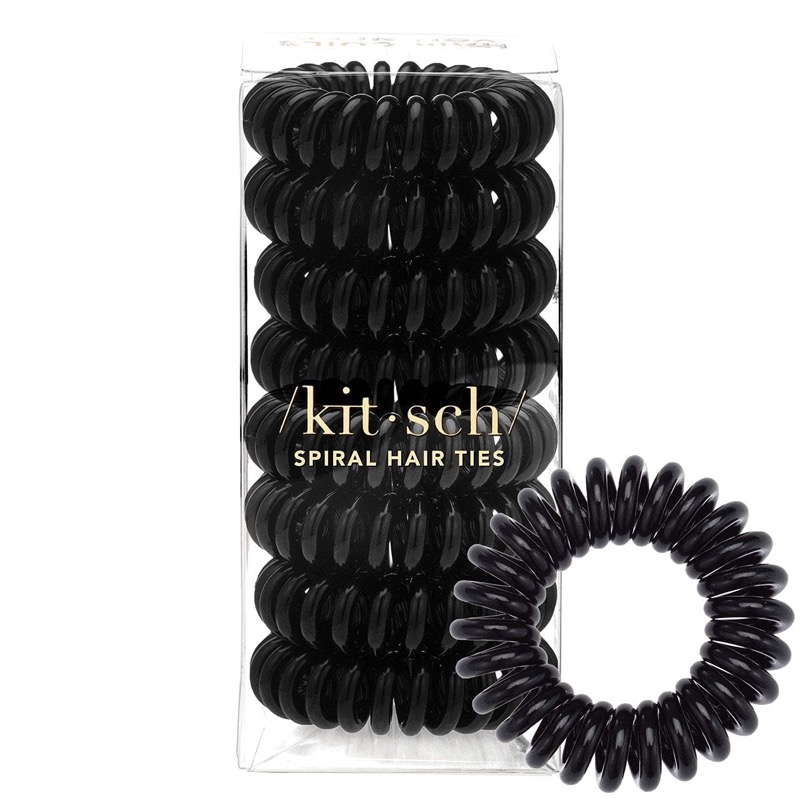
Spiral coil hair ties, 8 pack, black
A retail example with the full claim stack this guide examines: no damage, creaseless, dent-free, waterproof. The listing is why the test exists — every one of those words is checkable on a tress and a scale, and none of them is checked by looking at a photo.
7. Colour transfer. Store ties of different colours in contact in a sealed tub for a week at room temperature, and another set for 48 hours in a warm place. Include a clear tie against a black one. Then wipe each with a damp white cotton pad and a pad with a little facial oil. Look for colour on the pad and marks on the light ties. Wear a light tie against a white cloth dampened with salt water for an hour, to simulate sweat. Pigment migration inside a pack is the thing to catch before a customer opens the tub.
8. Heat, water and ageing. Soak ties in warm water (about 40 °C) for ten minutes and check for warping. Leave a set in a closed car or a mild oven for a few hours at a stated temperature and check for softening or fusing — write down the temperature. Wash ten ties with shampoo and warm water twenty times and re-measure free length. If you plan to say the ties suit swimming or the shower, test with chlorinated water and your own shampoo.
9. Volunteer panel. Recruit at least eight adults across hair types, including fine, thick and curly. Give each a protocol: low ponytail with one tie, as loosely as it will hold, for a stated number of hours on three days, noting comfort, slipping, creasing, ease of removal and strands left on the tie. Ask them to stop if there is pain or scalp tenderness, and treat that as a failure of the instructions rather than a sign of toughness. Ask which size they would choose from a range. Remind them that the AAD advises changing a style immediately if it causes pain. This is not a clinical study and cannot show any effect on hair health; it checks that ordinary users can wear the product comfortably.
What your listing can say
- Material: "TPU coil, Shore A (your measured value)" with values and a report if you have one. If you cannot name the material, say "plastic coil" and no more.
- Size: "Outer diameter, turns and free length as measured. Suitable for hair that gathers into a bundle up to the size you tested", with the range you tested.
- Design: "The coil spreads the grip over a longer length of hair than a single thin band." A design description. Do not say it prevents breakage.
- Use: "Wear loosely. If a hairstyle feels painful, it is too tight." This follows AAD guidance and costs you nothing.
- Water: "Non-absorbent plastic, dries quickly", if you tested it.
- Care: "Store colours apart; keep away from heat", with the temperature limit you found.
- Colour: if you sell mixed packs, say you tested for colour transfer and how you packed them.
Avoid "no damage", "prevents breakage", "hair-friendly", "creaseless", "dent-free", "gentle on all hair", "doctor recommended", "non-toxic" and "BPA-free" unless you have the evidence and the regulatory position for each. Avoid showing a tight, high ponytail in listing photos if the copy says "gentle".
Special cases and record keeping
Sizing across hair types. Hold depends on the ratio between coil and hair bundle, so one size cannot serve everyone. Before deciding on a range, measure the gathered bundle circumference on your volunteers for the styles you plan to show: low ponytail, high ponytail, loose bun. Write the bundle range each tie size held in your hold test, and offer at least two sizes if the volunteers' range is wide. Customers with thick or curly hair report slipping; customers with fine hair report snagging, so the two groups need different information.
Wet and oiled hair. Wet hair, or hair coated with leave-in conditioner or oil, is slippery, and a tie that holds dry hair may slide. Hair also changes dimension as it dries. Run the hold test in all three conditions and keep the results in your internal file, even if the listing only says "tested on dry and damp hair".
Sweat and heat. Plastic ties are sold for workouts and the beach. A tie that is tacky with sweat or soft after an hour in a hot bag is a different product from one that is fine on the bench. If the listing mentions exercise, run the sweat-like solution test and the mild heat test on the same samples.
Packaging and storage. Ties that sit coiled in a tub for months may take a set from the packaging itself, and colours may touch. Keep a sealed retained sample from each batch and open one after a month and after three months to check shape, smell and colour transfer. If the shape has changed in the tub, the customer receives a tie that was already stretched.
Batch records. Record supplier, batch, date, material report and the results of every test for each purchase order. When a customer reports a problem, the record lets you say whether the batch was tested and what the numbers were. If a later batch changes colourant, hardness or supplier, repeat at least the stretch, hold and colour-transfer tests before you sell it.
Returns and feedback. Track return reasons — too loose, wrong size, colour marks, snagging, smell. Those map directly onto the tests here, so a spike in one is a prompt to re-run the matching test on current stock.
Frequently asked questions
Is a spiral tie better for hair than a covered elastic or a scrunchie? We found no controlled comparison. Dermatology sources recommend covered bands and loose styles, and one clinic article mentions scrunchies for their lighter hold. A coil spreads force differently, but whether that matters depends on how tightly it is wound and how often it is worn.
Can I say my ties prevent hair breakage? No. We found no study supporting the claim, and AAD advice is about tension and frequency. You can say how you tested for snagging and what you found.
Why do coil ties go loose? Plastic can take a permanent set when stretched repeatedly, and some materials do so faster. Customers report anything from two weeks to several weeks per tie. Your stretch-recovery test shows how your material compares.
Do spiral ties work on thick hair? Only if they are the right size. Reviews and guides mention some coils cannot hold thick hair. State the bundle size you tested and offer a larger tie.
Are they safe to wear in water? Non-absorbent plastic does not soak up water, but chlorine, salt and shampoo can change a surface over time. Test with your own conditions before promising swim-readiness.
Why do my pale ties have dark marks? Pigment can migrate between ties that touch in a pack. Separate colours in packaging and test for transfer.
Is it safe to wear a hair tie to sleep? We found no guidance specific to coils. Dermatology sources warn about constant tension and styles requiring tight pulling. If you suggest sleeping in a tie, base it on your volunteer panel and keep the hold loose.
What should we say about children's hair? We did not research child-specific rules. Ask a compliance adviser about wording and markets involving children's products.