Choose a pregnancy pillow by your bed's width first, then by where you need support. A wedge fits any bed and suits a bump or a sore back; a C-shape gives head-to-knee support on one side without taking the whole mattress; a U-shape is the most enveloping and the most intrusive — it only works if you have the room and do not mind it blocking your roll. And no pillow is compulsory: the clinical advice in late pregnancy is about the position you sleep in, and ordinary pillows can deliver that.
Two claims get blurred together on product pages, and separating them is the point of this guide. One is a safety message about going to sleep on your side in the third trimester, which rests on real research. The other is a comfort claim that a pillow reduces pain, where the evidence is much thinner. This guide treats them separately, then gets practical about bed space, fill, covers and what to check before you buy. It is general information, not medical advice.
Later, once feeding starts, the purchase list changes; the same "buy a little, then decide" logic applies to nursing pads.
Why does everyone talk about side-sleeping in pregnancy?
Because of a set of studies linking back-sleeping in late pregnancy to stillbirth. The UK study known as MiNESS, summarised by Manchester University NHS Foundation Trust, confirmed earlier New Zealand and Australian findings: in the third trimester, after 28 weeks, women who go to sleep on their back are more likely to have a stillbirth. The Trust's summary puts the increase at roughly double, and estimates that if every pregnant woman in the UK went to sleep on her side in the third trimester there would be about 3.7 per cent fewer stillbirths — around 130 babies a year. The study itself involved just over a thousand women, 291 of whom had a third-trimester stillbirth and 733 of whom had a live birth in the same period.
Two things keep that in proportion. The research did not conclusively prove that sleeping position affects stillbirth risk, and NHS responses quoted by parenting media said more work was needed and the risk is very low whichever position you sleep in. A later pooled analysis reported in the parenting press put the increase for back-sleeping at about 2.6 times across more than 3,000 women — a different figure from the doubling in MiNESS, from different studies and methods, pointing the same way.
The practical advice from the Trust is to go to sleep on your side for any episode of sleep in the third trimester, including night wakings and daytime naps. If you wake on your back, roll over. One of the Trust's own tips is to put a pillow or pillows behind your back to help you stay on your side — which is a pillow solution that costs nothing.
Left side or right side?
You will hear "left" a lot, and it is worth knowing where that comes from. The MiNESS summary found no difference in risk between the right and left side. ACOG's position, as reported by Yahoo, is that left-sided or right-sided sleeping is safe, and that earlier advice favouring the left came from older studies. An Atlanta obstetrician quoted in a pregnancy pillow buying guide takes a different view and calls the left side optimal for circulation because it moves the uterus off major blood vessels — an expert's physiological argument, not a trial result.
For buying purposes the safe reading is that either side is fine, so choose a pillow that works for both or that you can flip. That is one argument in favour of a C-shape over a U: a C can be turned over, a U is what it is.
Before 28 weeks, sleep position does not appear to affect outcomes, according to a parenting site summarising the guidance, and the MiNESS advice is specific to the third trimester. Treat that as secondary sourcing and ask your midwife if you are unsure.
Does a pregnancy pillow reduce back or pelvic pain?
Possibly, but the proof is limited, and a listing that implies otherwise is overselling.
Pelvic girdle pain is common: the plain-language summary of a 2021 randomised trial in the International Journal of Women's Health says roughly 30 to 40 per cent of pregnant women worldwide have it, that it usually begins between weeks 12 and 24 and typically worsens as pregnancy proceeds. That trial tested a specific memory-foam mattress and pillow designed for people with sleep apnoea, where the pillow is separate from the mattress to take pressure off the shoulder and pelvis in side-lying. The comparison group got standard care alone, and the authors describe results as showing potential. Note what this is and is not: a small trial of one engineered mattress-and-pillow system alongside physiotherapy, not a test of a generic U-shaped pillow from a marketplace.
For pillows closer to the shapes you can buy, the evidence is weaker still. A Cochrane summary of the Ozzlo pillow, designed to support the abdomen when lying on the side, says the authors were very uncertain whether it improves pain or sleep, grading the evidence as very low quality. It tested a single product, so it says little about today's range — but it also means nobody has shown that a pregnancy pillow in general does what the box says.
A small New Zealand study found that pregnant women with pain consistently preferred side-lying to other positions, with sitting second. So the logic of a pillow — make side-lying more comfortable and easier to keep — is reasonable. Comfort is a legitimate reason to buy. Just keep expectations level with the evidence, and if pelvic or back pain is significant, speak to your midwife or a women's health physiotherapist: pain this common often responds to advice and exercise, not only to bedding.
How much bed space do you actually need?
More than you think, and this is the one criterion you can settle with a tape measure rather than an opinion. Retail guides frame bed size as the deciding factor: a U-shape needs a large bed and a partner who tolerates a barrier, while C-shapes and wedges suit smaller or shared beds. It is retail content rather than research, but the logic is mechanical.
Run this before you buy:
- Measure your mattress width and note how much of it your partner uses. A U-shape at 31 inches wide leaves about 23 inches on a 54-inch double.
- Read the listing's length and width, not just the shape name. "Full body" tells you nothing; 55 × 31 does.
- Mark the footprint for one night with a folded blanket or a row of ordinary pillows. If the test setup already feels crowded, size down.
- Check height against your own height. Experts quoted in buying guides warn that a very short person may need a smaller pillow, and an oversized one can cause discomfort rather than relief.
What about fill, firmness and covers?
Common fills are foam, microbeads, polyester and cotton. Firmer pillows give more support, particularly between the knees, and adjustable fill lets you change firmness — foam for firmer leg support, cotton if you want something softer. If a pillow comes with adjustable or removable fill, that is your correction mechanism if the first guess is wrong.
The cover matters more than it sounds. A removable, machine-washable, hypoallergenic cover is the practical baseline, and a cooling fabric helps if you sleep warm. Pregnancy often changes how warm you sleep, so a cover you can swap beats a beautiful one you cannot wash.
A positioning cue worth using on day one: with a pillow between your legs, your thighs should sit nearly parallel. If the pillow pushes your top knee far forward or leaves your hips twisted, it is the wrong thickness.
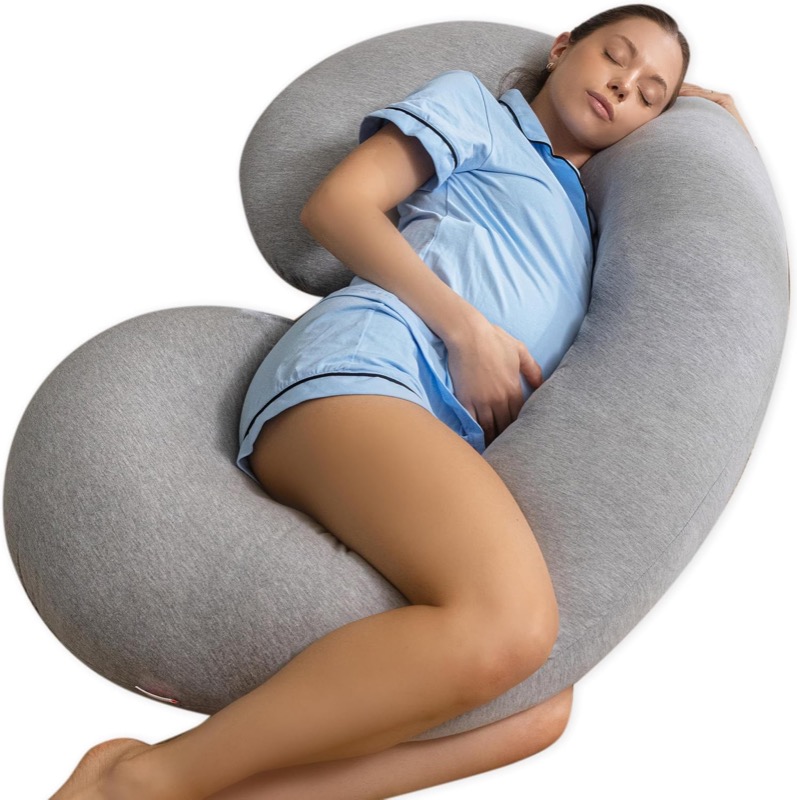
C-shaped pregnancy pillow
The space-efficient option: it wraps one side of the body instead of both, so it leaves more mattress for a partner, and it can be flipped when you turn over. A removable jersey cover is the practical detail — the thing you will actually wash.
Which shape is right: U, C, wedge or something else?
Start from where you need support — upper body or hip alignment — and then from how much bed you have. Buying guides quoting pelvic-health physical therapists list U, C, J, E, wedge and hourglass shapes; in practice most shoppers choose among three.
| Shape | What it supports | Bed space | Best if |
|---|---|---|---|
| Wedge | One area: bump, back or belly | Almost none | Early to mid pregnancy, small beds, travel, budget |
| C-shape | Head, belly, often knees, one side | Moderate | Shared or smaller beds, side-sleepers who turn |
| U-shape | Both sides, head to legs | Large | A big bed, a partner who does not mind a barrier |
Wedge. A small triangular pillow tucked under the belly or the upper back. It takes almost no bed space and is the easiest to travel with, and retail guidance suggests wedges suit early to mid pregnancy when a smaller amount of targeted support is enough. The trade-off is single-area support: you still need ordinary pillows for head and knees.
C-shaped. It curves around one side of the body, supporting head, belly and often knees, and several retail guides call it the space-efficient full-body option. Because it wraps one side, you may need to reposition it when you turn.
U-shaped. It wraps both sides, so you get support whichever way you face. Retail guides agree on the drawbacks: it can take over most of a double or queen bed, nestling into the arch can make turning over hard work, and in warm climates the extra fabric retains heat.
Straight body pillow. Worth listing because it is cheaper: body-length pillows can also support the arms and wrists, and carpal tunnel is surprisingly common in pregnancy — a reason to think about arm support, not only the bump.
One more finding that saves money: physical therapists say a regular pillow, or several, can work if positioned correctly, though a dedicated pregnancy pillow is often firmer and easier to keep in place. If you are on a budget, test your own pillows first: one between the knees, one under the bump, one behind the back.
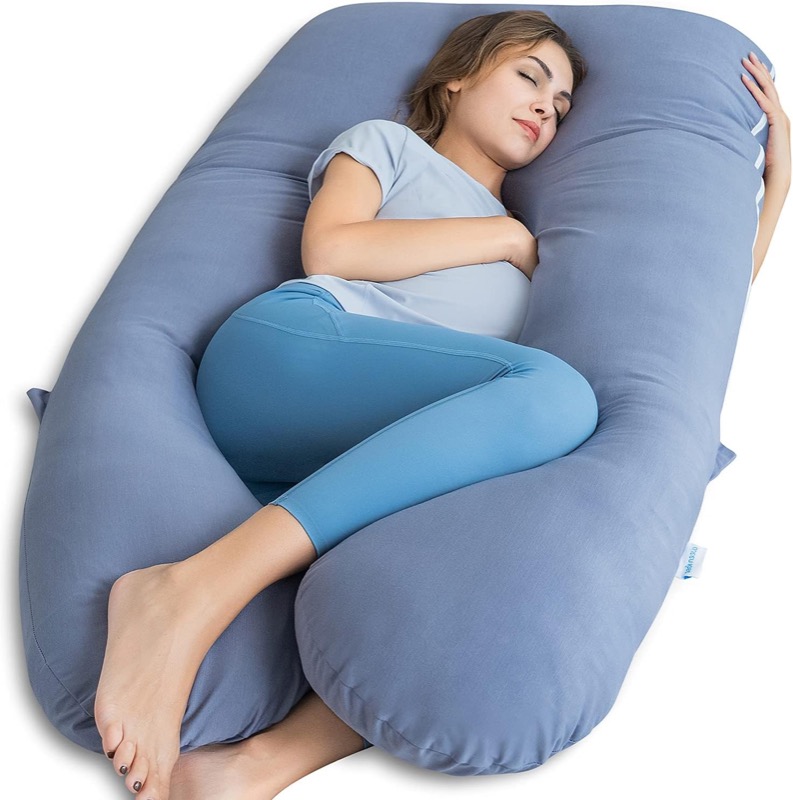
U-shaped pregnancy pillow, 55 × 31 in
The listing that states its footprint, which is the number that decides whether it fits: 55 inches long and 31 wide against a double bed of about 54 inches. This is the shape that gives support on both sides and the one most likely to crowd a shared bed.
Can you keep using it after the baby arrives?
Many pillows are marketed for nursing support too, and that is a separate question from sleep safety. One rule is absolute: infants should sleep on a flat surface without pillows, per American Academy of Pediatrics guidance cited in buying guides. A pregnancy pillow is not an infant product and must not go in a baby's sleep space — not in the cot, not in a co-sleeper, not as a nest.
Using it to support your own back while feeding is a different matter. Check the listing for that intended use, and keep it away from where the baby sleeps. For the products that do belong in that stage, the nursing pads comparison covers the buying logic.
What should you check before you buy?
- Shape named and dimensions given. Length, width and thickness, not "full body".
- Your bed width, compared against those dimensions and your partner's share.
- Fill type, and whether it is adjustable. That is how you correct firmness.
- A removable, washable cover, plus the care instructions. Washing a cover in a mesh bag keeps it from snagging; the bra wash bag checklist applies to any delicate cover.
- Breathable or cooling fabric if you sleep hot.
- Claims about pain relief. If the page promises to cure back or pelvic pain, remember what the evidence above does and does not support.
- Return policy. Comfort is personal and the first week is the real test.
- Stated use after birth, with the infant-sleep rule in mind.
What should a listing state?
Print if true: the dimensions in inches, the shape, the fill, whether the fill is adjustable, the cover fibre and whether it is machine washable, the manufacturer's intended uses (side-sleeping support, sitting up in bed, feeding support), and a clear line that it is not for infant sleep.
Avoid: "scientifically proven to reduce back pain", "prevents stillbirth", "the only pillow you need", "medical grade", and any claim that a shape suits every sleeper. The research supports side-sleeping as a position, not a particular product; a listing that is honest about that reads as more credible than one competing on health claims.
Frequently asked questions
Do I need a pregnancy pillow at all? No. Pillows behind your back are the Trust's own tip, and physical therapists say ordinary pillows work when positioned correctly. A dedicated pillow is a convenience, not a requirement.
When should I start using one? When you want it. The MiNESS advice applies after 28 weeks, and position before then does not appear to affect outcomes. Many people start earlier purely for comfort.
Is stomach-sleeping safe? The research discussed above concerns going to sleep on your back, not your front, and the advice to favour your side comes from that work. Ask your midwife for your own situation.
What if I keep waking on my back? Roll onto your side and go back to sleep, as the sources advise. A wedge or a folded pillow behind your back makes rolling onto your back less likely.
Which shape suits a hot sleeper? No tested comparison between shapes exists, so this is a judgement call: less fabric against you means less heat, which points to a wedge or C over a U. A cooling fabric cover is the other lever.
Can I use it in the bed alongside a partner? Yes, if you check the width. A 31-inch-wide U-shape leaves about 23 inches on a standard double; a C-shape or wedge leaves far more.
Does it help with reflux or heartburn? The sources we read did not test pillows for reflux in pregnancy. Elevating the upper body is a common home measure, but treat a wedge's usefulness there as plausible rather than demonstrated.