An eyelash curler is a small tool with an unusually bad failure mode. If a bobby pin is badly made, it slips out. If a curler is badly made, it can pinch eyelid skin or press a burred edge against a part of the face nobody wants pressed. The product is a hinged frame with two curved jaws, a rubber or silicone pad in one jaw and a handle. That is all. Yet listings carry some of the most confident language in beauty accessories: "pinch-free", "fits all eye shapes", "gentle on lashes", "hypoallergenic silicone", "no crimp", "includes replacement pads", "salon quality".
None of those phrases is defined, and several are in tension with each other. A frame cannot be both a deep curve for round eyes and a shallow curve for monolids. A pad soft enough not to crimp is also the part that wears out first. A set that "includes replacement pads" may include one pad, three, or a bag of fifty in sizes that may not fit the frame at all.
This guide sets out what eye-health and brand sources say about pads, hygiene and heated models, notes where they disagree, and gives a screening test you can run on samples with a loupe, a ruler, a few hundred squeezes and some patience. It recommends no product and makes no claim about anyone's eyes, lashes or skin. For other tools used near the eye, see the lash applicator guide and the eyebrow tweezer guide; for the storage side, makeup sponge case ventilation.
What an eyelash curler is, and where it fails
A mechanical curler is a lever. Squeezing the handles closes a curved upper jaw against a cushioned lower pad, and lashes between them are pressed and bent. Reference sources note patents for the device date from the 1920s to 1940, and that the usual use is the upper lashes only. The design has barely changed. What differs between a good curler and a bad one is almost entirely detail a listing photo cannot show.
The pad. The only part that touches lashes, and the part that wears. Brand pages call it silicone or rubber; retailers use the two words as if they were the same thing. Firmness, thickness and shape decide whether lashes bend in a smooth arc or fold along a crease.
The frame edge. The metal rim around the pad is what meets lashes if the pad is worn or misaligned. A rough seam, a burr or a sharp corner is a quality failure at any price. Reviewers describe something on a frame snagging the eyelid every use, and skin caught between the bottom plate opening and a vertical bar. Individual reviews, not data, but they point at the failure to look for: skin entering a gap the design should have closed.
The curvature. How deep the arc is and how wide the opening decides which eyes it fits. Buyer guides say rounder eyes may need a deeper curve and that a shallow arc can leave corner lashes out of reach, and that a wider opening helps when outer-corner lashes escape. Editorial opinion, not measurement.
The hinge. Pivot play makes the jaws close unevenly, so one end pinches harder. A review site describes a good hinge as having no lateral play; a brand artist quoted by a beauty retailer says a daily-use curler can start bending and warping.
The retaining detail. Pads sit in a channel. Loose pads shift, tight ones distort, and a rough channel cuts the pad from beneath. None of this is visible in a hero shot.
What eye-health sources say
We found no standard for the pad or frame of a mechanical curler. What exists is eye-health guidance, brand care instructions and regulation for the cosmetic category more broadly.
Heated curlers. The American Academy of Ophthalmology's eye-makeup page says heated curlers can give a longer-lasting lift, but that too much heat around the eye can be dangerous: it can make lashes fall out, damage the skin around the eye, or damage the eye itself. As we read it, the page notes eyelid skin is thin and burns at lower temperatures than other skin, and that these devices can reach roughly 100 to over 200 degrees Fahrenheit. It advises checking the exact temperature of each setting, starting with the lowest, not pulling hard on lashes and not repeatedly going over the same area. An ophthalmologist quoted on a separate Academy page says a blow dryer is not designed for eye tissue and recommends a heated curler designed for ocular use with built-in temperature limits. That argues for heat control, not for any model.
Hygiene. The same Academy page advises not sharing eye makeup even with family, replacing eye makeup every three months, avoiding store samples, and throwing eye makeup away after an eye infection. It does not discuss mechanical curlers, so we cannot say it recommends a cleaning or replacement schedule for the tool. A lens-company explainer says an uncleaned curler can harbour bacteria that transfer to lashes and the eye area, and that pinching can cause temporary pain, bruising or mild swelling; it cites an FDA page we could not open, so we treat it as an unverified summary.
Pinching. Reference encyclopedic text says curlers used carelessly can pinch the eyelid, and that depending on pressure this can cause serious injury. General text, not clinical data. We found no incidence figures. The accurate seller position: pinching is a known, plausible use error; design (opening width, edge finish, hinge precision) affects how easy it is; and no source we found shows how often it happens or how much a "pinch-free" design reduces it.
What no source supports. We found nothing showing that any pad material, curve or brand prevents eye injury, lash breakage or infection. Brand pages say their curlers do these things; brand pages are marketing. That matters for listing language below.
Pad replacement: the intervals nobody agrees on
This is the most-repeated care instruction in the category, and a good example of why a seller should say who said what. Brand and retailer pages we read gave these intervals.
| Source (type) | Pad interval | Curler interval |
|---|---|---|
| Thrive Causemetics (brand) | every 3 months | not stated |
| Lancôme, via a retailer page (brand) | about 3 months with daily use | not stated |
| Tweezerman, via a retailer page (brand) | 3 months | 12 months |
| A curler brand's reply on a retailer page | every 3 months | 1 year, "for sanitary reasons" |
| RevitaLash, via a retailer page (brand) | every 2 months | not stated |
| Tatti Lashes (brand) | after 6 months | not stated |
| A brand artist, quoted by a beauty retailer (editorial) | can wear out within 6 months; more often for contact-lens wearers | replace after 12 months |
| A fashion title, summarised by a lifestyle site (editorial) | rubber pads average about 3 months | not stated |
The pattern: two to six months for pads, twelve months for the tool where anyone says anything. The numbers are plainly rules of thumb. None of the pages gave a test method, a sample size or a measured end of life. Retailer pages for one premium curler attach a hygiene rationale — replacement for performance, hygiene and to prevent infections — but we found no evidence behind that statement. Several blog and buyer-guide pages repeat the three-month figure and add confident detail about microscopic cracks and pits; at least one was an obvious content-farm page with no named author, and we did not use it.
Two consequences for a seller.
Do not print a precise interval as fact. You can print "the manufacturer's recommendation" if you are the manufacturer and can show how you arrived at it. A seller can say accurately that several brands recommend replacing pads every two to six months and that wear depends on use. We make no claim that a specific number is correct.
Treat the interval as a bill of materials. If instructions say every three months and the box contains one spare, the customer runs out in six months. That is not a care problem. State the number of pads, and check that the spare count matches the interval you print.
Silicone, rubber and "hypoallergenic"
Product pages for one premium curler call its pads thick, rounded silicone that is hypoallergenic and will not crimp or stick, and say silicone is superior to rubber, which can cause irritation. A refill listing calls silicone "latex-free". A buyer guide says both silicone and rubber pads are allergy-free. A makeup artist quoted by a lifestyle title recommends upgrading from rubber to silicone and believes named-brand silicone lasts longer. These statements contradict each other and none comes with test evidence.
What can be said with confidence:
- "Rubber" can mean natural latex, synthetic rubber or a mix, and a listing that says only "rubber" does not tell you which. A claim that one option is "allergy-free" should be treated with caution; a buyer with a latex allergy needs the material, not a reassuring adjective.
- "Silicone" covers a range of formulations and hardnesses. Two pads both labelled silicone can differ in firmness, surface tack and how quickly they compress.
- "Hypoallergenic" has no regulatory definition we could confirm for cosmetic tools. Treat it as unsupported unless a test report is attached, and ask your supplier whether one exists.
- Softness loss matters. Retailer pages for pads sometimes say silicone loses softness over time and that this "could potentially harm" lashes. A plausible mechanism and a cautious statement, but a retailer's description, not a measurement.
Material composition is also something your compliance adviser should look at for your market, including any rules on skin-contact articles. We are not lawyers, and nothing here says a particular pad meets a particular rule.
Fit: "fits all eye shapes" cannot be literally true
Almost every listing claims the curler suits every eye shape. Buyer guides contradict this by describing which shapes need which curves. A review site says one popular curler's flatter arc suits monolids and almond eyes, and that another has an angled bar that can press against the brow bone on hooded eyes. Subjective, but the practical point holds: fit is geometry, and two customers with different brow-to-lash distances will find different curlers comfortable.
The honest position is "designed for a typical range of eye shapes", with opening width, curve depth and bar position given as measurements so a buyer can compare. A seller claiming "fits all" is making a claim about every face, which no sample test can support. For a small brand the cheaper move is specificity: say what shape it was designed around and what the dimensions are.
Heated curlers are a different product
A heated curler is not a mechanical curler with a battery. It adds an electrical product, a heating element, a surface that touches the lash line, and often a lithium cell and a USB port. The Academy guidance above is why it should be treated separately.
- Temperature. A heated tool aimed at thin-skinned areas needs a verified maximum surface temperature, measured, not copied from the supplier's page. We cannot say what that limit should be and the Academy page does not set one; it tells users to check each setting.
- Safety documents. Battery transport (a UN 38.3 test summary), electrical safety and radio or electromagnetic compliance are separate paperwork. Our LED mirror guide covers the battery side; ask your compliance adviser which apply.
- Auto shut-off and overheating. If the listing says auto shut-off, ask what it does and test it with a thermometer, a timer and a repeat cycle.
- Claims. "Safe for sensitive eyes" is a health-adjacent claim you cannot substantiate on a bench. We would not use it.
If you only plan to sell mechanical curlers, keep the material as a note on what you are not selling.
Terms the listing uses loosely
| Listing phrase | What it usually means | What to ask or check |
|---|---|---|
| "Pinch-free" | The designer intended no pinching; no test implied | Edge finish under a loupe; gap between jaw and pad at closure; volunteer trial |
| "Fits all eye shapes" | Opening is wider than a very narrow curler | Opening width, curve depth and bar position in measurements |
| "Gentle on lashes" | Soft pad | Pad hardness if available; crease line after a trial squeeze |
| "No crimp" | Rounded pad surface | Whether a crease appears on a card, our stand-in |
| "Hypoallergenic silicone" | Silicone, no test report | Material, grade and any test summary |
| "Medical-grade silicone" | Sales language | The standard it meets; unsupported without one |
| "Includes replacement pads" | At least one spare | Number, size and whether they fit this frame |
| "Salon quality" / "professional" | Marketing | Nothing to check; do not repeat it |
| "Stainless steel" | Possibly plated carbon steel | Material certificate; magnet and salt-spray screen |
| "Durable" | Not defined | Cycle test and hinge play measurements |
| "Universal pad" | May fit many frames, none exactly | Whether it fits yours without moving |
On "stainless steel": buyer guides describe stainless frames with confidence and premium retail pages say nickel-plated or stainless steel. We found no authoritative statement that curler frames need a particular grade. As with tweezers, ask for the material in writing rather than accepting a brand phrase.
What goes wrong with these products
From the sources, our reading of retailer reviews and the construction, these are the failures to screen for. We cannot give rates.
- Worn or misshapen pad. A permanent groove holds lashes less evenly. This is why brands print replacement intervals.
- Wrong-size spare pads. A "universal" pad slightly too thick stops the jaws closing; too thin and it slips.
- Gap between pad and frame. If the pad does not sit flush, eyelid skin can reach it. This is the failure in the reviews above.
- Burr or rough seam. A single rough spot is a quality control failure, and it may not appear on every unit.
- Hinge play. Jaws close unevenly, so one end pinches harder or the outer lashes go unpressed.
- Plating wear and corrosion. Plated frames show wear at handle and rim; a frame left in a humid bathroom may spot.
- Sticky pad. Some pads attract lint and lash debris, and some stick to lashes.
- Pad falls out. A wide retaining channel lets the pad escape in the bag.
- Packaging claims wrong. "3 pads included" with one in the box is a returns problem.
- Heated models: overshoot or uneven heat. If you sell one, this is the failure that matters most.
The sample test: nine steps in an afternoon
These are our own screening procedures, not a standard. They find obvious problems before you commit to a quantity, and they are not a safety assessment. Use at least three units from different cartons and keep a record sheet with unit number, date and photographs.
1. Count and identify. Count curlers, pads and accessories against the listing. Record the stated pad material and compare with anything printed on the insert. Mismatches are the first finding.
2. Edge inspection. Under a loupe and good light, inspect the whole rim and the pad channel. Look for burrs, sharp corners, uneven plating, scratches inside the opening and rough seams. Run thin cotton fabric or a cotton pad along the rim and see whether it snags. Photograph anything you see. A snagging rim is a fail, and it does not have to be dramatic to matter.
3. Closure gap. With the pad installed, close the curler and look for any gap where skin could enter. Slide thin paper into the gap and record whether it fits, then measure the gap with callipers. We know of no published threshold; use your best reference product as the comparison and set your own limit.
4. Opening and curve measurement. Measure inside opening width, curve depth and the distance from the handle bar to the top of the frame, for each unit and for a reference. Unit-to-unit variation is a quality signal in itself.
5. Pad fit and retention. Remove and reinstall the pad three times. It should seat flush without tools and not fall out when shaken upside down. Then try the spare pads the same way. Loose spares or jaws that will not close are a fit failure.
6. Pad hardness and recovery. Record Shore A hardness if you have a durometer; if not, press a thumbnail in and see whether it recovers. Squeeze 200 times on a stack of card and re-measure. Record any visible groove or permanent set. A stand-in for wear; it does not tell you how many months a pad lasts.
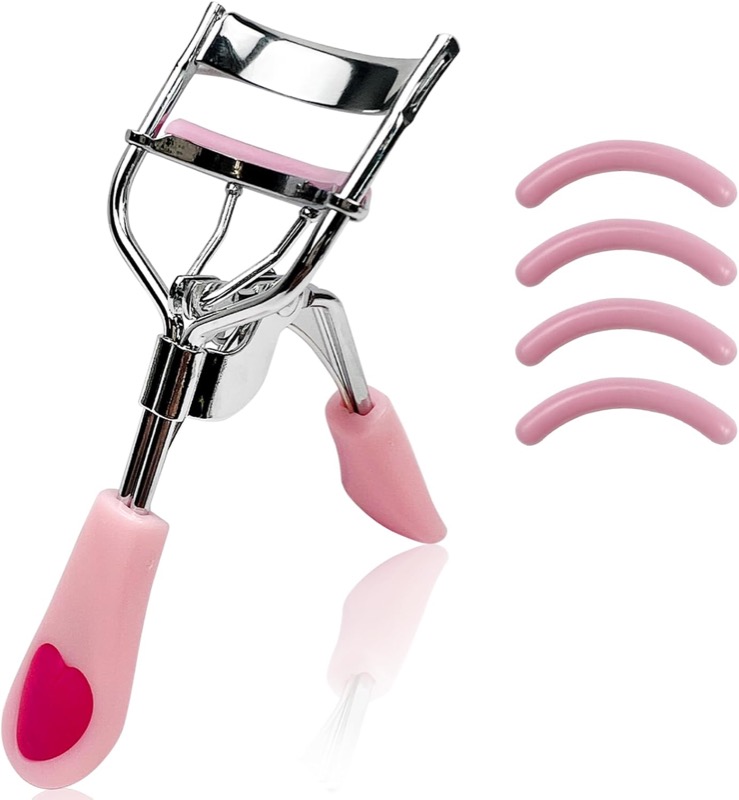
Stainless steel eyelash curler with four refill pads
A retail example carrying the full claim stack this guide examines: pain-free, fits all eye shapes, a calibrated hinge for even pressure. Four refills also makes the pad count testable against the replacement interval.
7. Crimp screen. Close on a strip of thin card or a bundle of hair strands taped to a card, hold three seconds, release, and look for a crease or kink at the clamp line. Compare with a reference unit, and do it on a bench rather than on a person.
8. Hinge play and alignment. With the curler closed, hold the frame and try to move the jaws sideways; record the play. Close it on carbon paper or a thin film of marker and check whether the contact line is even across the pad width. An uneven line means one end carries the load.
9. Humidity and cleaning. Put one unit in a sealed bag with a damp towel for 72 hours and inspect the plating. Separately wipe another unit's pad and frame with the cleaner your card recommends, five times, and watch for swelling, stickiness or finish wear; record the cleaner. One blog claims strong alcohol makes silicone brittle but we found no reliable source, so test instead of relying on it.
For heated models, add surface temperature with a thermocouple at each setting after warm-up, time to temperature, behaviour at the end of the shut-off period, and a battery review by a qualified person. None of this on a person.
Reading the results: pass, revise or fail
| Check | Pass | Revise | Fail |
|---|---|---|---|
| Count and material | Matches the listing | Minor wording mismatch | Pads or material not as stated |
| Rim inspection | Smooth, no snag | Cosmetic marks only | Any burr or snag |
| Closure gap | Flush, no paper entry | Small gap in some units | Visible gap where skin could enter |
| Dimensions | Within tolerance across units | Some spread | Large spread |
| Pad retention | Seats flush; spares fit | Spares loose | Pad falls out or jaws will not close |
| Wear after 200 squeezes | Slight or no groove | Visible groove | Deep groove or split |
| Crimp screen | Smooth bend | Mild crease | Hard crease |
| Hinge | No play, even contact | Slight play | Obvious play or uneven line |
| Humidity and cleaning | No spots; pad unchanged | Light spotting | Corrosion, swelling or tacky pad |
Rows marked fail stop the order until the supplier fixes them. A revise belongs in the next sample round, with the change written into the brief. Keep the photographs; they are the only reliable way to hold a supplier to the original.
Variants: mini, travel and comb curlers
Mini and travel curlers. A smaller frame has a narrower opening and tighter curve, so "fits all" is even harder to support. Test opening width on your target range and describe it honestly.
Curlers with a built-in comb. The comb is a second small part that can snag; inspect it under the loupe. A comb sitting close to the pad may also catch the pad when closed.
Curlers sold with refill kits. A bulk bag of pads only helps if they fit. Test every size in the bag against the frame.
Curlers marketed for lash lifts or extensions. Extensions are bonded with adhesive and outside this guide. We found no source we could rely on for compatibility claims, so we would leave the claim off.
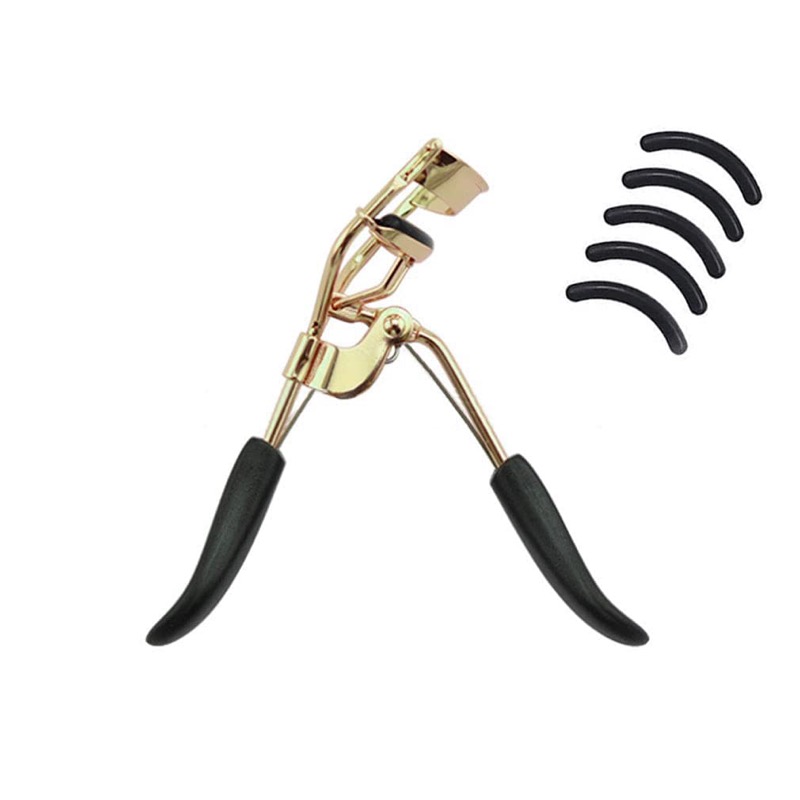
Stainless steel lash curler with five pads
A second build to compare on the same bench tests. Five spares is a different commercial promise from one, and it is the number to reconcile with the replacement interval you print.
Packaging, spares and returns
Protect the jaws. Pads can take a permanent set if the curler is stored closed under pressure. Check whether your packaging holds the jaws open, and test a unit after a week in the box.
Pad packaging. Spare pads should be in a labelled bag with the number and material. A loose pad rolling around a carton is a complaint waiting to happen.
Insert card. Print replacement guidance as a range with its source, not a single confident number. Tell the customer to stop using a pad that has split.
Returns. A used eye tool is not resellable. Decide in advance whether a defective unit is replaced, refunded or both, and record the batch.
Complaint log. Log each complaint with batch, symptom and pad age. Pinching complaints should be read by a person and not auto-closed.
The supplier brief
Send this before sampling and ask for written answers.
- Frame material and plating, with a certificate or test report if one exists; state whether the frame is nickel-plated and for which markets you need a nickel-release report.
- Pad material (silicone, natural rubber, synthetic rubber), hardness and any test report; say whether the pad contains latex.
- Opening width, curve depth and bar position, with tolerances.
- Retaining channel design, and how the pad is meant to seat.
- Number, size and fit of included spares, and whether pads are sold separately.
- Hinge type, and any pivot or rivet specification.
- Edge finishing process and the inspection step that checks it.
- Closure gap tolerance between pad and frame.
- Batch traceability and the sampling plan for outgoing inspection.
- Packaging that holds the jaws open or protects the pad from set.
- For heated models: maximum surface temperature per setting, measurement method, safety documents, battery documents and charging specification.
- Any claims the supplier believes the product supports, with the evidence.
Apply your supplier selection and CPS process to the shortlist only once samples pass the screening above.
What your listing can say
Write only what you have tested or can show. Phrases we would be comfortable with, if true for your product:
- "Mechanical eyelash curler with a replaceable silicone pad" (material in writing).
- "Opening width X mm; curve depth Y mm" (measured).
- "Includes N spare pads, size Z; fits this frame" (counted and tried).
- "Brands commonly recommend replacing pads every two to six months; replace sooner if the pad splits or loses shape."
- "Curl before applying mascara" — several brand and editorial pages advise this, and one brand says applying mascara first can make lashes stiffer and raise the risk of breakage.
- "Clean the tool as instructed and do not share it."
Avoid unless you have evidence for each: "pinch-free", "pain-free", "no damage", "won't break lashes", "fits all eye shapes", "hypoallergenic", "allergy-free", "medical-grade", "safe for sensitive eyes", "prevents eye infections", "lasts X months" for a pad, and "dermatologist" or "ophthalmologist approved" without the written approval. We have also not confirmed that "FDA-approved" or "FDA-registered" is appropriate for a curler; ask your adviser first.
We are not lawyers. The categories above are cautious, not legal advice, and your market's advertising rules may be stricter.
Frequently asked questions
How often should I replace the pad? Brand and editorial sources range from two to six months, and one artist advises changing more often for contact-lens wearers or sensitive eyes. None gives a test method. Replace when it splits, grooves or goes sticky.
How long does a curler last? Several sources say twelve months for the tool, and one brand artist says daily use can bend and warp it. We found no measured lifetime.
Should I curl before or after mascara? One brand advises curling first, because mascara can make lashes stiff and raise breakage risk if you curl afterwards. A brand statement.
Can I use a heated curler? The Academy says too much heat near the eye can be dangerous and advises checking each setting and starting low. A seller should treat heated curlers as a separate electrical product.
Is silicone safer than rubber? Brands and editors say silicone is gentler and less likely to irritate. We found no test evidence. If a customer has a latex allergy, the listing should say what the pad is made of.
Are universal replacement pads fine? Only if they fit your frame. A pad that sits proud, shifts or stops the jaws closing is worse than a worn pad.
What if a customer reports a pinch? Ask them to stop, keep the unit and pad, record the batch and symptoms, and advise seeing an eye professional if there is pain or vision change. Ask the supplier for inspection records.
Can I clean the pad with alcohol? One premium brand's retail page says to clean pads after use with an alcohol wipe. Another blog claims strong alcohol makes silicone brittle without a verifiable source. Test your pad with your cleaner and print what you tested.