The thing you wash with is probably the least considered purchase in your bathroom. A mesh pouf comes free with a gift set, a natural loofah looks wholesome in a basket, a silicone scrubber promises to be "antibacterial", and a pair of exfoliating gloves goes viral for rolling grey skin off someone's arm. They all sit wet in the warmest, dampest room in the house, and most of them stay there far longer than any doctor would suggest.
This guide sets out what medical sources say about what grows in a body scrubber, how to clean it, when to replace it, where those sources disagree, which listing claims have nothing behind them, and what to look at when a new one arrives. It does not recommend a brand and it is not medical advice. If you have a skin condition, ask a dermatologist what suits you before buying anything that scrubs.
For related tools, see silicone scalp massagers, silicone facial cleansing brushes, microfibre hair towel wraps and shower caps.
The short version
- A loofah or pouf that stays damp can grow bacteria and fungi. A Cleveland Clinic dermatologist says to dry it daily, clean it weekly and replace it regularly.
- The most-quoted replacement advice is every three to four weeks for a natural loofah and about two months for a plastic pouf. Other sources say anything from "single use" to three months.
- Doctors quoted in health and shopping articles commonly suggest washcloths, silicone scrubbers or washable gloves as easier to keep clean. One article's experts say bare hands are the safest option of all.
- "Antibacterial" silicone is a marketing phrase. The supported claim is narrower: silicone dries quickly and is easy to rinse.
- Scrubbing is optional. The American Academy of Dermatology says exfoliation is not for everyone and can do more harm than good if done badly.
- Whatever you buy, do not share it, and do not use it on broken or freshly shaved skin.
What these things are
Natural loofah. The dried, fibrous inside of a gourd. A hospital health article describes it as a piece of dried luffa gourd that became popular for washing and exfoliating. Plant material: stiff when dry, softer when wet, full of small cavities.
Mesh pouf. The gathered ball of nylon or plastic netting, often also called a loofah. It lathers well, which is most of its appeal.
Silicone scrubber. A pad or mitt covered in soft silicone bristles or ridges, sometimes double-sided, sometimes on a long handle for the back.
Exfoliating gloves and mitts. Textured fabric gloves, usually nylon or viscose. The rougher mitts sold for "peeling" are a more aggressive version.
Washcloth. A small terry or muslin cloth. Unglamorous, and, as we will see, the option doctors keep coming back to.
Hands. Not a product, but in at least one article it is the experts' first choice.
What the medical sources say about bacteria
The clearest source is a Cleveland Clinic article quoting dermatologist Melissa Piliang. As we read it and the outlets that reproduce it, her points are these.
- Loofahs become lodged with skin cells, and because they sit in a damp shower they do not dry out fully, which makes them a good place for bacteria to grow.
- The organisms that may be found include E. coli, Pseudomonas, staph and strep bacteria, and loofahs can also contain fungal organisms that lead to skin infections.
- That does not mean you can never use one. Her advice is to keep it clean, replace it regularly and use it gently, without rubbing the skin too hard.
A second Cleveland Clinic piece from its newsroom quotes an infectious disease specialist. He singles out staph: if staph bacteria on the skin transfer to the loofah, they can form a biofilm, a mucus-like layer that lets them persist and multiply. Local news reports of the same interview add that he considers silicone scrubbers and washcloths easier to keep clean.
A hospital system's article makes the point that synthetic loofahs made of nylon or plastic can harbour and breed bacteria too. So switching from a gourd to a mesh pouf does not solve the problem; it changes how fast it develops.
What none of these sources gives is a number: how often a contaminated scrubber actually leads to an infection. They describe what can grow and how to reduce it. For a healthy adult with intact skin, the practical risk is not quantified anywhere we looked. By the sources' own logic, it rises when skin is broken.
Cleaning: where the advice agrees
Every source says the same three things: rinse it, dry it, and deep-clean it weekly. They differ on the method.
| Source (type) | After each use | Weekly deep clean |
|---|---|---|
| Cleveland Clinic dermatologist (medical) | Dry it daily | Soak in diluted bleach for five minutes and rinse well, or run it through the dishwasher |
| Cleveland Clinic infectious disease specialist (medical, via newsroom and local news) | Rinse, shake off water, hang to dry | Soak in a vinegar solution |
| A consumer health site | Dry it out of the shower | Clean weekly; cites an older study in which a 10 per cent bleach solution reduced contamination |
| A loofah seller's blog (commercial) | Squeeze out water, dry fast | Vinegar soak for 15 to 30 minutes; also suggests microwaving a wet loofah |
Bleach and vinegar are both suggested by clinicians. We would not rely on the seller's microwave suggestion without the manufacturer's say-so: mesh poufs are plastic, some scrubbers have metal or hard plastic parts, and a dry natural loofah in a microwave is a fire risk.
Two further points from the sources:
- Where it dries matters. Hang it somewhere it can dry, which for most bathrooms means outside the shower enclosure.
- Smell and mould are the end. A consumer health site says any sign of mould or a lingering musty smell means throw it away immediately.
Replacing: where the advice does not agree
| Source (type) | Natural loofah | Mesh or plastic pouf | Other tools |
|---|---|---|---|
| Cleveland Clinic dermatologist (medical) | Every three to four weeks | About two months | — |
| Cleveland Clinic infectious disease specialist (via local news) | About every month | About every month | — |
| A medical information site, reviewed by a doctor | Some dermatologists say single use | Same | — |
| A Gulf newspaper's feature quoting doctors | Every two to three months | — | — |
| A retailer's blog quoting its dermatologist founder | Aim to replace regularly; do not share | — | — |
| A shopping article quoting experts | — | — | Silicone: around six months or longer |
| The same article, relaying a brand | — | — | Exfoliating gloves: every three months |
| A hospital system article | — | — | Washcloth: no fixed timeline; replace when frayed, thin or smelly |
| A Cleveland Clinic article on towels | — | — | Washcloth: launder at least a couple of times a week |
The range for a loofah runs from once to three months. The figure most widely repeated is the Cleveland Clinic dermatologist's, and it is a sensible default: three to four weeks for natural, two months for plastic. But it is a clinician's rule of thumb, not a tested lifespan, and the silicone and glove figures are thinner still — one comes from unnamed experts in a shopping article, the other from a brand.
What you can do with that:
- Treat a loofah or pouf as a consumable. If you would not replace it monthly or so, it is the wrong tool for you.
- Work out the yearly cost. A pouf replaced every two months is six a year. A silicone scrubber kept six months is two. A set of seven washcloths laundered with your towels may last years. Arithmetic on the sources' intervals, not a tested comparison, but it often changes which option looks cheap.
- Go by condition. Smell, discolouration, mould, fraying or a slimy feel all mean it is finished, whatever the calendar says.
Which type do doctors suggest?
No source ranks these in a study. What we have is a pattern in what clinicians say when asked.
- A dermatologist quoted in a shopping article recommends a washcloth washed after use, or, for exfoliation, a washable glove or a silicone scrubber that dries out completely. A second dermatologist in the same piece suggests washcloths, konjac sponges, silicone body brushes and exfoliating gloves.
- Another shopping article says its experts consider hands the safest way to cleanse, and reports that gloves exfoliate more deeply than a loofah and suit rough areas such as elbows and knees.
- The Cleveland Clinic dermatologist notes washcloths tend to be laundered and replaced more often than a traditional loofah.
- The infectious disease specialist names silicone scrubbers and washcloths as easier to keep clean.
Against that:
- A hospital system article warns that reusing yesterday's washcloth, or someone else's, can spread germs, and lists pink eye, warts and staph infection among the things that can be passed on. A washcloth is only the clean option if it is actually washed.
- A grooming brand's blog points out that gloves are still fabric, so the damp-and-bacteria problem applies to them as well, that they need replacing often, and that "one size fits all" does not fit every hand.
- An editor testing a silicone scrubber for a shopping article says it does not lather soap well.
So the trade-off is roughly this. Poufs and loofahs lather best and are hardest to keep clean. Silicone is easiest to rinse and dry, lathers worst and scrubs most gently. Gloves scrub hardest and need laundering. Washcloths are the most forgiving if you own enough to use a fresh one each time.
Do you need to scrub at all?
The American Academy of Dermatology's advice on exfoliating at home begins with a caution: some people believe it improves how their skin looks, but it is not for everyone and, done improperly, could do more harm than good. Its dermatologist, Rebecca Tung, says some people end up with more redness or breakouts. The points most relevant to a body scrubber:
- A tool such as a brush or sponge is mechanical exfoliation. The method should suit your skin type.
- Some products, including prescription retinoids and products with retinol or benzoyl peroxide, can make skin more sensitive, and exfoliating on top of them may worsen dryness or cause breakouts.
- With a brush or sponge, use short, light strokes.
- Never exfoliate over open cuts or wounds, or on sunburnt skin.
- Moisturise straight afterwards, because exfoliating can be drying.
- The more aggressive the method, the less often it should be done, and over-exfoliating can leave skin red and irritated.
A news article adds that doctors often suggest limiting loofah use to once or twice a week and avoiding it for several days after shaving, so bacteria cannot get in through small cuts. A consumer health site advises keeping a loofah away from the genital area. Both fit the general logic: scrubbers are for intact skin, used gently, not every day.
If all you want is to be clean, hands and a mild cleanser do that. The scrubber is for texture and lather, and it is fine to decide you do not need one.
Terms the listing uses loosely
| Listing phrase | What it usually means | What to look for instead |
|---|---|---|
| "Antibacterial" or "repels bacteria" | Silicone or a treated fibre | Evidence of a test, which is rarely given; you still have to wash and dry it |
| "Hygienic" | Dries quickly | A hanging loop and an open shape |
| "Natural" or "organic" loofah | Dried gourd | Natural fibre holds water; the shortest replacement interval applies |
| "Exfoliating" | Any texture | How coarse; the AAD says gentler is safer |
| "Deep clean" | Marketing | Skin does not need abrasion to be clean |
| "Dermatologist recommended" | Rarely explained | The named dermatologist and what they said |
| "Lasts for years" | Not tested | Sources suggest months, even for silicone |
| "For sensitive skin" | Softer texture | The AAD advises caution with sensitive skin and mechanical exfoliation |
| "Food-grade" or "medical-grade" silicone | Sales language | The material stated in writing; treat grades as unverified |
| "One size fits all" (gloves) | A single size | Hand measurements, or a mitt with a wrist band |
| "Eco-friendly" | Plant fibre, or long-lasting silicone | What happens at disposal where you live; frequent replacement has its own footprint |
| "Dead skin rolls off" | A coarse mitt | That visible result is aggressive exfoliation; use rarely |
On "antibacterial" silicone specifically: a seller's blog describes silicone scrubbers as antibacterial, and an unattributed question-and-answer page says a silicone brush is "designed to repel bacteria". We found no test behind either statement. The supportable version, which is what the clinicians say, is that a non-porous scrubber is easier to keep clean and dries completely. That is a real advantage. It is not the same as killing bacteria, and a silicone scrubber left in a puddle of soap residue still needs washing.
Checks to run when it arrives
Our own suggested checks, not a standard and not a hygiene test. They catch an obviously unsuitable item while you can still return it.
Packaging. Sealed and unused. Anything that looks or smells used goes back.
Smell. A strong chemical or musty smell out of the packet is a poor start. Rinse and air it for a day; if the smell remains, return it.
Material. Does it match the listing? Squeeze a silicone scrubber: if it feels spongy in the middle, there may be a foam core.
Shedding. Rub a natural loofah or glove over a dark towel. A few fibres at first are normal for a natural loofah; steady shedding from a glove or pouf is not.
Seams and ties. On a pouf, tug the cord and the central tie. On gloves, check the seams between the fingers.
Hanging loop. Pull it firmly. It has to hold a wet item.
Rinse test. Lather it with soap, then rinse under running water for 30 seconds. Does the foam clear, or does residue stay trapped?
Drying test. Hang it where you intend to keep it and check after 12 and 24 hours. If it is still damp after a day, it will always be damp.
Texture. Draw it lightly over the inside of your forearm. It should feel like texture, not scratching.
Colour. Rub a wet white cloth against a dyed glove or pouf to check for colour transfer.
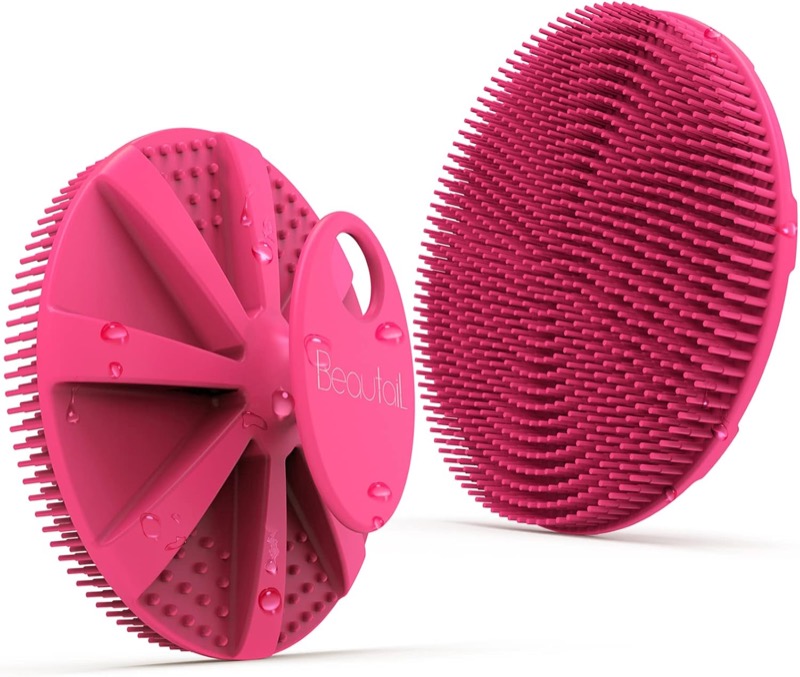
Silicone body scrubber with grip handle
A retail example of the silicone tier, which the clinicians name as easier to keep clean. The listing's own words — non-porous, dries quickly — are the supportable ones; anything stronger needs a test report.
What to look for before you buy
Something you will actually maintain. This is the main decision. If you will not replace a pouf every month or two, choose silicone or washcloths.
A hanging loop or hook hole. Everything in the cleaning advice depends on the item drying between uses.
An open structure. For silicone, bristles with space between them rinse more easily than a dense pad or one with a sealed pocket. Some scrubbers have a hollow for a bar of soap; check that it can be opened and rinsed.
No hidden sponge. Some "silicone" scrubbers are a silicone face over a foam core. Foam holds water. Look for a clear statement of what is inside.
A texture that suits the job. Soft for daily lather; anything coarse is an occasional tool.
For gloves and mitts: fit, and whether they are machine washable. A glove that slips will not exfoliate evenly, and one that cannot go in the wash is a fabric loofah.
For washcloths: enough of them. The option only works with a fresh cloth each time, so a pack is better than a pair.
For long-handled back scrubbers: a secure join. The head should not twist or detach under pressure.
Honest care instructions. A listing that says how to clean it and when to replace it is more credible than one that says it never needs replacing.
What a higher price should buy
We do not publish prices we have not verified. Price here follows material and construction, not cleanliness. A more expensive pouf is a denser pouf, which lathers better and dries more slowly. A more expensive silicone scrubber may have a better handle, a second texture or thicker silicone. Whether it lasts longer is not something any source we read has measured.
Pay for a design that dries, a handle that reaches, and washcloths in a quantity that lets you rotate them. Do not pay for the words in the table above.
Keep it or send it back
| Check | Keep | Query the seller | Return |
|---|---|---|---|
| Packaging | Sealed and new | Outer bag torn | Looks or smells used |
| Smell | None after airing | Faint | Persistent chemical or musty smell |
| Material | As listed | Unclear | Foam core not disclosed, or different material |
| Shedding | Little or none | Some at first | Continuous |
| Seams and ties | Firm | One loose thread | Comes apart |
| Hanging loop | Holds when wet | Thin | Breaks or missing |
| Rinse | Clears quickly | Slow | Traps residue |
| Drying | Dry within a day | Damp at 24 hours in a humid room | Still wet |
| Texture | Comfortable | Rougher than expected | Scratches |
| Colour | No transfer | Slight | Clear transfer |
Using and looking after it
A summary of the sources, not a substitute for a professional's advice about your skin.
- Use it gently. Short, light strokes, per the AAD. The Cleveland Clinic dermatologist says not to rub too vigorously.
- Keep it for the body. A retailer's dermatologist suggests reserving a shower loofah for body wash with gentle circular motions. Facial skin is a separate question.
- Skip broken, sunburnt or freshly shaved skin.
- Rinse thoroughly, shake or squeeze it out, and hang it to dry, ideally outside the shower.
- Deep-clean weekly, using a method the maker allows.
- Launder washcloths and gloves with your towels. The Cleveland Clinic suggests washcloths at least a couple of times a week, and a fresh one per use is the cautious reading of the hospital advice on reuse.
- Do not share. A dermatologist quoted by a retailer says not to share a loofah with family members, and a hospital article lists infections that can pass on a shared cloth.
- Replace on schedule or on condition, whichever comes first.
- Moisturise afterwards if you have exfoliated.
- If you develop a rash, bumps or irritation that does not settle after you stop using a scrubber, see a doctor.
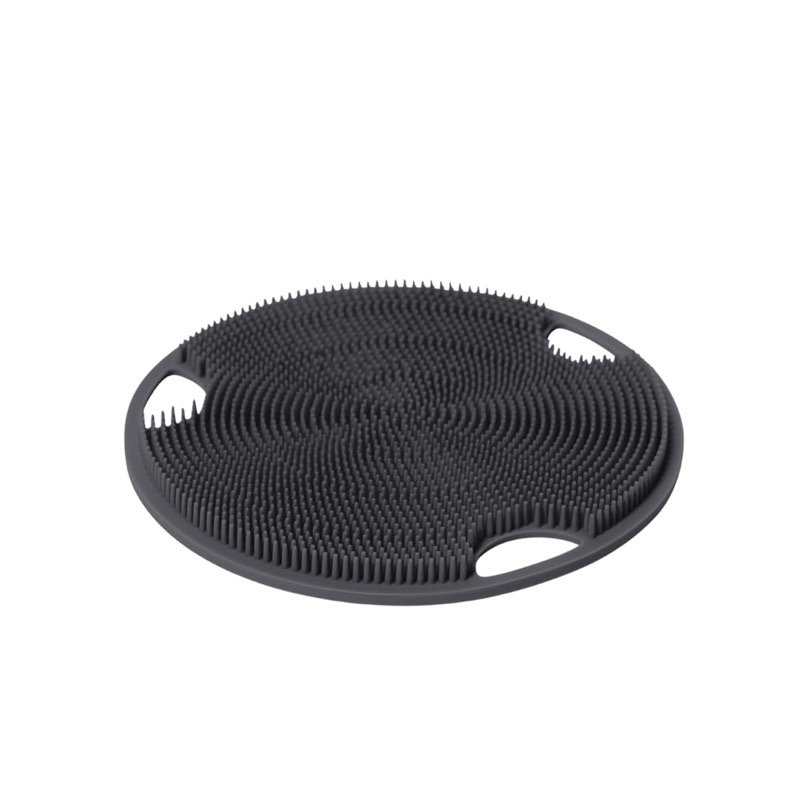
Flat body scrubber, loofah alternative
A flat scrubber sold on its hygiene story, with a stated six-month life. The month figure is the thing to weigh against the clinical defaults — and the reason a replacement interval belongs on the listing.
What your listing can say
If you sell these products, write only what you tested or can show.
Safe to print, if true:
- "Non-porous silicone. Rinse and hang to dry; dries quickly." That is the claim the clinicians support.
- "Silicone material: [type and hardness from the supplier]."
- "Rinse after every use, deep-clean weekly, replace when worn or at the first sign of mould or smell."
- "Body use only. Do not use on broken, sunburnt or freshly shaved skin."
- "Do not share."
- "Includes a hanging loop" (a design fact you can photograph).
Avoid unless you hold evidence for each: "antibacterial", "antimicrobial", "repels bacteria", "self-cleaning", "sterile", "dermatologist recommended" without a named dermatologist and statement, "food-grade" or "medical-grade" silicone without a document, "lasts for years", and "removes dead skin instantly". A replacement interval stated by the brand is fine as guidance; presenting a lifespan as tested is not.
We are not lawyers, and this is not legal advice. Your market's rules may be stricter.
Frequently asked questions
Is a loofah unhygienic? It can grow bacteria and fungi if it stays damp, according to Cleveland Clinic clinicians. They say it can still be used if it is dried, cleaned weekly and replaced regularly.
How often should I replace a loofah? The most-cited advice is every three to four weeks for natural and about two months for plastic. Some doctors say sooner.
Are silicone scrubbers better? Clinicians say they are easier to keep clean and dry fully. They lather less and exfoliate more gently. We found no test showing they are "antibacterial".
How long does a silicone scrubber last? One shopping article's experts say around six months or longer. No test supports a longer claim.
Are exfoliating gloves safe? They exfoliate more deeply, so use them sparingly and wash them. The AAD says the more aggressive the method, the less often it should be used.
Is a washcloth more hygienic than a loofah? Only if it is washed. Doctors favour it because it goes in the laundry.
Can I put my pouf in the washing machine or dishwasher? The Cleveland Clinic dermatologist mentions the dishwasher for loofahs. Check the maker's instructions for your item.
Can I use a body scrubber on my face? The sources we read suggest keeping shower loofahs for the body. Ask a dermatologist about facial exfoliation.
Should I use one after shaving? Doctors advise avoiding loofahs for several days after shaving, per a news article.
Do I need to exfoliate my body at all? No. The AAD says exfoliation is not for everyone.