A spa headband is a strip of towelling with a job: hold hair, bangs and flyaways off the face while someone washes, applies a mask or does makeup. It is also one of the cheapest items in the beauty accessory category, sold in packs of two to six, which makes it easy to approve without a second thought. Listings reflect that. The same sentences appear on nearly every one: "super soft", "highly absorbent", "non-slip", "adjustable", "one size fits most", "washable without losing shape", "won't damage hair", "gentle on sensitive skin".
None of those phrases comes with a number, and several fail in ways a buyer discovers on the first wash. A band that is soft but sheds lint onto a clean face. A band that absorbs water but takes a day to dry and smells. A hook-and-loop closure that grabs hair at the nape. A stretch band that holds for a week and then no longer closes. A packet promising three colours that delivers a different shade of grey.
This guide is for small brands and sellers about to approve a headband, and for buyers who want to read a listing critically. It sets out what fabric and care sources say about weight, fibre and washing, what hair-care sources say about tension, and where those sources are thin. Then it gives a screening test that needs a kitchen scale, a ruler, a washing machine and a few evenings. It recommends no product and makes no claim about anyone's skin or hair. For related fabric accessories, see the microfibre hair towel wrap test, silk scrunchies on fine hair and reusable makeup pads.
What a spa headband is, and where it fails
Retail listings describe three common constructions.
Terry cloth. Cotton or cotton-blend fabric with uncut loops. One three-pack listing gives 60 cm by 8.5 cm and calls the material terry cloth with a "magic sticky" closure; another describes a two-pack as 100% cotton terry. A fabric guide explains that terry is a woven structure with uncut loops, called pile, standing up from the fabric to increase surface area.
Microfibre. Fine synthetic fibres, usually polyester or a polyester-nylon blend, often as fleece or plush. One marketplace listing gives 80% polyester and 20% cotton for a microfibre terry band; another brand describes 100% elastic microfibre fleece.
Bubble or padded styles. A brand page describes a terry construction with a "bubble" structure for gentle shape and a secure hold. We found no way to check what that structure is from a photo.
Closures vary: stretch only (an elastic band sewn into a tube), hook-and-loop at the back, or a stretch band with a hook-and-loop adjuster. Listings call hook-and-loop "adjustable". One supplier-style listing describes a wide closure strip placed at the ends, claiming it protects hair from getting stuck — which tells you the failure the designer worried about.
From the listings, the reviews and the construction, these are where a headband usually fails.
- Shedding. Lint from cut edges and pile, especially in the first washes.
- Absorbency. A band that looks plush but does not take up water, or one that saturates and drips.
- Drying time. A thick band that stays damp and goes into a drawer wet.
- Closure snagging. The hook side catches hair, or the loop side picks up lint from other laundry.
- Stretch fatigue. Elastic loses recovery, so the band slips back or leaves a mark.
- Seam and edge. A rough seam at the hairline or a raw edge that frays.
- Colour transfer. Dark or bright dye on a band that touches a wet face.
- Shrinkage and distortion. Terry changes size after a hot wash or dryer cycle.
- Fit. A "one size" band too small for some heads and too loose for others.
Nobody can tell you how often any of these happens. The point of the test below is to find out for your supplier's band before you hold stock.
What the sources say about fabric, weight and care
Towel and linen sources are the closest thing to published guidance for terry and microfibre, and they are written for bath towels. The vocabulary and care advice carry over. A numeric range does not.
GSM. Towel guides define GSM as grams per square metre, a measure of fabric weight. A bath-linen guide gives roughly 300 to 400 as light and 450 to 600 as heavy. A retail guide says the standard bath-towel range is about 300 to 900 and that lower GSM does not mean lower quality, just a less fluffy, faster-drying towel. A luxury retailer says GSM correlates with absorbency, feel and performance. All of that is about bath towels. We found no GSM range published for headbands, and a narrow terry strip that is mostly elastic by area is not comparable. If a supplier quotes GSM for a headband, ask how it was measured and on which part of the band.
Fibre length matters as much as weight. One retail guide says a heavy towel made from short-staple cotton can still shed lint and lose softness, because GSM measures density while fibre length decides durability. Another says combed cotton, which has had short fibres removed, tends to shed less. Retailer statements with no cited test, but the logic is sensible: weight is not quality.
Terry structure. A bath-linen guide says better terry has a close, firm underweave with close loops, and that longer loops give more absorbency. In a headband, long pile can also snag on a hook closure. We found nobody who has measured that trade-off.
Microfibre. One towel retailer says microfibre is made of fibres split at their ends and is more absorbent than other types; a luxury retailer calls it a lightweight polyester-nylon blend, thinner than cotton and lower quality. The two contradict each other and both are sellers. A lifestyle guide on lint-free towels says plush microfibre is a reliable low-lint option and that long-staple cotton is more durable and less lint-prone than short-staple. All opinion. For a headband the practical questions are: does it shed, does it take up water, and how fast does it dry.
Care. Multiple towel guides say fabric softener coats fibres and reduces absorbency. A headband listing we read says to wash with soap or detergent, that machine washing is more effective, and not to use softener. A brand page says machine wash cold and tumble dry low. A reviewer suggests air drying to avoid shrinkage. These instructions are consistent, but none is a tested result for a specific band. Write care instructions you have actually followed with your sample.
What hair-care sources say about tension
A spa headband is worn for minutes, not hours, so the tension questions around daytime headbands apply less strongly. They do not vanish, because buyers also wear these bands to sleep, to the gym and around the house, and some sellers advertise them for that.
A hair-clinic blog says a headband is not by itself a cause of hair loss, but that how it is worn, what it is made of and how tight it is decide whether it can damage hair; elastic headbands can pull strands and cause breakage along the hairline, and repeated use of tight elastic bands should be avoided. A dermatologist quoted by a lifestyle site says constant pressure on the hair shaft and follicle can lead to damage over time, and the same article says a tight style can cause headaches. A hair-magazine piece quotes a stylist saying a style should never make the hairline hurt or visibly pull at the skin. A scalp-care brand blog suggests a self-check: after styling, move your eyebrows or tilt your head, and if you feel pulling the style is probably too tight.
What these sources do not tell us: how tight is too tight, how long is too long, or whether a terry band changes the answer. They are clinic, magazine and brand blogs, not controlled studies. They support one cautious conclusion: a band should be comfortable at rest, and instructions should tell the customer to loosen it if it hurts. A seller should not promise it is "gentle on hair" without saying what that means. We also found a content-farm page, published under an e-commerce platform's insights section, with an invented-sounding expert quote about headband headaches; we did not rely on it.
Terms the listing uses loosely
| Listing phrase | What it usually means | What to ask or check |
|---|---|---|
| "Super absorbent" | The fabric is terry or fleece | Water uptake on a standard test, and drying time |
| "Soft" | It feels soft when new | Feel after five washes; shedding |
| "Non-slip" | A closure or slightly grippy fabric | Slip test with wet hair; weight of the closure strip |
| "Adjustable" | Hook-and-loop strip or stretch band | Range in centimetres; snagging |
| "One size fits most" | A single length | Length unstretched and stretched; head circumference tested |
| "Washable, won't lose shape" | Survived a wash at the factory | Dimensions before and after your washing protocol |
| "No shedding" | Less lint than an ordinary towel | Lint capture after washes |
| "Hypoallergenic" / "gentle on sensitive skin" | Marketing | No defined meaning here; ask for fibre and dye information |
| "Microfibre" | Polyester or a blend | Fibre content in writing, with percentages |
| "100% cotton terry" | Possibly just the pile | Fibre content of the whole band, including elastic and closure |
| "Quick-dry" | Dries faster than cotton | Drying time on your protocol |
| "Machine washable" | May survive a cold wash | Which cycle, which temperature, whether a bag is needed |
A note on fibre content. A band sold as "100% cotton" will almost always contain elastic, and how the whole textile must be labelled may be regulated differently in your market. Textile labelling rules differ by market and by what counts as a component. We are not lawyers; ask your compliance adviser how to label a band that contains elastic and a hook-and-loop strip.
What goes wrong with these products
In roughly the order a customer meets them.
- Lint on the face and in the sink. Early washes shed pile, and a band that sheds is a problem in a face-washing product more than in a hair towel.
- Slow drying. Cotton terry holds water. A band that takes more than a day to dry in a bathroom will be put away damp.
- Odour. Follows from the previous point. We found no data; test it.
- Hook closure snags hair. The listing language about protecting hair shows the designer knew.
- Loop side collects lint. The soft loop surface collects debris and sheds it back.
- Elastic fatigue. The stretch panel loses recovery and the band slides or creeps.
- Edge fray and seam failure. Cheap overlock stitching unravels at the ends.
- Colour bleed. Strong dyes transfer to a wet forehead or the pillowcase.
- Shrinkage. After a hot wash or tumble dry, a band that fitted may not.
- Pack variation. Colour, size or fabric weight differ between pieces in one multipack.
Reading the results: pass, revise or fail
| Check | Pass | Revise | Fail |
|---|---|---|---|
| Count and pack match | Same as listing, pieces consistent | Minor weight spread | Wrong count or wrong fabric |
| Lint after washing | Little on cloth and tape, drops over washes | Noticeable but declining | Heavy shedding after five washes |
| Absorbency | Takes up water and holds it | Slow uptake | Water runs off |
| Drying time | In line with your reference | Slower than reference | Still damp after a day |
| Wash | Size and shape hold; no bleed | Slight shrinkage | Marked shrinkage, fraying or bleed |
| Closure | No hair caught; little wear | Occasional catch | Frequent catching or hook failure |
| Stretch recovery | Returns near original length | Some creep | Does not recover |
| Fit | Comfortable at rest, no creep | Creeps on some heads | Too tight or slides off |
| Colour and smell | None | Slight | Visible transfer or odour |
A single fail should stop the order. A revise belongs in the next sample round with the change written into the brief.
Variants: bubble bands, microfibre fleece, sports and sleep
Bubble or padded bands. Extra loft can hide a stiffer inner layer. Open a spare along the seam and see what is inside.
Microfibre fleece. Usually dries faster but can generate static and pick up lint. Test both.
Bands sold for sport or sleep. If the listing mentions a gym or night use, tension and slip questions are more serious. We would not market a spa band for sleep without a specific test.
Kids' sizes. Smaller circumference, smaller seam tolerance, and child-specific rules in some markets. Talk to a compliance adviser before offering.
Bands with a bow, ears or embellishments. Decorations add snag points and a laundering problem. Check them in the wash cycle.
Mixed colour packs. Run dye tests per colour, not per pack.
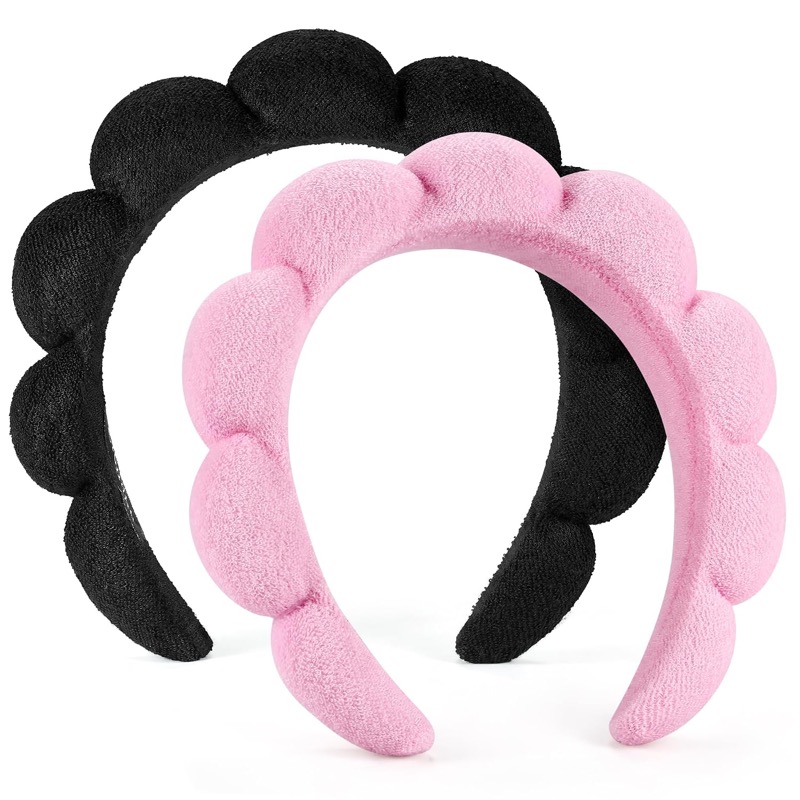
Terry cloth knotted spa headband, two-pack
A knot-style build with a plastic core inside the twist. Two things to test that the photo cannot show: whether the core ends bite at the temples, and whether the twist holds after five washes.
The sample test: nine steps you can run in a week
These are our own screening procedures, not a standard. They are not a safety or skin-compatibility assessment, which belongs to a qualified lab. Use at least three bands from different cartons, and keep a record sheet with unit number, date and photographs. Do not run any of this on a person without consent and a stop rule.
1. Count and identify. Count bands and colours against the listing, and record fibre content from any label. Weigh each band to 0.1 g and measure it flat and stretched. Differences between pieces in a pack are the first finding.
2. Weight per area (our own arithmetic). Cut a 10 cm by 10 cm square from the body of a spare band, weigh it and multiply by 100 to estimate grams per square metre of the fabric panel. This is our own screening arithmetic, not a certified GSM measurement, and it ignores the elastic panel and closure. Use it to compare samples with each other and with a reference, not to print a number on a listing.
3. Initial lint test. Wipe a dry band firmly across a dark cloth ten times and photograph the cloth. Then press a strip of clear tape on the band and photograph what it picks up. A rough method: it ranks bands, it does not quantify shedding.
4. Absorbency screen. Lay a dry band flat and pour a measured 30 ml of water onto the centre. Wait 30 seconds and photograph how much soaked in and how much ran off. Then submerge the band, wring it by hand the same way each time, and weigh before and after. The difference is water held. Record every sample and a reference.
5. Drying time. Wet each band as in step 4, hang it at room temperature and weigh every hour until it returns to within a few percent of dry weight. Record the hours. We found no published figure for how fast a headband should dry.
6. Wash cycle. Wash five times on the cycle you plan to print, with dark and light items to catch colour bleed, and no fabric softener. After each wash record size, weight and lint on the cloth, and photograph the washing water on the first wash. After the fifth, compare dimensions and note shrinkage, fraying, curling or colour change.
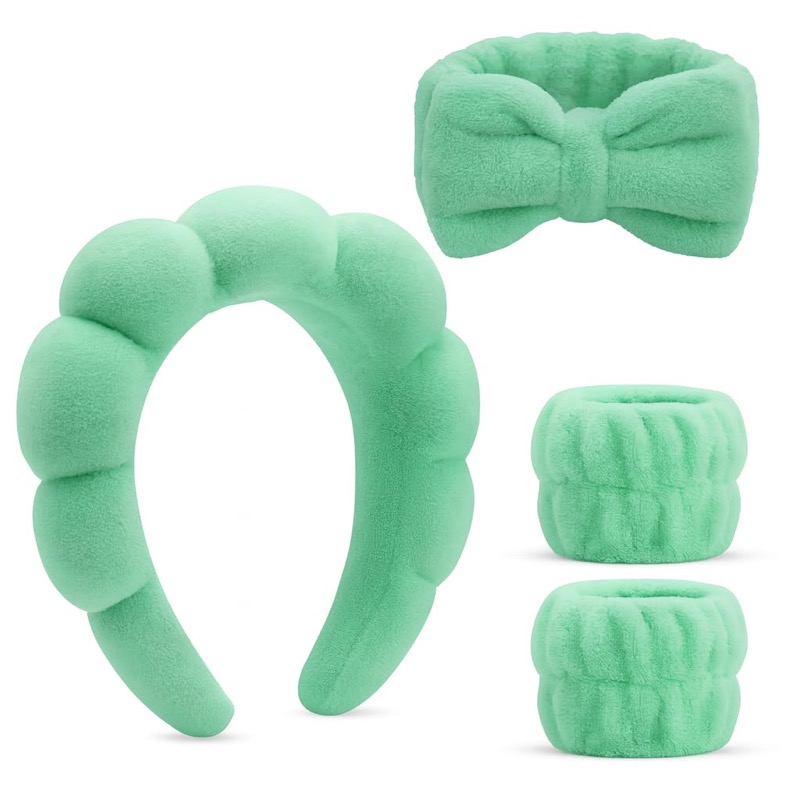
Puffy terry spa headband and wristband set
A retail example of the puffy construction, where a sponge core sits inside terry. That core is the thing to open up: it decides drying time, and no listing photo shows it.
7. Closure and snag test. Fasten the hook-and-loop closure 100 times and note wear. Then tie a swatch of long hair to a stand, fasten the band at the back and open it 20 times, counting how often hair catches and how many strands pull out. For stretch-only bands, stretch to the stated maximum 500 times and measure length after a rest.
8. Fit and slip screen. On a head form or a consenting volunteer, measure the circumference, wear the band for ten minutes with the body tilted and a mock face-wash, and note whether it creeps or slides. Check the seam against the skin for marks. Ask whether it is comfortable and feels tight. Anything beyond mild pressure at rest is a revise.
9. Colour and smell. Wet a white cloth, press it against a damp band for five minutes and look for transfer. Put a damp band in a closed bag for 24 hours and smell it. Crude, and cheap.
Keep the photographs. They are the only reliable way to hold a supplier to the original sample.
Packaging, display and returns
Present the fabric honestly. A photo shot against a studio background can make pale grey look white. Hold the bands next to a printed colour card.
Show the closure. Put a close photo of the closure strip and its length on the listing.
Pack for compression. Terry compresses. Test a pack that has been squashed in a mailer for a week and see how it recovers.
Returns. A used face-wash band is not resalable. Decide whether you refund or replace, and record the batch.
Complaint log. Log each complaint with batch, symptom and number of washes. A cluster of lint or elastic complaints is a signal to inspect stock, not a reason to rewrite the listing.
The supplier brief
- Fabric and fibre content for body, elastic panel and closure, as percentages, with any test report.
- Fabric weight, and the method used, on the body panel.
- Pile height and construction (terry, fleece, bubble), and what is inside any padded section.
- Dimensions unstretched and stretched, with tolerances, and the intended head-circumference range.
- Closure type, its length, and the design feature that prevents hair catching.
- Dye type, colourfastness testing performed, and any reports.
- Recommended wash cycle and temperature, and any washing test already run.
- Edge and seam finishing, and stitch type.
- Pack contents: number, colours, and a guarantee of consistency between pieces.
- Batch traceability and the outgoing inspection plan.
- Packaging that avoids permanent compression.
- Any claims the supplier believes the product supports, with the evidence.
Apply your supplier selection and CPS process to the shortlist once samples pass the screening above.
What your listing can say
Write only what you tested or can show. Phrases we would be comfortable with, if true:
- "Terry cloth headband, X% cotton, Y% polyester, Z% elastane" (from the supplier's fibre report).
- "Length X cm unstretched, Y cm stretched; fits head circumferences of about A to B cm" (measured).
- "Hook-and-loop closure, N cm long" (measured), with a photo.
- "Machine wash cold, no fabric softener, tumble dry low or air dry" (followed on your sample).
- "Pack of N: colours as shown" (checked).
- "Shed less lint after N washes in our own screen" — only if you ran it and kept the photographs.
Avoid unless you have evidence for each: "gentle on hair", "won't damage hair", "prevents breakage", "hypoallergenic", "gentle on sensitive skin", "dermatologist tested", "lint-free", "no shedding", "super absorbent" without a stated test, "quick-dry" without a stated drying time, "fits all head sizes", and "eco-friendly" or "sustainable" unless you can show what that means.
We are not lawyers. These categories are cautious, not legal advice, and your market's advertising and textile-labelling rules may be stricter.
Frequently asked questions
Is terry or microfibre better for a spa headband? We found no test comparing them for headbands. Towel retailers disagree about microfibre and each is selling something. Test both on absorbency, drying and lint.
What GSM should a headband be? We found no published range. Towel guides give 300 to 900 for bath towels, which do not translate to a narrow strip. Use the figure to compare your own samples.
Does fabric softener matter? Multiple towel sources say softener coats fibres and reduces absorbency, and headband listings advise against it. Print the instruction, and make sure your wash protocol did not use it.
Can a headband cause hair loss? A clinic blog says a headband alone is not the cause, but tight elastic bands worn repeatedly can pull at the hairline, and a dermatologist in a lifestyle article says chronic pressure can damage hair and follicles. We found no study of spa headbands. Advise customers to loosen the band if it hurts.
Can I sell it for sleep or exercise? We would not, without testing. Tension, slip and hygiene questions differ from a ten-minute face wash.
How often should the band be washed? We found no authoritative guidance; brand and retailer pages only say it can be machine washed. Pick a recommendation from your own test and call it a suggestion.
What if a customer reports a skin reaction? Ask them to stop, record the batch and fibre content, ask your supplier for dye information, and advise seeing a professional if it persists.
Why does my band shed when new? Terry sheds cut fibres in early washes. Your lint screen shows whether the amount falls over repeated washes.